Russia’s full-scale invasion of Ukraine in 2022 did not merely disrupt the geopolitical status quo—it detonated the illusion of European security complacency. For decades, the continent benefited from the Pax Americana and a peace dividend that allowed defense budgets to shrink while the specter of conventional war faded. That paradigm is no longer tenable.
In response to this tectonic shift, the European Union has unveiled its most ambitious defense strategy to date: European Defence Readiness 2030, informally known as the “ReArm Europe” plan. This sweeping blueprint for strategic autonomy sets out to reshape Europe’s defense posture, industrial base, and geopolitical role by the end of the decade. But while the ambition is commendable, success hinges on overcoming entrenched political, institutional, and industrial inertia.
ReArming in an Age of Uncertainty
The notion of strategic autonomy has long circulated in EU policy circles, often dismissed as aspirational or symbolic. But with the United States recalibrating its global posture—signaling an increasing focus on the Indo-Pacific and warning of overstretched commitments—autonomy is no longer a luxury. It is becoming a strategic necessity.
The Readiness 2030 strategy acknowledges that Europe can no longer presume the indefinite presence of US military power as its security guarantor. Instead, it proposes a dual approach: boosting Europe’s own defense capabilities while reinforcing NATO complementarity. The underlying logic is clear—an autonomous Europe is not a rival to NATO, but a stronger and more credible partner within it.
The heart of the ReArm Europe initiative lies in its unprecedented financial scope. European defense budgets have risen since 2022, yet most countries still lag behind NATO’s 2% GDP guideline. The strategy aims not only to meet but to exceed that benchmark.
To that end, the EU proposes a series of financial innovations:
- The SAFE Instrument, offering up to €150 billion in EU-backed loans, incentivizing joint procurement from European suppliers.
- A coordinated escape clause from EU fiscal rules, which would allow member states to exceed deficit limits to fund defense investments—unlocking up to €800 billion over four years.
- The plan reframes defense spending not as a budgetary burden, but as a macroeconomic and strategic priority.
This reorientation of fiscal policy marks a historic shift, reminiscent of wartime economic mobilizations. However, whether national parliaments will follow through with concrete allocations remains an open question.
The Industrial Challenge: Rebuilding Europe’s Arsenal
The Ukraine war exposed a sobering reality: Europe’s defense-industrial base is not equipped for sustained high-intensity warfare. Stockpiles are low, production rates insufficient, and supply chains fragile. The EU’s pledge to provide Ukraine with 1 million shells in 2023 resulted in less than half that, underscoring the disconnect between ambition and capacity.
The Ammunition Plan 2.0 now aims to double that target to 2 million shells annually and build long-term strategic reserves. Moreover, Europe is investing in new production capacity—from TNT plants in Finland to drone warfare systems across member states—and reorienting procurement policies to prioritize intra-European suppliers.
Importantly, the strategy tackles financial bottlenecks. The environmental, social, governance (ESG) constraints and reputational risk have made defense unattractive to European capital markets. By reforming sustainable finance guidelines and doubling the European Investment Bank’s defense investments, the EU hopes to unlock private capital for its rearmament agenda.
Nonetheless, industrial transformation is slow by nature. Defense firms require multi-year contracts to justify new production lines, and bureaucratic procurement processes remain a significant obstacle.
Modern warfare demands not only firepower but the ability to deploy it rapidly, and the state of Europe’s current infrastructure presents another serious constraint. Incompatible rail systems, weight-restricted bridges, and customs procedures delay military mobility across the continent.
The Readiness 2030 plan treats logistics as a strategic domain. Co-financing critical infrastructure upgrades, harmonizing cross-border regulations, and improving NATO-EU coordination are essential steps. Military mobility projects—while unglamorous—may offer some of the earliest tangible returns on EU defense investments.
By 2030, the goal is a seamless network of transport corridors that allows a brigade in Germany to deploy to the Baltics in days, not weeks. This is vital not just for deterrence but for operational credibility within NATO’s new force posture.
Ukraine: The Crucible of European Credibility
Support for Ukraine is more than an act of solidarity; it is a litmus test for Europe’s claim to strategic responsibility. The Readiness 2030 framework positions Ukraine as the immediate and enduring frontline of European defense.
Delivering sustained military aid—ammunition, air defenses, drones—and integrating Ukraine into the European defense-industrial ecosystem are core pillars. Moreover, training and interoperability initiatives lay the groundwork for future EU and potentially NATO membership.
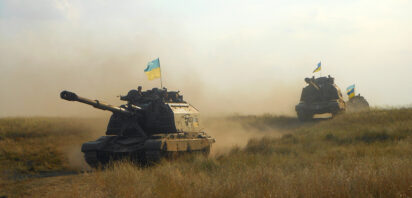
Critically, this support is not charity — it is a strategic investment. Every Russian tank destroyed in Ukraine is one less threat to NATO territory. Every Ukrainian factory restored strengthens Europe’s defense supply chain.
But public and political fatigue is a real risk. The EU must make the case—clearly and consistently—that Ukraine’s resilience is Europe’s security.
The Transatlantic Tightrope: Complementarity, Not Competitive
A more autonomous Europe should not be misread as anti-American. On the contrary, ReArm Europe aligns with longstanding US calls for fairer burden-sharing within NATO. The goal is a Europe capable of defending itself and contributing meaningfully to transatlantic security.
The strategy wisely emphasizes “complementarity,” not duplication. For example, European investments in air-to-air refueling, space-based intelligence, and missile defense ease pressure on US assets and enhance Alliance-wide capabilities.
But diplomacy will be key. Restrictions on non-EU firms accessing SAFE funds have already drawn criticism from the United States and UK. Managing these tensions will require transparency, reciprocity agreements, and a continued commitment to NATO integration.
Implementation: From Paper to Power
The greatest threat to ReArm Europe is not geopolitical—it is procedural. Grand strategies have come and gone in Brussels, often suffocated by slow implementation, fragmented interests, and bureaucratic inertia.
The White Paper identifies the right priorities: joint procurement, industrial scaling, stockpiling, and mobility. But success depends on prompt execution. The EU must establish mechanisms to monitor progress, troubleshoot supply chain issues, and hold member states accountable.
Early wins are essential. A pan-European air defense system, a shared tank project, or a functional ammunition reserve by 2025 would provide momentum and credibility.
The EU must also tackle personnel challenges: attracting, training, and retaining soldiers capable of wielding these new capabilities. Readiness is as much about people as platforms.
Looking Ahead
The European Defence Readiness 2030 strategy is more than a policy document—it is Europe’s bid to reclaim agency in an increasingly volatile world. If implemented faithfully, it could transform the EU from a security consumer into a security provider by the end of the decade.
Strategic autonomy does not mean going it alone. It means ensuring that Europe can act when it must, support allies when it should, and deter adversaries when it needs to. It means becoming a pillar of stability in a world where Pax Americana no longer guarantees order.
The coming years will test Europe’s resolve. But if the continent follows through on its commitments, it will emerge not only more secure but more sovereign—ready, by 2030, to uphold peace not by promise, but by power.
The views expressed in this article belong to the author(s) alone and do not necessarily reflect those of Geopoliticalmonitor.com.