Dr. Hasim Turker

Dr. Hasim TURKER was born in 1976 in Antalya, Turkey. He graduated from the Turkish Naval Academy in 1998 and served at various units of the Turkish Navy for 19 years. Between 2014 and 2016, he commanded TCG Giresun, a guided missile O.H. Perry class frigate. In 2017, he retired with the rank of commander. Dr. Turker is the academic coordinator and senior researcher at Bosphorus Center for Asian Studies, which is an independent think-tank located in Ankara. In 2005, Dr.TURKER graduated from the National Defense University ATASAREN with an MA degree in “International Relations’ and in 2008 from the Turkish Naval War College, with an MA degree in ‘National and International Security Strategies Management and Leadership.’ He is an ancien of the NATO Defense College (SC-118 of 2011). He received his PhD from Kocaeli University in 2018.

Márquez’s “Chronicle of a Death Foretold” Mirrored in Global Politics

Generated by ChatGPT on October 15, 2025. All flags, maps, and likenesses contained within this image are not necessarily accurate representations of reality.

Márquez reminded us that even the foretold can be undone by a single act of conscience. The question is whether the global community, having rehearsed its own tragedy for so long, can similarly improvise a different ending.

From Defense to War: The Language of a Changing Global Order

Generated by Google Gemini AI on September 8, 2025. All flags, maps, and likenesses contained within this image are not necessarily accurate representations of reality.

The renaming of the US Department of Defense is not new, and it reflects a global order that is pivoting back toward the peer military conflicts of the past.

The World of Yesterday Returns: Stefan Zweig’s Timeless Warning

Lot 3619-5: German Military Activities, World War I. Serbian troops, now prisoners-of-war in Belgrade, by Austro-Hungarian forces, probably 1915. Photograph by F.J.M. Reshe, Munchen, Germany. (10/2/2015).

Stefan Zweig’s lament of Europe’s tragic descent into the barbarism of World War I holds lessons for us today. It reminds us that history’s darkest chapters aren’t buried—they return when we forget.

US Protectionism Reborn: Trump’s Response to China’s Ascendancy

cc Marek Ślusarczyk, modified, Car factory production line. Opel Astra J manufactured in General Motors Manufacturing Poland plant in Gliwice. / https://commons.wikimedia.org/wiki/File:002_Production_line_-_car_assembly_line_in_General_Motors_Manufacturing_Poland_-_Gliwice,_Poland.jpg

The recalibration of US trade policy under the second Trump administration is response to profound structural challenges in the global economy. Here’s what it hopes to achieve.

In Uncertainty, Opportunity: China’s Approach to Trump 2.0
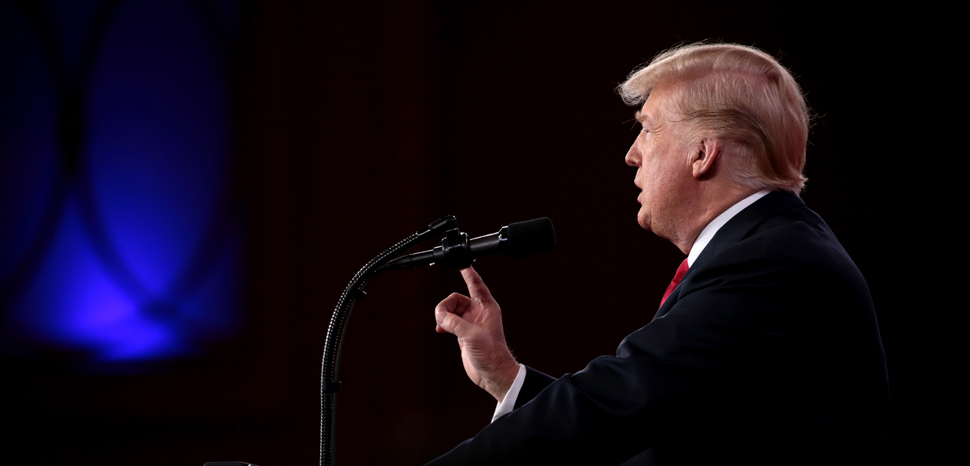
TrumpCPAC, cc Flickr Gage Skidmore, modified, https://creativecommons.org/licenses/by-sa/2.0/

Beijing is looking to benefit from President Trump's disruptive approach, but there are also risks involved.

Europe at a Crossroads: Promise and Perils of the ‘ReArm Europe’ Strategy
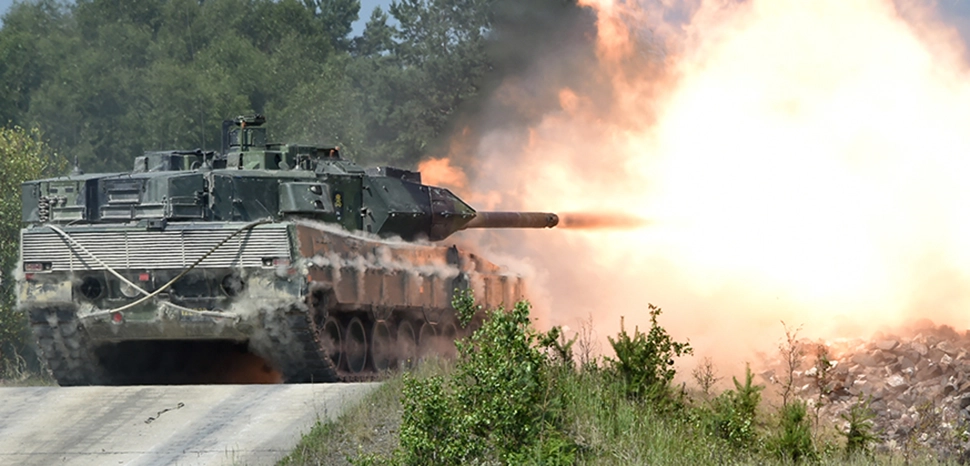
Grafenwoehr - Swedish soldiers with the Wartofta Tank Company, Skaraborg Regiment in a Stridsvagn 122 main battle tank conduct the defensive operations lane during the Strong Europe Tank Challenge, June 7, 2018. U.S. Army Europe and the German Army co-host the third Strong Europe Tank Challenge at Grafenwoehr Training Area, June 3 - 8, 2018. The Strong Europe Tank Challenge is an annual training event designed to give participating nations a dynamic, productive and fun environment in which to foster military partnerships, form Soldier-level relationships, and share tactics, techniques and procedures. (U.S. Army photo by Gertrud Zach) / https://www.7atc.army.mil/MediaAndNews/Photos/igphoto/2002178412/

While the ambition behind the ReArm Europe strategy is commendable, its success hinges on overcoming entrenched political, institutional, and industrial inertia on the continent.

The United Nations, Ukraine, and the Crumbling Pillars of Global Order

cc U.S. Department of State, modified, Secretary of State Antony Blinken chairs a high-level meeting of the United Nations (U.N) Security Council on August 03, 2023 in New York City. The meeting intends to highlight global food insecurity and the conflict in Ukraine that has worsened it. (Official State Department photo by Chuck Kennedy)

Global geopolitics are being remade in real time by the Trump administration, and the lessons aren’t lost on longtime US allies in the Asia-Pacific.

Trump’s Russia Strategy: Breaking the Sino-Russian Alliance or Strengthening It?
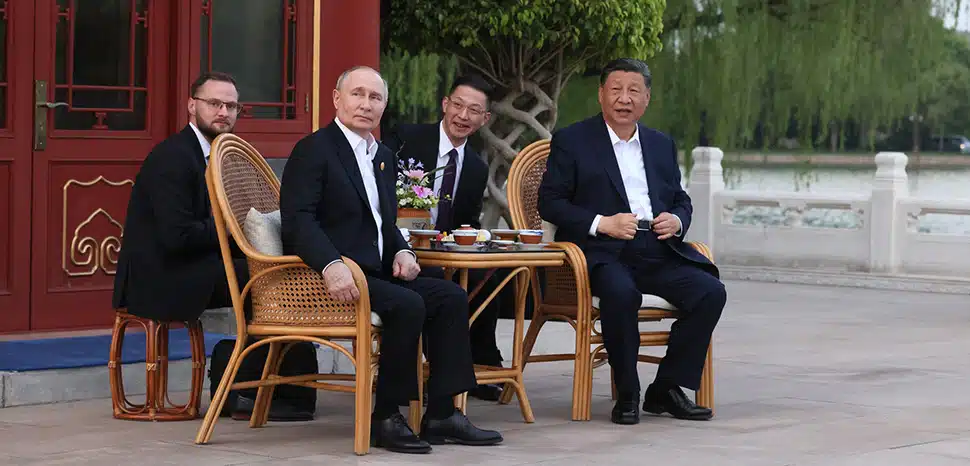
President of Russia Vladimir Putin and General Secretary of the Chinese Communist Party Xi Jinping having tea at an informal setting at the garden of Zhongnanhai in Beijing. / cc kremlin.ru, modified, https://en.m.wikipedia.org/wiki/File:Vladimir_Putin_and_Xi_Jinping_having_tea_at_the_garden_of_Zhongnanhai_%282024-05-16%29_2.jpg

Pulling off a repeat of the Sino-Soviet split may be wishful thinking.

BRICS Kazan Summit: Ambiguous Ambition in Pursuit of Multipolar World

cc The Presidential Press and Information Office of Azerbaijan, modified, https://en.m.wikipedia.org/wiki/File:2024_BRICS_Summit_%281729759568%29.jpg

The BRICS Kazan Summit showcased the bloc’s strengths in advancing the interests of the Global South, but also some of the challenges in reaching consensus amid such ideological, regional, and geopolitical diversity.

New Trade Routes, Old Challenges: India’s Diplomatic Milestone at the G20
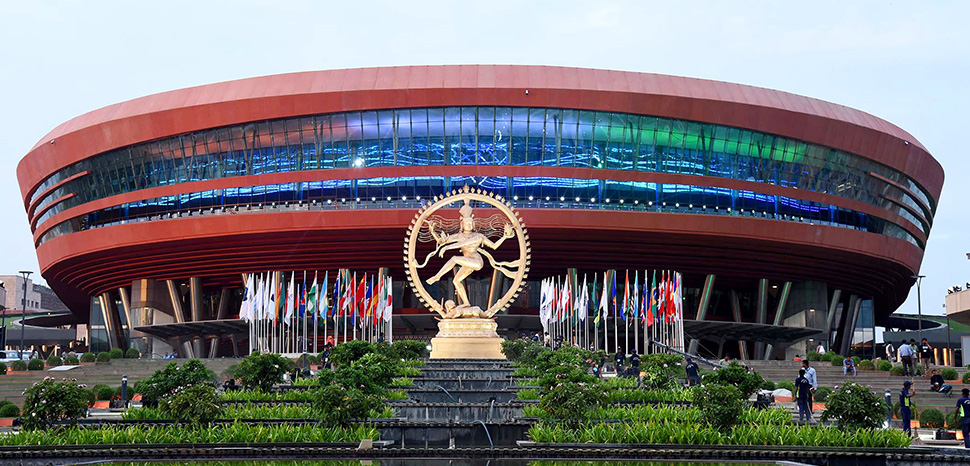
Glimpse of Bharat Mandapam in Pragati Maidan ahead of the upcoming G20 Summit, in New Delhi on September 06, 2023., cc PHOTO DIVISION (PIB), modified, https://commons.wikimedia.org/wiki/File:Bharat_Mandapam_Morning_View.jpg

The recent G20 summit in New Delhi reveals an evolving global institutional framework that coincides with an increasingly multipolar power distribution.

More Stories
Back to Top
Keep Pace with a Changing World
Sign up to our mailing list for weekly reports and discounted subscription rates.
Use Code:
0
0
0
0
Act now for a limited-time deal on an annual subscription.
GPM99
: