Over the past few days, the commercial paper market – where companies look to secure short-term funding for their day-to-day operations – ground to a halt as major banks, concerned about their own cash reserves, opted for the safety of cash. The liquidity crunch is highly reminiscent of the 2008-2009 Great Recession and, in another echo of the events of over a decade ago, the Federal Reserve has since announced that it will begin making direct purchases of commercial paper. The move is just the latest in a string of attempts by US central bankers to shore up market confidence amid the cascading crisis of a global COVID-19 pandemic.
Here’s an outline of the Fed’s recent interventions:
- There’s today’s intervention in commercial paper markets, which came in the form of purchases of unsecured and asset-backed commercial paper from companies that meet certain conditions. The purchases will be made by the New York Fed, which will in turn be backed with $10 billion in credit protection from the US Treasury department. Three-month, dollar-denominated commercial paper will be eligible for purchase; the hope is that, with the full backing of the US government, private and institutional investors can be convinced to return to the $1.1 trillion-dollar commercial paper market. However, these investors may still be inclined to hold onto their cash so long as the true extent of the coronavirus’ economic impact remains unknown (how bad, how long).
- On March 15, the Fed slashed its benchmark rate by 100 basis points, down to a range of 0 to 0.25%. The cut came right on the heels of previous unscheduled reduction of 25 basis points on March 3.
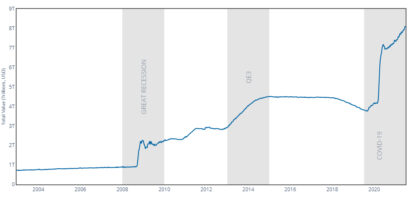
- On March 15, the Fed announced a resumption of 2009-era quantitative easing in all but name. As in the past, the program seeks to inject cash into the financial system and ensure liquidity amid the COVID-19 disruption. The Fed is authorized to make $500 billion worth of Treasuries and $200 billion worth of mortgage-backed securities purchases “over the coming months,” with no weekly or monthly caps.
- The Fed has also been highly active in short-term repo markets, offering $1.5 trillion in funding last week, and another $500 billion as of Tuesday afternoon. Thus far, market demand has fallen well short of the levels that the Fed has been willing to provide.
The Fed has now deployed most of its available arsenal against COVID-19, and it has done so in what appears to be only the first skirmishes in a long and protracted campaign against the virus. The only other possible steps would be to dabble with zero-level or even negative interest rates. But essentially we have already reached the extent of what monetary policy can do in order to shore up market confidence in the short-term.