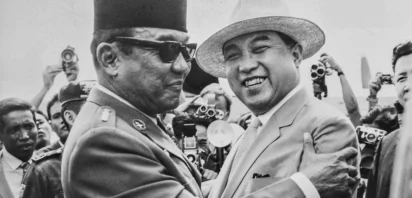
Jakarta’s visit to Pyongyang embodies something genuinely Indonesian and quietly courageous. When Foreign Minister Sugiono arrived in North Korea on 10–11 October and signed a renewed memorandum of understanding, it wasn’t driven by nostalgia for Sukarno-era bromances, but rather a strategic middle-power move: to reopen a dormant channel, test the limits of dialogue, and remind the world that small to middle powers still have a say in shaping the rules of engagement.
To put it bluntly, this is not about trade. Bilateral commerce is almost theatrical in its humility – official numbers indicate only a few million dollars exchanged, emphasizing Jakarta’s geopolitical rather than commercial initiative. Symbolism and leverage are important considerations. Indonesia reopened its embassy in Pyongyang in mid-2025 and sent its top diplomat back to a capital most democracies prefer to sideline — a statement that clearly signals a ‘free and active’ foreign policy in today’s language.
Prabowo’s Jakarta is trying to square two instincts at once: the Bandung-era conviction that dialogue trumps ostracism, and the hard-headed realism of a country hedging between great powers. That duality explains the choreography. Indonesia promises to facilitate DPRK engagement with ASEAN forums like the ASEAN Regional Forum; at the same time, officials stress that the MoU covers cultural, technical and sociocultural cooperation, not arms deals. It’s a classic middle-power play — carve out a niche as an honest broker, even if the broker occasionally makes uncomfortable allies.
Yet this experiment has consequences beyond ceremony. Seoul has reacted with alarm, not merely at the optics of ministers smiling at each other in Pyongyang, but at the very real risk that defense-industrial know-how could slip through seams. The KF-21 fighter-jet partnership with South Korea is a live worry in Seoul: any hint that joint-project technology might be exposed to Pyongyang lands straight in analysts’ worst-case folders. South Korean officials insist safeguards remain, but the concern is visceral and immediate.
Australia and its AUKUS partners will observe with a similar uneasy mix of admiration and distrust. Canberra admires neighbors who chart their own course and do not automatically fall into great power blocs, but AUKUS was always going to make regional allies nervous about the spread of sensitive capabilities and the fragile architecture of non-proliferation. Southeast Asian unease about AUKUS’s nuclear dimension is well-documented; Indonesia’s outreach to Pyongyang will fuel those anxieties if it is misinterpreted as transactional rather than diplomatic. The right response from Canberra and Washington is not to browbeat Jakarta, but to lower the political temperature and shore up transparency. Heavy-handed lectures will simply push Indonesia’s experiment into clandestine corners.
Diplomacy’s long game is a subtler and often underappreciated prize. Engagement through ASEAN forums or sports and cultural contacts can push an isolated dictatorship towards predictable behavior, or at the very least make the costs of instability more visible to neighbors. That, in theory, is the liberal hope: institutions and routine interactions nudge revision. Yet there’s no magic in hospitality. If Laos and Vietnam’s exchanges with Pyongyang are any guide, friendly visits can coexist with strategic mischief. Indonesia must therefore be pragmatic — keep the MoU’s scope narrow, insist on UN-compliant boundaries, and build verifiable safeguards into any technical cooperation.
Here’s a fresh point that is often overlooked in frantic commentary: this is as much about Indonesia redefining its own standing as it is about North Korea. Jakarta is promoting an image of a Global South actor who rejects binary options. That stance is important in a world where many countries object to being forced to “pick.” Indonesia’s outreach is an attempt to turn Bandung’s rhetoric into 21st-century leverage: by communicating with Pyongyang, Jakarta can mediate, cajole, and, most importantly, seem to act independently. This is significant for countries with memories of post-colonial agency.
However, if Indonesia goes too far, if symbolic outreach turns into grey-zone technical cooperation that tangles with sanctions or defense technologies, the consequences would be severe. Relationships with South Korea, trust with AUKUS partners, and Indonesia’s position as a rule-abiding middle power may all suffer. That’s not scary rhetoric; it’s geopolitical math.
So, what is the region supposed to do? Consider Jakarta’s move as an opportunity, not a provocation. Offer a partnership on transparency measures, collaborate on ASEAN-led confidence-building, and direct any technical cooperation towards benign domains (agricultural, disaster relief, public health) with strict monitoring. Resist the impulse to punish theatrics through public shaming. Nudges and institutional offers are more likely to produce strategic results than ultimatums. Also, keep the discussion about standards front and center: UN sanctions are unavoidable; engagement should never be used to justify proliferation or sanction-busting.
Indonesia’s visit to Pyongyang is, at its core, an act of diplomatic daring or foolishness, depending on how neighboring countries perceive it. However, it is preferable to speak to it as a bet: that lowering animosity through discussion, ritual, and rarefied middle-power arrogance could all be part of a safer regional script. Canberra and Seoul may not like every frame Jakarta adopts, but they should not stifle experimentation. The Asia-Pacific region is large enough to support chaotic, autonomous diplomacy. If Jakarta can thread the needle and converse without jeopardizing trust, its quiet return to Pyongyang could become a small model for peaceful engagement in contentious times.
The views expressed in this article belong to the author(s) alone and do not necessarily reflect those of Geopoliticalmonitor.com.