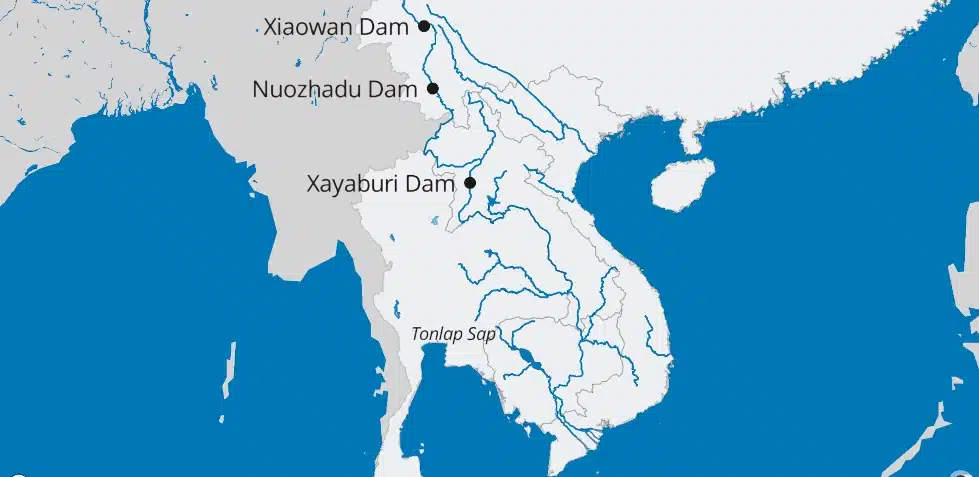
The Lower Mekong River Basin is emerging as a geopolitical flashpoint where water scarcity, the expansion of hydropower, and limited regional coordination converge to produce recurring and intensifying crises. This article explores the environmental and strategic shifts taking place across the Lower Mekong region, focusing on the interactions among Cambodia, Laos, Thailand, and Vietnam, and the upstream influence of China. The river, spanning over 4,300 kilometers and passing through six countries, serves as a lifeline for over 70 million people, many of whom rely on it for agriculture, fisheries, and drinking water. Key themes include the river’s valuation as a strategic asset, the changing geography of power, and the persistent tension between holistic ecological sustainability and the more narrow pursuit of national interest.
National Interest Reigns on the Mekong
Upstream dam construction by China and Laos illustrates deliberate, interest-driven strategies aimed at maximizing national gain. Since the 1990s, China has developed more than a dozen major dams on the Lancang River, the upper stretch of the Mekong, including mega-dams like the Xiaowan and Nuozhadu. These facilities allow China to regulate seasonal flows, store water during wet periods, and release it in dry seasons to support its energy grid, while minimizing disruption to domestic agriculture in its sparsely populated and mountainous southwestern provinces.