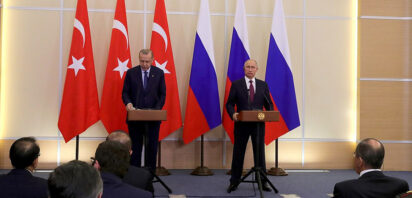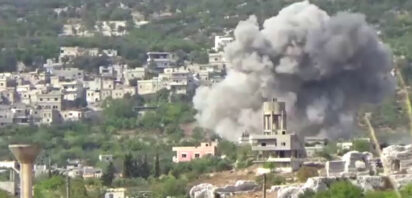
At least 33 Turkish soldiers were killed in an airstrike on a mechanized infantry convoy traversing southern Idlib province on Thursday night. Moscow has denied that its jets were involved in the strike, but some have pointed to the Russian air force’s likely involvement.
The incident marks a significant escalation in Idlib, one that risks worsening an already tenuous humanitarian situation by drawing Turkey and Russia into direct conflict. There are also potential consequences for Europe, as Ankara has recently announced that it will open its borders for refugees moving westward.
Background
Some background information regarding week’s events:
- The Syrian government and its Russian ally are attempting to take control of Idlib province, the last major rebel-held territory in Syria.
- Idlib is home to proxy groups and militias that maintain close cultural and/or patronage links to the Turkish government.
- A 2018 agreement between Russia and Turkey established a de-escalation zone in Idlib in which Ankara was supposed to crack down on terrorist groups in exchange for a freeze on attacks by the Syrian government in Idlib. As part of the agreement, Turkey was allowed to establish a series of military observation posts in the province. The deal broke down in the lead-up to the current fighting.
- Turkey’s first-order objective is to stem the flow of Syrian refugees across the border (there are already 3.6 million Syrian refugees living in Turkey). Secondarily, Ankara wants to establish a buffer zone in northwestern Syria. Just how big of a zone (the entirety of Idlib?) and to what lengths it will go to support its Syria-based proxies remain to be seen, but President Erdogan ordered a significant troop build-up in Idlib leading up to this week’s attack (5,000 new troops dispatched to Syria, 30,000 remain on the border).
- The current fighting in Idlib has unleashed a new wave of migration, with up to one million refugees on the move.
Analysis
If it is true that the Russians were behind the airstrike, as suggested by the type of bunker-buster bomb used and the fact that the attack took place at night, then this represents a bluff call by the Russian authorities. The question is: How far is the Erdogan regime willing to go to achieve its goals in Syria? Just two weeks ago, the Turkish president was warning that “we will strike regime forces everywhere from now on regardless of the deal if any tiny bit of harm is dealt to our soldiers at observation posts or elsewhere.”
Thirty-three deaths certainly constitutes a “tiny bit of harm.” So how will Erdogan respond?