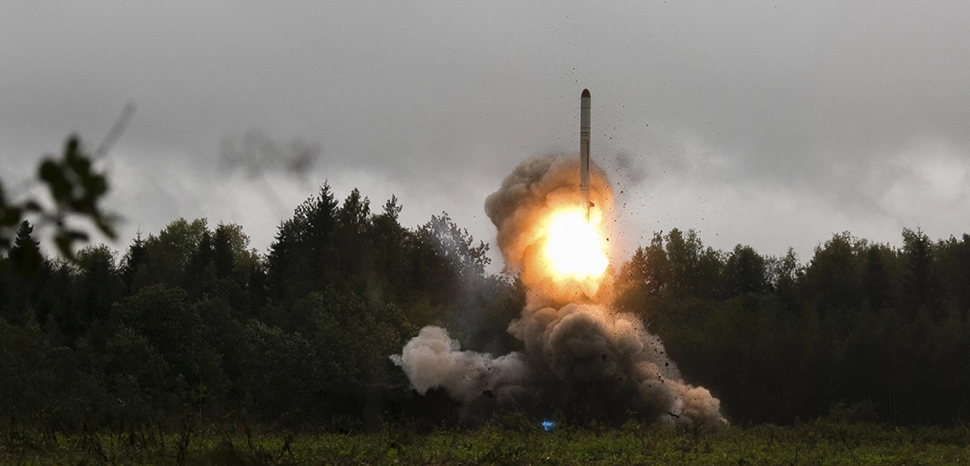
Russia’s long-range strike arsenal was supposed to be running on empty by now. At the end of 2022, Ukrainian intelligence assessed that Russia had fired through most of its pre-war Iskander stockpile, and analysts widely expected its precision missile stocks to be exhausted within months. That prediction was wrong. Rather than exhausting this supply, Russia rebuilt it. The arsenal that exists in 2026 is now larger and more varied than the one Russia took to war. What stands out is that Russia produces almost all of these weapons. The strike complex now terrorizing Ukrainian cities is the output of a Russian defense industry rebuilt around three priorities: extending range, increasing warhead lethality, and saturating defenses.
Russia’s Wartime Arsenal
Russia’s long-range strike inventory now spans three operating tiers:
- Mass-produced one-way attack drones
- Theatre-range cruise and ballistic missiles
- Intermediate-range and air-launched systems with continental or global.
Each tier addresses a different operational problem, and the boundary between them is increasingly blurred as drone payloads and ranges grow.
Russia’s strike strategy layers cheap drones with cruise and ballistic missiles in coordinated packages, exploiting the mismatch between threats and countermeasures, and forcing Ukrainian defenders to choose in the terminal seconds what to engage and what to let through.
Russia’s One-way Attack Drones
The Shahed-class drone is the clearest case of Russian industrial adaptation during the war. Initially, Moscow was purchasing Iran’s Shahed-136 loitering munition. By November 2022, Russia and Iran had agreed on a $1.75 billion deal for Russia to build a domestic production line at the Alabuga Special Economic Zone in Tatarstan, with Iran transferring production documentation, software, engine manufacturing procedures, and training for Russian personnel. The original contract called for 6,000 drones by September 2025. Alabuga met that target roughly a year early and has since moved well past it. It is estimated that around 90% of Russian Shahed-136 production is now domestic, and the unit cost has fallen from around $200,000 to approximately $70,000. Russia has upgraded the airframe, guidance systems, and warhead beyond what Tehran supplied, and current output at Alabuga is running at over 5,500 units per month.