The Ukraine war poses a formidable challenge for diplomats and conflict-resolution experts: both parties maintain demands that are difficult to reconcile, and the trade-offs are so substantial that neither side is inclined to yield. After the Alaska and Washington meetings, however, the central item on the peace agenda has become security guarantees for Ukraine; provisions that, in theory, could satisfy the principal stakeholders and support durable regional peace.
The media is not talking too much about security guarantees for Russia, which is understandable since Moscow is the aggressor and proposing protections for the invader can sound counterintuitive. However, it is worth remembering that the Russian narrative frames the war as a response to perceived threats from the West toward Moscow’s security. Thus, what is required is a creative security architecture that not only terminates the current conflict but also removes incentives for future disputes by credibly satisfying both parties’ core security demands.
A new security design will be required to address the cause of the conflict and reduce the risk of renewed confrontation. While any eventual arrangement may add something novel to security studies, it should be informed by historical models. This paper therefore asks: What design lessons from past security-guarantee settlements are conditionally transferable to the Russia-Ukraine case? To assess the transferability of such arrangements, this analysis focuses on one successful and one unsuccessful case and is structured to meet the security requirements of two sovereign states. In this regard, the Treaty of Guarantee (1960) and the Egypt-Israel Peace Treaty (1979) will be examined and compared with the demands advanced by Kyiv and Moscow in the following sections.
Cyprus Treaty of Guarantee (1960)
In 1960, Greece, Turkey, and the United Kingdom concluded a settlement intended to end intercommunal conflict and underpin a peaceful constitutional order in Cyprus. The package comprised three instruments: 1) the Treaty of Establishment, which created the Republic of Cyprus and carved out the UK Sovereign Base Areas; 2) the Treaty of Guarantee, under which the three states recognized and guaranteed Cyprus’s independence, territorial integrity, and constitutional order, including an explicit prohibition of union with another state or partition; and 3) the Treaty of Alliance, which permitted limited Greek and Turkish military contingents on the island. Constitutionally, Cyprus adopted a power-sharing system with a Greek Cypriot President and a Turkish Cypriot Vice-President, each holding veto powers on specified matters, alongside communal institutions and quotas in the civil service.
The Cyprus case demonstrates that guarantor arrangements with opposed interests can drift toward minimal enforcement or be instrumentalized by one party. The United Kingdom often prioritized Sovereign Base Area access and intra-NATO crisis management over robust defense of the constitutional order, an approach widely described as British pragmatism. London’s position tended to harden or soften with US and broader allied stances, and the United States shuttle diplomacy frequently carried the load in crisis. The result was an erosion of the original power-sharing design despite the formal guarantee. The core lesson is that guarantor interests must align with the settlement’s enforcement, or the guarantee will lack credibility.
Transposing a Cyprus-style model to Ukraine would raise several problems:
- Statehood/Partition Logic. The 1960 package accompanied state creation and fixed external guarantees; any analogous new political entity in occupied Ukrainian territory would be unacceptable to Kyiv and would entrench partition rather than restore sovereignty. A more limited concept, high-autonomy arrangements within Ukraine, would still face legitimacy, security, and verification hurdles. In a Cyprus-style arrangement, territory remains within the internationally recognized borders of the state, but internal territorial units are granted autonomous status under a single sovereignty. Translated to Ukraine, this would imply the creation of autonomous republics that are free from direct control by Moscow, coupled with explicit prohibitions on both partition and unification with any other state. Such prohibitions would aim to preserve Ukraine’s territorial integrity while acknowledging that certain powers of self-government, administrative, cultural-linguistic, perhaps policing, could be devolved to the local level.
- Power-Sharing and Local Forces. While power-sharing can help manage divided polities, importing a bi-communal veto system is ill-suited to Ukraine’s context and risks institutional paralysis. Similarly, allowing reciprocal limited contingents from Ukraine and Russia in disputed areas would undermine sovereignty unless placed under tight international control with clear mandates and timelines. One concept is to allow strictly capped, symmetrical troop deployments by Ukraine and Russia inside the autonomous areas, paired with the presence of a third-party deterrent force whose task is to dissuade renewed aggression and to verify that force-caps and equipment restrictions are being observed. In theory, if a credible external security guarantee were in place, clear mandate, access rights, inspection authority, and pre-agreed responses to violations, Kyiv might be willing to de-emphasize near-term NATO accession and curb heavy-weapon deployments in the autonomous zones. In practice, however, the political and legal risks of any Russian uniformed presence inside Ukraine are acute; if contemplated at all, such presence would have to be time-limited, geographically bounded, and embedded in a stringent verification regime with automatic consequences for non-compliance.
- Who Guarantees? A credible guarantor (or guarantor coalition) would need aligned interests, capacity, and political will to enforce violations. EU states are natural candidates given their stated view that Ukraine’s security is Europe’s security, but Russia is unlikely to accept EU states as guarantors or any forward deployment that it perceives as strategic encroachment. The United States possesses capacity and credibility in organizing monitoring/enforcement, but any US troop presence would be politically contentious given US contributions to NATO and historical context of US-Russia relations. A UN deployment is structurally difficult due to the Security Council veto where Russia is a permanent member. China lacks proximate interests that would make costly enforcement likely and is perceived in Kyiv and Europe as too close to Moscow to be trusted as a neutral guarantor. Türkiye has brokered deals like Black Sea Grain Initiative and maintains ties to both parties. Türkiye also has security interests around the region. For Ankara, a durable maritime preponderance by either Russia or NATO in the Black Sea is undesirable. Turkish policy seeks to preserve equilibrium, upholding Montreux, limiting extra-regional naval presence and preventing unilateral hegemony. However, its priority theaters (e.g., Middle East), positioning itself as a Muslim world’s guarantor, domestic economic constraints, and balancing posture vis-à-vis Russia raise doubts about sustained, costly enforcement.
The Cyprus experience warns against guarantees premised on opposed co-guarantors and against designs that create loopholes for unilateral “restoration” by force. For Ukraine, any credible arrangement would require: 1) aligned guarantors (likely a coalition of European states and partners); 2) clear, automatic enforcement mechanisms (sanctions/aid triggers) rather than discretionary goodwill, and 3) international monitoring that is treaty-anchored and non-UN (to avoid veto politics), without importing power-sharing vetoes or new statehood constructs that would entrench division.
Egypt-Israel Peace Treaty (1979)
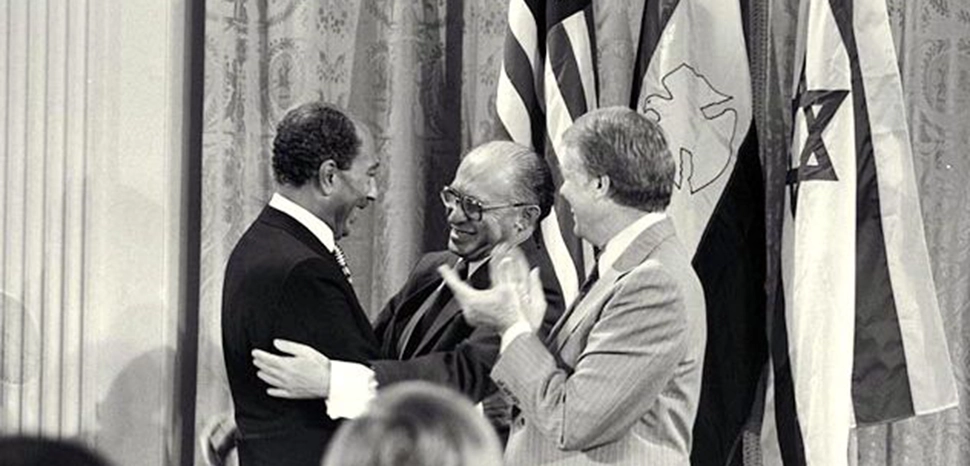
The Egypt-Israel Peace Treaty (1979) is widely recognized as a durable settlement. Israel agreed to withdraw fully from the Sinai Peninsula, and Egypt’s sovereignty over Sinai was restored. The agreement also launched normalization: diplomatic relations, mutual recognition of territorial integrity, and the end of boycotts.
Annex I divided Sinai and adjacent areas into limited-forces zones with detailed caps on personnel and equipment. The international presence was tasked to conduct checkpoints, patrols, and observations, verifying compliance with the treaty. Although the treaty envisaged a UN force/observer mission, Cold War politics, specifically the prospect of a Soviet veto at the UN Security Council, blocked a permanent mandate. Egypt, Israel, and the United States therefore created the Multinational Force & Observers (MFO) in 1981, an independent, treaty-anchored mission with lightly armed contingents from multiple states to perform the monitoring and verification role. The MFO is not a combat force; it does not defend either party and is not a “guarantor” in the legal sense. Disputes are to be resolved by negotiation and, if needed, conciliation or arbitration under the treaty.
While not spelled out as a formal guarantor, the United States has been the settlement’s principal sponsor: broker at Camp David, largest troop contributor to the MFO, major funding source (along with Egypt and Israel), and sustained provider of bilateral military and economic assistance to both parties. This political, financial, and logical backing helped reassure Israel that withdrawal would not compromise its security and assured Egypt of credible, impartial monitoring.
An MFO-style mechanism for eastern Ukraine and Crimea would require clear legal grounds, agreed maps and caps, access/inspection rights, and burden-sharing among contributors. Ukraine’s core concerns differ from Sinai: Russia is the primary threat, and Kyiv is unlikely to accept any enduring Russian military presence on its territory. Conversely, Moscow is unlikely to accept arrangements it reads as strategic encroachment (e.g., NATO forces stationed in Ukraine). These asymmetries mean that any adaptation would have to privilege neutral, non-UN monitors, automatic violation reporting, and pre-agreed responses (e.g., sanctions/aid triggers) rather than rely on contested “guarantors.” A credible non-Western, treaty-based multinational mission can monitor buffer/limited-forces zones to address veto politics concerns and disagreements over reliability of certain armies for conflicting parties. Carefully designed force-caps and inspection rights can reduce escalation risks while preserving each side’s right to self-defense. Above all, the most crucial issue is the question of third-party sponsorship. Durable settlements often require a capable sponsor (or coalition) that invests money, manpower, and political capital over time, even if the sponsor is not a formal guarantor.
In the Sinai case, monitoring (MFO) and sponsorship (USA) were the two essential external functions. Translating the logic yields a functional question for Ukraine: Who could credibly provide monitoring and who could provide sustained sponsorship, given acceptability, capacity, and legal feasibility? The United States could mirror the Egypt-Israel experience through convening power, logistics, funding, and experience sustaining treaty-based monitors. However, domestic sensitivity to deployments and US-Russia rivalry may limit any uniformed footprint. EU and NATO member states have high capacity for financing, sanctions enforcement, training, and contributions to a lightly armed monitoring mission, and their security interests align strongly with Ukraine’s. That said, branding a mission “NATO” would likely reduce acceptability to Moscow; a treaty-anchored, non-NATO mission with significant European contributors is more feasible. The United Nations is well suited for political facilitation, human-rights monitoring, PoW/IDP issues, and public reporting. A new Security Council mandate for peace operations is, however, unlikely and veto-vulnerable, as noted in the Cyprus discussion. As a Black Sea stakeholder with working channels to Kyiv and Moscow and prior facilitation experience (e.g., the grain corridor), Türkiye again could serve as facilitator and monitoring contributor. Constraints include competing theaters, economic pressures, and a balancing posture that may limit enforcement willingness. China has potential leverage with Moscow and reconstruction-finance capacity, but is perceived in Europe and Kyiv as partial, has limited proximate security interests, and shows uncertain appetite for costly enforcement.
The Sinai precedent suggests separating functions: a treaty-anchored, non-UN multinational monitor staffed by willing contributions (primarily European states, potentially with US/regional participation), under sustained sponsorship from a capable external actor or small coalition. This mirrors the verification-plus-sponsorship pairing that underwrote durability in the Egypt-Israel case while acknowledging current veto politics.
Conclusion
This analysis does not yield a single historical template that can be transplanted wholesale to the Russia-Ukraine context; substantial context-specific adaptation is required to design a viable security architecture. The Cyprus arrangements lacked credible, continuous monitoring and ultimately failed, whereas the Egypt-Israel settlement embedded stricter verification procedures and has remained effective. This evidence highlights the importance of verification density, as settlements with treaty-anchored and continuous verification are more likely to prevent major violations than those relying on episodic or informal monitoring. Durability appears to improve when a sponsor’s interests align with those of the beneficiaries, yet the United Kingdom’s limited engagement in Cyprus contrasts with the United States’ role in the Egypt-Israel, where Washington’s interests were not straightforwardly identical to either party. Thus, guarantor alignment plays a crucial role: if the sponsor’s security interests align with the beneficiary’s (and misalignment with spoiler’s), settlements are more durable. In the Egypt-Israel case, predefined responses linked to monitoring helped sustain compliance which exhibits automatic violation ladders’ positive impact on the durable peace. Where treaties specify automatic, graduated responses to violations, compliance is higher than when responses are discretionary.
Approaches introduced in this article might help Kyiv mitigate its exposure by pairing visible monitoring with graduated enforcement and limited but credible rearmament rights. Yet the central question remains the guarantor architecture. Who is prepared to assume responsibility as a guarantor? Are great and regional powers prepared to cooperate at the level required to sustain such a mechanism over time? Would sponsors provide a transparent, consistent, and even-handed approach to their roles, including public reporting and predictable triggers for remedial actions? And, crucially, are potential countries sufficiently trusted by the parties at war to serve as credible sponsors, or would a broader coalition (e.g., adding European contributors and regional actors) be necessary to distribute burdens, enhance legitimacy, and reduce perceptions of bias?
The historical case analysis once again demonstrates the importance of reliable sponsors in sustaining a settlement. More broadly, this insight may be extended to conflict resolution in general: a credible security guarantee requires effective enforcement mechanisms, robust verification procedures, and reliable sponsors. Durable security arrangements depend less on formal promises alone than on dense verification, credible sponsorship, and pre-agreed enforcement. Above all, however, the termination of any conflict ultimately depends on the political will of the parties involved. Without such political will, even the most carefully designed arrangements are likely to remain on paper.