Geopolitics Weekly analyzes emerging geopolitical trends around the world, distilling the cacophony of global events into one easy reader. It lands in the inbox of Geopolitical Monitor subscribers every week. This week’s edition has been made available to all our readers.
Asia
Thai Ruling Coalition Collapses as Fighting Spreads along Border with Cambodia
What Happened
The Thai government launched airstrikes on Cambodian positions on December 8, claimed to be in response to the death of a Thai soldier from a newly laid mine. Fighting has since erupted along the border, killing at least 20 and injuring 200. Compounding the uncertainty, the Thai government – only three months old itself – collapsed toward the end of the week after a key member of the ruling coalition withdrew its support.
Why It Matters
- A Combustible Escalation. This new round of fighting has already eclipsed the July clashes in severity. Notably, where the July clashes were centered on the Preah Vihear temple complex, last week’s fighting played out across several border provinces. Airstrikes and heavy artillery exchanges have been reported along the border of Sisaket (where the Preah Vihear is located), Surin, Buriram, and Ubon Ratchathani. Airstrikes and naval operations have also been reported in coastal Trat province, home to another un-demarcated and highly contested maritime border and a popular tourist destination in Thailand. The broader distribution of fighting is generating more severe displacement than before, with at least 800,000 people forced to flee along the border. The stated death toll is likely an underestimate and can be expected to be revised upward in the future.
- War and Politics. Amid the worsening kinetic conflict, a political drama also unfolded in Thai Prime Minister Anutin Charnvirakul’s decision to dissolve his government and call for new elections. The move was pre-emptive: a coalition partner, the People’s Party, was about to pull its support over the prime minister’s recent siding with conservative elements in defense of the 2017 military-drafted constitution, breaking their coalition agreement to revisit constitutional reform. Given the ideological disconnect between the two partners, this was a betrayal long foretold and surely planned for. One potential rationale would be to play the nationalist card in the context of the border tensions with Cambodia in the hope of coming out of elections with a stronger position in Parliament. Recall that the previous prime minister, Paetongtarn Shinawatra, lost her job for appearing too soft on the border issue. Charnvirakul’s stated intention to ‘return power to the people,’ his early rejection of outside mediation, and his deflection of Trump’s diplomatic re-engagement would all seem to align with this interpretation. Nevertheless, whatever the specific motivations involved, the overriding takeaway here is Thai politics have once again been plunged into the unknown, with the border conflict serving as currency for new challengers in the Bangkok Game of Thrones.
- The Limits of Trumpian Diplomacy. The Thailand-Cambodia border war reflects certain limits in President Trump’s transactional approach to diplomacy. While it’s true that US economic and military power are important to both states and can be wielded as a carrot or stick to make them ‘play nice,’ this dynamic only goes so far. A reason for this is the yawning gap in political will between the two sides. For Thailand and Cambodia, the border is a matter of civilizational honor, simmering for decades – the type of issue that people are willing to die for in the face of rationale economic or political arguments otherwise. For the United States, it’s a footnote that ebbs or flows on the news cycle. Additionally, the Trump peace frameworks that we’ve seen in Gaza, the DRC, and here are all top-down and lacking in any concrete institutional conflict resolution mechanisms. These mechanisms are the hard part of peacebuilding; they take time to build and inevitably involve tough compromises. But they also act as fail safes that can de-escalate sudden setbacks like the mine death of December 9 and avoid a full resumption of hostilities. The latest round of hostilities exemplifies these limits, with both sides ignoring or downplaying efforts by President Trump to re-insert himself into the peace process.
Americas
US Military Seizes Oil Tanker off of Venezuela, Weapons Shipment to Iran
What Happened
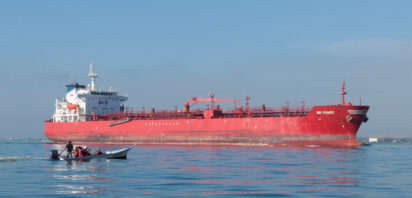
The US military seized a Venezuelan oil tanker in the Caribbean on December 10, indicating that additional seizures would occur in the future. According to the US government, the vessel belongs to an Iranian shadow fleet that was helping the Islamic Revolutionary Guards Corps evade sanctions. Elsewhere, the Wall Street Journal reported on a similar interdiction that took place last month, this time involving a ship making its way from China to Iran in the Indian Ocean. The cargo of unspecified weapons components was seized and destroyed and the ship was released from custody.
Why It Matters
Strategic considerations inform both operations. For Venezuela the goal is to sap the regime’s one remaining source of fiscal strength in oil exports; for Iran it is to forestall the replenishment of missile stocks ahead of another potential war with Israel. But it’s the method – interdiction at sea – that is remarkable.
- Sanctions 2.0. The seizures broadly reflect the eroding efficacy of conventional US sanctions. A similar incident transpired just five years ago where the cargoes of four tankers were seized over sanctioned trade with Iran. Yet unlike last week, these seizures did not require a military operation. Instead, the seizures were facilitated by a cooperative, West-based ownership group through legal channels. In the post-Ukraine war geopolitical context, where ‘shadow fleets’ have been organized and supported with the singular goal of sanctions evasion, voluntary legal compliance is waning, which makes sanction enforcement a matter of hard power projection in certain contexts. This results in increased policing costs (interdiction operations aren’t cheap) and a not-insignificant risk of escalation if and when a seizure does not go to plan.
- Venezuela Signaling. As a tool of statecraft, maritime interdictions are more fitting for Venezuela than Iran – shorter coastline, closer to home, less of a conventional naval threat, and a less volatile neighborhood. Looking ahead, the policy could naturally evolve into something resembling a blockade, which would be a fiscal disaster for a Venezuelan state that is almost wholly reliant on oil revenues. This would be in keeping with the Trump administration’s approach toward Venezuela, which projects hard power while maintaining a conspicuously circumspect approach. The tanker seizure checks the visual boxes on what makes for good politics for the Trump administration; it also has the additional benefit of actually turning the screws on Caracas. Yet just like the recent evolution of ‘gray zone’ warfare in the South China Sea, the US government is grasping at a new normal that has yet to fully coalesce. Will allies Russia, Cuba, and China come to Venezuela’s aid? Is there a risk of kinetic escalation from a cornered Maduro regime? Can the operating costs of policing the Caribbean Sea be borne indefinitely? The jury is still out, but when the answers do come they could sour the optics.
Canada Posts Trade Surplus Despite US Tariffs
What Happened
Canada’s monthly merchandise deficit closed a $6.4 billion gap from August, posting a slight surplus of $153 million in September. The 6.3% spike in exports was the largest since February 2024, and it helped to partially reverse a plunge in exports in the wake of US tariffs coming into effect in March. The export gains were led by metal and non-metallic minerals, energy, and aircraft and transportation equipment parts. Though the vast majority of US-Canada trade remains protected by the CUSMA free trade agreement, the Trump administration has imposed tariffs on non-CUSMA auto manufacturing (25%), aluminum (50%), steel (25%), along with copper (50%), furniture (25-30%), and lumber tariffs (35%).
Why It Matters
The data will be welcomed by a Carney government that owes its office to fears of US political and economic coercion. Trade diversification has been a consistent theme in the administration’s policies and messaging. Yet it was actually trade with the United States that helped fuel the September reversal, as Canada’s bilateral trade surplus widened by 44% on higher exports of aircraft, light trucks, and gold. Signs of diversification were still present: exports to non-US destinations were up 11%, with higher exports to Switzerland (gold), Germany (crude oil), and Singapore (crude oil and aircraft) leading the way. Overall, the United States accounted for 71% of Canadian exports, which is below the 2024 average rate of 75.9%.
Should the trend persist, it will convert into political capital at home and at the negotiating table surrounding the future of CUSMA. However, the US market’s size and proximity loom large as ever over Canada’s economic destiny, and any diversification can realistically be expected to be partial and gradual.
Europe
Ukraine Drops NATO Membership Requirement in Berlin Peace Talks
What Happened
Ukraine President Zelensky has dropped an aspiration to join NATO in an effort to move peace talks forward in Berlin.
Why It Matters
As a symbol, the move is highly significant. For Ukraine, NATO came to symbolize a shift in geopolitical orientation, toward Brussels and away from Moscow. It is an issue that has loomed large over decades of Ukrainian politics.
For Russia, removing the specter of NATO removes its stated rationale for perpetuating the war; unless, of course, there are other reasons underpinning Russia’s invasion in the first place.
In more tangible terms, Zelensky’s concession isn’t necessarily a gamechanger. NATO membership is merely a means to an end as a strong security guarantee. The million-dollar question is: What extent of external commitment is necessary to deter future Russian aggression? Whatever replaces NATO membership in the talks – bilateral or multilateral guarantees from the ‘Coalition of the Willing,’ for example – it won’t be as ironclad as NATO, and consequently to some extent will be contingent on the goodwill of the protecting polity, which could be asked to intervene on Ukraine’s behalf in some future, gray area contingency that falls short of wartime hostilities. Shoring up these security guarantees continues to be the overriding priority of Ukrainian negotiators.