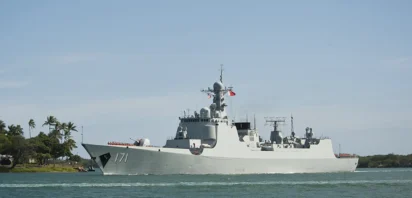
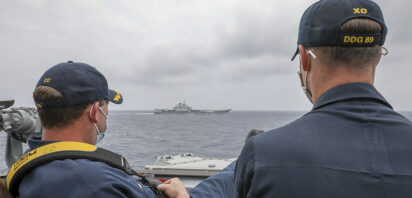
China’s People’s Liberation Army (PLA) is currently ranked as the third most powerful military in the world, behind only the United States and Russia. Its naval arm, the People’s Liberation Army Navy (PLA Navy), is actually larger than the US Navy, currently consisting of an active duty battle force of around 370 platforms. Moreover, that number is a likely underestimate since it does not include smaller-scale vessels that can be equipped with anti-ship cruise missiles (ASCMs) in a hypothetical conflict near Taiwan; for example, the Type 022 (Houbei Class) patrol boats that pose a credible risk to blue water platforms while not being able to traverse the open oceans themselves. Nor does it include the irregular forces that could be brought to bear in any conflict in China’s littoral waters, such as the People’s Armed Forces Maritime Militia (PAFMM).
How the PLA Navy continues to expand over the short- and medium-term is a matter of mounting concern for US policymakers and military strategists. China’s ongoing shipbuilding and force modernization programs expect to grow the PLA Navy to 395 ships by 2025, and 435 ships by 2030. In contrast, the US Navy was fielding 296 battle ships as of August 2024, and US efforts to catch up are complicated by the yawning gap in shipbuilding capacity between China and the United States. Just how big is this gap? According to a leaked US Navy briefing, China has a domestic shipbuilding capacity 232 times greater than the United States.
The PLA Navy may be winning in terms of quantity, but the US maintains a qualitative edge, albeit one that is rapidly diminishing over time. To quote an unclassified US naval intelligence briefing on China’s shipbuilding program in 2020: “Chinese naval ship design and material quality is in many cases comparable to [US Navy] ships, and China is quickly closing the gaps in any areas of deficiency.” There is some fog of war here in that the PLA Navy remains untested by actual combat with a peer adversary, and the opaque nature of China’s politics typically obscures any disclosure that might suggest the modernization program is not a rousing success, with some notable exceptions such as the reported sinking of a cutting-edge submarine while in dock in September 2024.
This backgrounder will break down the PLA Navy by vessel type, examining force structure, capabilities, new platforms, respective roles in China’s overall maritime strategy:
Aircraft Carriers

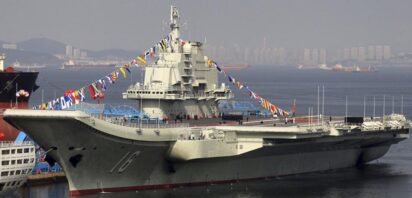
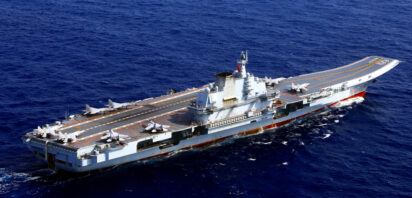
China currently possesses three aircraft carriers, the Liaoning, Shandong, and Fujian. These carriers, with their expansive flight decks, are central to the PLA Navy’s power projection capacity, enabling the launch and retrieval of fixed-wing aircraft and rotorcraft.
The PLA Navy’s first aircraft carrier was the Liaoning (Type 001). Commissioned in 2012, the Liaoning is a refitted Soviet Kuznetsov-class vessel. It serves mainly as a training and weapons testing platform, though it remains fully operational for combat.
The Shandong (Type 002), commissioned in 2019, is China’s first domestically built carrier and is regarded as an improved version of the Liaoning, featuring more advanced systems. The ship weighs around 70,000 tons at full load and is both longer and heavier than the Liaoning. In a modification from the original Kuznetsov design, the Shandong swaps out missile launch capacity for a larger air wing, which consists mostly of Shenyang J-15s jets (an estimated 36), along with Changhe Z-18 and Harbin Z-9 helicopters. Neither the Shandong nor the Liaoning are equipped with a catapult, limiting the potential loadouts of their air wings.
The most recent addition to the PLA Navy is the Fujian (Type 003), launched in 2022, which represents a significant leap in capability with its flat-top design and electromagnetic catapults, representing an advance on the steam-powered catapults used in most US carriers. The Fujian is believed to weigh in at around 80,000-85,000 pounds at full capacity, making it the largest conventionally powered carrier in the world. Its large flight deck and catapult allow for a larger and more advanced air wing, which was revealed in 2025 to include Shenyang J-15Ts (modified for catapult takeoff and recovery), Shenyang J-35s (the PLA’s fifth-generation stealth fighter), and notably the Xian KJ-600 airborne early warning (AEW) aircraft. The KJ-600, which only made its maiden flight in 2020, will greatly extends the radar horizon of the carrier group and coordinate protection from incoming threats.
Concerns have recently been raised about certain aspects of the Fujian’s design, which limit the carrier’s aircraft launch rate compared to US carriers. These include having only two launch catapults (the USS Ford has four); an island placement that limits deck space; and aircraft elevators that are too forward placed. All issues trace back to the Fujian’s conventional propulsion and will presumably be addressed in future, nuclear-powered models. They could also be remnants of a shift from steam-powered to electromagnetic catapults, which reportedly happened midway through the design process. The Fujian’s electromagnetic catapults were widely celebrated as evidence that the PLA was closing the qualitative gap with the US Navy. Incidentally, the catapults have since become a political issue in the United States, with President Trump frequently calling for a return to steam catapults and hydraulic elevators due to reliability issues that plague the new Ford-class systems.
A fourth PLA Navy aircraft carrier is currently under construction. Early satellite photos suggest that the new carrier will be larger than even the US Navy’s Ford Class, with space for an air wing of up to 100. It is also believed to be the first Chinese model to feature nuclear propulsion; however, there are indications that significant technical challenges have yet to be solved. Looking ahead, there are plans to field a total of 5-6 carriers by the 2030s.
China’s aircraft carriers differ from their US counterparts in that they are designed to operate exclusively under the protective “bubble” created by China’s anti-access/area-denial (A2/AD) systems, particularly within the first island chain. These A2/AD systems intend to restrict the US Navy from entering key areas, allowing China’s carriers to function in a more localized context, supporting power projection closer to home. The carriers, therefore, are not the core of China’s fleet but rather play a supporting role within a broader defensive strategy aimed at controlling regional waters and limiting US naval reach. The strategy strikes a contrast to that of the United States, which employs carriers as the central plank of a blue water projection capacity.
Helicopter & Drone Carriers
 The PLA Navy currently fields four helicopter carriers, all of which are the relatively new Type 075, first launched in September of 2019. Helicopter carriers are typically used as launchpads for supporting rotorcraft and vertical takeoff and landing (VTOL) aircraft. While they are smaller than aircraft carriers, their flexibility in supporting various aircraft, including unmanned aerial vehicle (UAV) operations, makes them a crucial part of modern fleets.
Helicopter carriers play a critical transport and support role in amphibious assaults, making the Type 075 decisive in any Taiwan contingency. In addition to the 30 helicopters that the model can hold, the carrier can also serve as a launchpad for up to three Type 726 landing crafts, each housing anywhere from 60-70 troops and up to three vehicles (one tank, two infantry vehicles). In all, the Type 075 can transport 800-1,200 marines. In terms of size and displacement (35,000 tons), the Type 075 is roughly comparable to the US Navy’s Tarawa and Wasp Class amphibious ships.
The development of the successor Type 076 was long shrouded in mystery. In 2024, satellites caught a glimpse of a new ship hidden away on the Yangtze River, whose size and hull were speculated to be the first iteration of a dedicated drone carrier. It has since been revealed that this was the Type 076, which combines an amphibious assault ship with electromagnetic catapults for launching an exclusively unmanned air wing – a novel design in naval warfare. The Type 076 is loaded up with defensive systems: three HQ-10 surface-to-air missile launchers, three Type 1130 30mm gatling guns, and three defensive launchers for flares and chaffs to defend against incoming missile strikes. The first Type 076, the Sichuan, began sea trials in November, 2025.
Destroyers
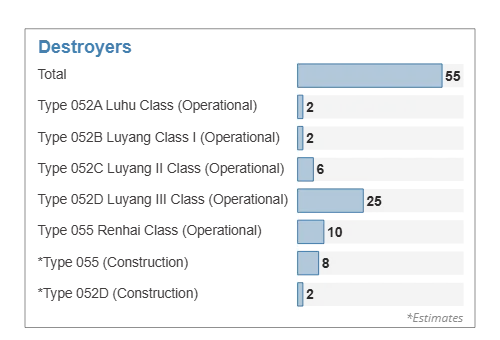
With 45 destroyers in operation and at least 10 under construction, the PLA Navy continues to put a heavy emphasis on the expansion of its destroyer fleet. Destroyers are generally regarded as the jack-of-all trades of naval operations: they are heavily armed and armored, able to engage in anti-air, anti-submarine, and anti-ship warfare. They also house vertical launch systems (VLS) that can strike land-based targets with cruise missiles. And finally, their range and radar systems allow them to surveil and monitor vast expanses of maritime territory.
The current backbone of the destroyer fleet is the Type 052, which first entered service in 1994 and has received several significant overhauls since then. The Type 052D, in service since 2014, is the most recent iteration and is generally equated with the US Aegis system (boasting a comprehensive and interconnected radar, sensor, and weapon suite). The Type 052D is equipped with a VLS able to fire HHQ-9 surface-to-air missiles, YJ-18 anti-ship missiles, CJ-10 cruise missiles, and CY-5 anti-submarine missiles. The model also has a 130 mm H/PJ-38 naval gun for land and sea targets, torpedo tubes, and anti-missile defense systems.
The Type 055 Renhai Class is the newest destroyer fielded by the PLA Navy, and it is expected to become the primary escort for carrier groups, all the while serving as a powerful force projection tool for expeditionary operations beyond the first island chain. The model represents an advance on the Type 052D on several fronts. The Renhai is significantly larger, weighing in at 13,000 tons compared to the Type 052D’s 7,500. It has double the VLS capacity, from 64 to 112 VLS cells, vastly expanding its missile stockpile. The cells are also larger and able to accommodate new hypersonic missiles like the Y-21 anti-ship missile. The ship’s radar and propulsion systems have also been overhauled, and the flight deck is large enough to accommodate two helicopters.
Frigates

China operates 42 frigates, the vast majority of which are of the relatively older Type 054A model that first started going into commission in 2008. The operational role of a frigate mirrors that of a destroyer, but they are typically smaller, less heavily armed, and therefore more cost effective to deploy. Destroyers used to have a considerable speed advantage over frigates, but this gap has been closed in recent times.
The backbone of the PLA Navy’s frigate fleet, the Type 054A, is primarily designed for anti-air warfare, though it is able to engage in anti-ship and anti-submarine operations as well. The ship has a displacement of around 4,000 tons at full load. Its 32-cell VLS can launch HQ-16 surface-air missiles able to strike aerial targets at a distance of up to 50 km. Its primarily anti-ship weapon is the YJ-83 ‘carrier killer’ anti-ship cruise missile, along with a 76mm naval gun and torpedo tubes for anti-submarine warfare. The flight deck is also large enough to accommodate one medium-sized helicopter.
A new variant of the Type 054A was unveiled in early 2026, the Linfen, which features a larger caliber main gun for surface targets and a larger flight deck to accommodate anti-submarine helicopters like the Z-20F,
Corvettes

The PLA Navy operates 50 stealth corvettes, with another 22 used by the China Coast Guard. These vessels are smaller than frigates and are generally used for patrol and search-and-rescue missions in littoral waters.
This coastal mission scope is reflected in the specifications and armaments of the Type 056. The corvette has a range of around 3,500 nautical miles and a maximum speed of 28 knots. Its typical loadout includes YJ-83 anti-ship missiles, and it has a 76 mm main gun along with two 30 mm remote-controlled guns. It also has a HQ-10 surface-to-air missile launcher that can fire up to eight missiles at incoming ordinance. Finally, the Type 056 is equipped with two torpedo launchers allowing for a minimal anti-submarine capacity.
The Type 056 has met with some success as an arms export, with vessels now in operation in the Bangladesh Navy, the Algerian National Navy, and Royal Cambodian Navy, the latter of which were provided free of charge by the Chinese government in September of 2024.
Submarines
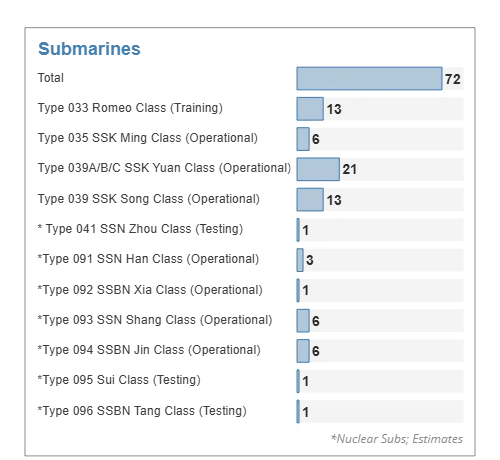
The true extent of the PLA Navy’s submarine fleet is a matter of speculation, which is to be expected given the concealable nature of submarines compared to surface ships (the above numbers are largely based on US DoD estimates). Taiwanese military sources put the count at around 70 conventional and two nuclear submarines in early 2024. A late 2024 US DoD report estimated 48 diesel or air-powered attack submarines (SSKs or ‘hunter killers’) and 12 nuclear powered submarines, six of which are attack subs (SSNs) and six of which are ballistic missile subs (SSBNs). By way of comparison, the US Navy currently fields 67 submarines. Whatever the actual number, it’s clear that the PLA Navy’s submarine force is a top priority in China’s naval modernization program, reflected in the breadth and increasingly quality of China’s submarine forces. Over the past 15 years alone, the PLA Navy is believed to have constructed 12 nuclear submarines.
The Type 094 SSBN (Jin Class) was dubbed China’s ‘first credible sea-based nuclear deterrent’ by a 2023 US DoD report on Chinese military power. The model was an early priority in China’s modernization program and entered into service in 2010. The Type 094 is able to remain at sea for an estimated 60 days. Its loadout typically includes 12 JL-2 SLBMs, each able to be armed with a nuclear warhead, achieving a maximum range of 7,400 km (approximately the distance between Okinawa and Hawaii). As of late 2024 there were indications that some Type 094s had been upgraded with JL-3 ballistic missiles with a range of 12,000, allowing for easier targeting of the continental United States. A longstanding weakness of the Type 094 is that it has a higher noise profile than its peers, a noteworthy vulnerability given China’s littoral geography and the need for its submarines to frequently traverse shallow chokepoints. Early indications are that this weakness has been rectified in the Type 096 SSBN, the successor to the Jin Class, which is believed to have a much quieter profile, creating new detection challenges for the US Navy and its allies in the Indo-Pacific. The Type 096 is currently expected to enter into service in the late 2020s, early 2030s.
The Type 093 SSN (Shang Class) is the PLA Navy’s nuclear-powered attack submarine, first commissioned in 2006. There are several variants of the model – Type093A/B/C – that have collectively improved on the initial design. Notably, the Type 093B added a vertical launch system that can be equipped with sophisticated land- and surface-attack cruise missiles, such as the YJ-18 and CJ-10, dramatically extending the conventional power projection capabilities of the PLA Navy’s nuclear submarine corps. These Type 093Bs continue to be rolled out, with four new vessels entering into service between May 2022 and January 2023. The Type 095 SSN (Sui Class), successor to the Shang Class, is in early development and while not much is known about the new model at this point, it’s expected to bring another qualitative leap in China’s nuclear attack submarine program.
The Type 041 SSN (Zhou Class) underlines ongoing intelligence gaps in Western assessments of the PLA Navy’s submarine program. Its existence was only revealed when satellite photos caught an advanced sub sinking at dock in the Wuchang Shipyard in May or June, 2024. The Zhou is believed to feature a hybrid propulsion capacity combining a conventional engine with a small nuclear reactor. The model is experimental – and now lost – but it suggests an effort to combine the range and survivability of nuclear SSNs with the cost-effectiveness and quietness of diesel/battery propulsion, pivoting to either as the situation demands.
Mine Warfare
Historically, the PLA Navy has favored mine-laying as an asymmetric strategy that can even the odds against a numerically or technologically superior foe, initially the Kuomintang Navy and later the US Navy. In the event of a conflict in or around Taiwan, China can deploy its significant stockpile of 50,000-100,000 mines to block of key shipping lanes or even US military bases in the Indo-Pacific. The US Navy maintains an estimated stockpile of 10,000 maritime mines, most of which date back to the Cold War era.
The PLA Navy has several options for mine delivery: surface naval ships, submarines, air-dropping, and even utilizing irregular maritime forces like the People’s Armed Forces Maritime Militia (PAFMM) to place the mines. A notable recent revelation was the appearance of the AJX002 unmanned minelayer in a military parade in September 2025. This is an interesting development for several reasons. First, it underscores the growing capability gap between the PLA and US Navy on mines, fed by the latter’s lack of urgency and underinvestment in recent decades. Second, given that naval mines would be decisive in any blockade or invasion of Taiwan, the actual process of seeding of mine fields in the lead-up to the conflict becomes a key consideration, both for Taiwan and China. With enough mines and AJX002s, the mine fields could be seeded sight unseen, affording Beijing an element of surprise.
The PLA Navy has also prioritized its mine countermeasures capacity in recent years and is now able to field 60 minesweeping vessels, along with unmanned surface minehunters.