In November 1983, a NATO command post exercise—Able Archer 83—almost triggered one of the deadliest nuclear miscalculations of the Cold War. This exercise was designed to simulate an escalation scenario from a conventional war to nuclear release procedures, which incorporated operationally unprecedentedly realistic elements, including leadership participation, encrypted communications, and command transitions that reflected actual wartime operational protocols. For NATO, it was a typical readiness drill. Nonetheless, for the Soviets, it appeared indistinguishable from preparations for a real preemptive first strike.
The broader geopolitical environment amplified such misinterpretation. Under President Ronald Reagan, US-Soviet tensions rapidly deteriorated, while the Korean Air Lines Flight 007 downing incident had already heightened Soviet threat perceptions. Intelligence assessments later suggested that Moscow interpreted the exercise as a potential prelude to a nuclear attack, naturally prompting some of its forces to enter a state of high alert. The crisis elapsed without further escalation, but only narrowly. Its enduring significance lies in a structural insight: that deterrence could crumble based on how capabilities are perceived under stress and uncertainty, and not necessarily due to insufficient capability.
The lesson is no longer confined to Cold War history. Today, the United States, Japan, and South Korea are faced with the growing risk of a dual contingency—China invading Taiwan while North Korea opportunistically exploits the situation and embarks on provocative activities on the Korean Peninsula. However, unlike during the Cold War period, a dual contingency in contemporary East Asia would unfold at a faster pace, involve more actors, and be accompanied by a higher level of ambiguity. Under such circumstances, the primary risk hinges not simply on the simultaneity of crises, but on how actions taken in one theater could be interpreted in another.
A Dual Contingency in Practice
A contemporary dual contingency scenario would likely unfold at a speed and complexity that far exceed the dynamics of Able Archer 83. In the initial phase, it can be assumed that China would initiate military operations against Taiwan through a combination of precision missile strikes and naval and aerial assault. Ballistic and hypersonic missiles could strike Taiwan’s major airbases and command nodes, while the PLA Navy and Air Force would attempt the isolation of the island. In response, the United States would rapidly activate its Indo-Pacific contingency plans. Strategic bombers, including B-52Hs, would be deployed to Andersen Air Force Base in Guam, while additional assets, such as B-2 bombers, would be held in reserve for potential escalation. Forward-deployed carrier strike group in Japan would sail toward the Philippine Sea, while US air and naval assets would be broadly dispersed across the region.
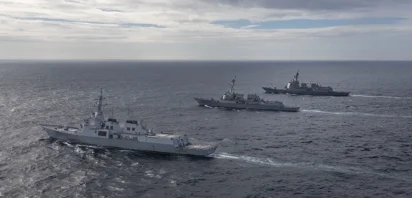
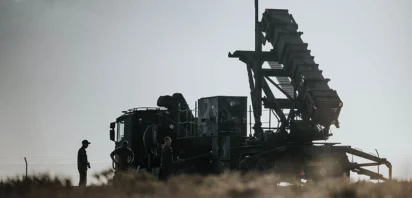
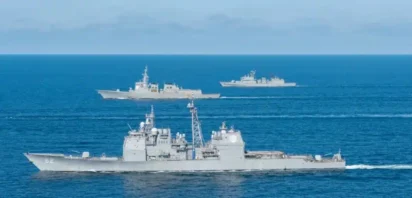
Japan, as a frontline ally, would deploy its Self-Defense Forces to provide rear-area and missile defense—in line with the 2015 US-Japan Defense Guidelines. Aegis destroyers would be redeployed to enhance anti-ballistic missile coverage, while PAC-3 batteries would enter a heightened alert status. At the same time, USFJ would begin dispersion operations in order to reduce vulnerability to Chinese missile strikes. The result is a dense operational environment characterized by rapid force relocation, elevated readiness, and continuous ISR activities that create massive volumes of ambiguous data.
Meanwhile, on the Korean Peninsula, South Korea would strengthen its own military preparedness in response to such changing circumstances. Air Force assets would be placed on high alert, the Navy would be redeployed to reinforce missile defense, while some elements of preemptive doctrine would be activated—in accordance with the Three-Axis System—against North Korea’s probable opportunistic behavior.
From the standpoint of the US, Japan, and South Korea, these measures are primarily defensive, designed to prevent further escalation. Yet, from Pyongyang’s perspective, the accumulated picture may appear diametrically different.
North Korea would observe the deployment of US strategic bombers to Guam, the dispersion of air assets across Japan, and South Korea’s high readiness posture that is linked to preemptive strike and regime-change capacity. Taken together, these elements could be seen as preparations for coordinated multi-axis strikes. The ongoing US-China competition would likely amplify the uncertainty. Pyongyang would not easily distinguish whether these developments are merely dispersion, a secondary front, or the early stages of a broader campaign that includes the Korean Peninsula.
Faced with such ambiguity, North Korea might take preemptive action not because an attack is certain, but because of the judgment that the cost of waiting would be prohibitive. These actions could start off with calibrated measures like short-range ballistic missile launches into surrounding waters, followed by more demonstrative steps like an SLBM test intended to signal resolve. Limited artillery fire near the DMZ or cyber operations targeting South Korean infrastructure could also reinforce these signaling strategies. All of these activities would likely be conducted at a level not exceeding the threshold for triggering a large-scale war; yet they could forge an escalating cycle of perception and response.
The trilateral alliance may interpret these developments as confirmation of hostile intention, likely prompting further increases in readiness—which include additional activation of missile defense systems and increased surveillance activities. However, these responses would reinforce the very fears that triggered North Korea’s earlier actions. As a result, a feedback loop—where each side’s defensive measures are mutually interpreted as preparations for an attack—would be established, creating strikingly similar dynamics to those evidenced by Able Archer 83; the distinction is that in today’s environment, this process would unfold rapidly across interconnected theaters at the same time.
Making Deterrence Interpretable
Able Archer 83’s key lesson is that deterrence should not only be credible, but also interpretable. In a dual contingency environment, this requires efforts to ensure that military actions are understood as intended even amidst extreme stress and the fog of war.
For the United States, Japan, and South Korea, this begins with clearly distinguishing Taiwan-related operations from activities involving the Korean Peninsula. Without such distinction, routine force movements—bomber deployments, naval repositioning, and activation of missile defense—contain the risk of being perceived as part of a unified offensive strategy. Structuring a clearer signaling framework, whether through public statements or private channels, would contribute to reducing such ambiguity.
Force deployment sequencing is also an invaluable factor. If high-visibility strategic assets are activated across multiple theaters simultaneously, this could give the impression of an imminent coordinated attack. On the contrary, an approach that prioritizes defensive measures and incrementally introduces offensive assets afterward could help preserve interpretability without seriously undermining overall deterrence; this would not eliminate risk entirely, but could reduce the chances of defensive actions being misread as having offensive intent.
In addition, indirect or unofficial channels of communication that allow clarification of intentions during crises would be equally important. Able Archer 83 showcased that the worst assumptions prevail in the absence of such communication channels. In today’s world, where escalation timelines are substantially shortened, the ability to relay intent in a swift and trustworthy manner has become increasingly important.
Last but not least, when designing military exercises and readiness activities, it is imperative to account for how they are externally perceived. Incorporating novel elements that closely resemble real wartime operations under highly tense circumstances would increase the risk of misjudgment. Here, the objective is not to compromise realism, but to ensure that such realism is not unintentionally interpreted as an opening signal of imminent conflict.
Able Archer 83 remains one of the most dangerous near-misses of the Cold War, as it illustrates the fragile boundary between intention and perception. In today’s Indo-Pacific, that boundary is becoming increasingly narrow. A dual contingency involving both China and North Korea would likely create a strategic environment in which misinterpretation becomes a structural risk rather than an exception.
The challenge faced by the United States, Japan, and South Korea goes beyond preserving mere military superiority. However necessary a measure may be, the trilateral partners must ensure that it is understood by the opponent as originally intended. In an era of overlapping crises, the effectiveness of deterrence depends not only on brute force, but on the ability to prevent that strength from being mistaken for the conflict it seeks to avoid.