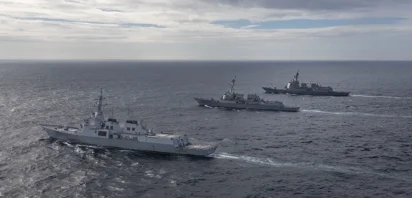
As tensions continue to rise in the Taiwan Strait, discussions have emerged over whether South Korea should deploy naval assets to support US and Japanese operations in the event of a full-scale Chinese military invasion. Some argue that if China imposes a naval blockade around Taiwan, South Korea should contribute to securing sea lines of communication (SLOC) as part of a broader regional response. While it remains unclear what specific actions South Korea would take in such a contingency, it is evident that the strategic responsibilities of the ROK Navy have steadily expanded—despite limited naval resources relative to the scale of potential missions. In 2019, I participated in a study commissioned by the South Korean Navy titled “Regional Naval Modernization Trends and Future Directions for the ROK Navy’s Core Capabilities.” The study aimed to assess what force structure would be adequate not only for the defense of South Korean waters, but also for preventing regional crises from jeopardizing national interests. This article revisits the findings of that study in light of today’s strategic environment (2025) and explores what specific measures South Korea should now consider to meet emerging maritime security challenges.
In the 2019 study, the Republic of Korea Navy’s “core capabilities” were defined as critical elements of naval power essential to protecting the nation’s key strategic interests. Specific naval platforms—such as the Sejong the Great-class Aegis destroyers, the Jang Bogo, Son Won-il, and Dosan Ahn Chang-ho-class submarines, and the Dokdo-class amphibious assault ships—were designated as core assets due to their strategic relevance to several major security challenges. These included: 1) the ability to secure vital sea lines of communication critical to South Korea’s energy imports and trade, particularly in the context of potential maritime conflict between the United States and China; 2) the capacity to deter or respond to North Korea’s submarine-launched ballistic missile (SLBM) threats; 3) the capability to counter China’s efforts to assert exclusive control over regional waters through its so-called “interiorization” strategy; and 4) the readiness to defend South Korea’s territorial waters—including the Dokdo/Takeshima island—against Japan’s Maritime Self-Defense Force.
A multi-method approach was adopted to assess and compare the naval power of neighboring countries and determine the appropriate scale of the Republic of Korea Navy’s (ROKN) core capabilities in the 2019 study. Four primary methodologies were employed: tonnage-based comparison, hull count-based comparison, and two variants of the Battle Force Missile (BFM) methodology.
The tonnage-based comparison is a traditional method that calculates total fleet displacement to estimate the overall size and weight of a navy. This approach has been widely used since the Washington and London Naval Conference and offers a broad understanding of fleet scale. However, it fails to capture qualitative differences among ships with varying sizes and capabilities. The analysis used data from Jane’s Fighting Ships (2018–2019).
The hull count-based method compares the number of major naval platforms each country possesses. It is useful for estimating how many platforms can be rapidly deployed to crisis zones in the event of maritime conflict. While it helps in understanding force availability, it does not account for variations in vessel size or firepower, which may lead to misleading assessments of actual combat capability.
To address the limitations of traditional methods, the study introduced a Battle Force Missile (BFM)-based approach, originally proposed by former US Deputy Secretary of Defense Robert O. Work. This method evaluates a fleet’s strength based on the number of offensive missiles it can deploy—such as anti-submarine rocket (ASROC), Harpoon, Tomahawk, and Standard Missiles—excluding short-range self-defense systems like rolling airframe missile (RAM) or evolved sea sparrow missile (ESSM). The BFM method emphasizes the importance of missile firepower in modern naval warfare, especially as smaller ships can now be equipped with high-performance anti-ship missiles. A historical case often cited to support this view is the 1967 sinking of the Israeli destroyer Eilat by an Egyptian missile boat using four Styx missiles. This event underscored the obsolescence of judging fleet power solely by ship size or gun caliber, highlighting the growing dominance of missile capabilities.
The study also applied an enhanced version of the BFM method—BFM Tiered Analysis—which categorizes platforms into different classes based on their missile loadouts. For instance, vessels carrying over 100 BFMs are classified as Tier 1, those with 90–99 missiles as Tier 2, and so forth down to platforms with fewer than six missiles, which remain unclassified. This tiered system allows for a more granular and realistic comparison of effective firepower across navies. It helps identify not just the total volume of firepower, but also the distribution and concentration of strike capability across a given fleet.
Ultimately, this combined methodological framework—integrating traditional metrics with modern firepower-based assessments—was used to evaluate and compare the naval capabilities of the United States, China, and Russia, and to benchmark the ROK Navy’s core forces accordingly. Emphasis was placed on the BFM approach, which the study regarded as more reflective of the evolving nature of naval warfare in the missile-dominated era.
The 2019 study concluded that, in a scenario where South Korean naval assets are deployed to protect sea lines of communication (SLOC) amid a US-China conflict over the Taiwan Strait—and face resistance from the People’s Liberation Army Navy (PLA Navy)—South Korea would require a naval force capable of delivering at least 339 BFMs to establish credible deterrence and fulfill its operational objectives. Achieving this missile capacity would necessitate a combination of three key force structure enhancements: 1) the introduction of a light aircraft carrier capable of operating F-35B fighter jets armed with anti-ship missiles; 2) the acquisition of two to three arsenal ships equipped with a high number of vertical launch systems (VLS) optimized for anti-ship strike missions; and 3) the reconfiguration of existing destroyers, such as the KDX-II and KDX-III classes, by prioritizing anti-ship missiles over air-defense missiles in their primary loadouts. Collectively, these measures would provide the ROK Navy with the firepower required to counter Chinese naval forces in a high-intensity SLOC engagement.
Now fast forward to 2025, the strategic environment confronting the South Korean Navy has changed dramatically. Between 2019 and 2025, the PLA Navy has undergone a rapid and extensive buildup, expanding its fleet from roughly 335 to an estimated 395 ships, with projections reaching 435 by 2030. This expansion encompasses a wide array of capabilities, including advanced destroyers, frigates, submarines, amphibious vessels, and logistical support ships. A key highlight of this growth is China’s aircraft carrier program: while operating the Liaoning and Shandong, China has pushed the Fujian (Type 003) into sea trials and commenced construction of a fourth carrier, potentially nuclear-powered (Type 004). Alongside this, the PLA Navy has steadily fielded more sophisticated surface combatants, such as the Type 055 destroyers, and has modernized its submarine fleet. These developments underscore Beijing’s strategic intent to extend its naval reach, assert control over contested maritime areas, and build a world-class blue-water navy—profoundly altering the regional maritime balance and presenting new challenges for South Korea’s naval posture.
Given the evolving strategic environment, South Korea would require a significantly larger set of core naval capabilities—necessitating a fundamental reassessment of the force structure proposed in the 2019 study. However, considering the constraints of the national defense budget, a substantial expansion of high-cost core assets appears to be an impractical solution. Instead, the South Korean Navy must adopt a cost-effective, asymmetric, and network-centric approach to maritime defense.
In light of these limitations, I propose the following six alternative policy recommendations:
First, South Korea should prioritize the development of arsenal ships over full-sized aircraft carriers. These unmanned or minimally crewed surface platforms, equipped with vertical launch systems (VLS), provide substantial firepower at a fraction of the cost associated with traditional carriers. Accelerating the development of multi-role arsenal ships—with integrated strike capabilities, control of unmanned underwater and surface vehicles (UUVs/USVs), and intelligence, surveillance, and reconnaissance (ISR) systems—would enhance maritime lethality without requiring a full blue-water carrier force.
Second, South Korea should expand its use of unmanned and autonomous systems. Unmanned surface vehicles (USVs) and unmanned underwater vehicles (UUVs) can play key roles in mine countermeasures, anti-submarine warfare, and maritime surveillance. Medium-altitude, long-endurance unmanned aerial vehicles (UAVs) like the MQ-9B SeaGuardian could offer persistent ISR and limited strike capabilities at significantly lower cost than manned aircraft. To maximize effectiveness, these systems should be integrated into a broader C4ISR (Command, Control, Communications, Computers, Intelligence, Surveillance, and Reconnaissance) architecture, allowing for sustained situational awareness even against numerically superior adversaries.
Third, South Korea should move toward a distributed maritime force posture by investing in a larger number of smaller surface combatants, such as FFX-III-class frigates, corvettes, and high-speed interceptors, rather than focusing solely on large destroyers or carriers. These smaller platforms would enable swarming and multi-axis saturation attacks—tactics well-suited for deterring or countering larger Chinese naval formations in high-threat environments.
Fourth, deepening maritime interoperability with the United States and allied partners is essential. This includes enhancing integration through joint exercises and real-time data sharing via frameworks like the Joint All-Domain Command and Control (JADC2). Trilateral coordination with the U.S. and Japan in overlapping Exclusive Economic Zones (EEZs) and critical transit routes would further enhance maritime ISR coverage and regional defense.
Fifth, South Korea must invest in maritime domain awareness (MDA) infrastructure. This includes the deployment of satellites, over-the-horizon radar, and seabed sensor networks—all vital tools for detecting submarine infiltration and surface incursions before they threaten national waters.
Finally, the strategic use of the Jeju Naval Base and southern islands should be reinforced. Jeju can serve as a power projection hub, providing forward logistics and ISR support. Additionally, transforming key islands into bastions—equipped with anti-ship missiles, surface-to-air missile systems, and UAV stations—would help establish layered defense zones in the southern maritime theater.
To counter its quantitative disadvantage, South Korea must pursue a strategy centered on qualitative superiority, distributed lethality, and multi-domain integration. The objective is not to match China in fleet tonnage or total BFMs, but rather to make any attempt at maritime aggression prohibitively costly, operationally uncertain, and strategically visible—essentially, a 21st-century form of “sea denial with teeth.” This approach should emphasize the seamless integration of emerging technologies—such as unmanned surface and underwater vehicles (USVs/UUVs)—with existing platforms like Aegis-equipped destroyers and other surface combatants. Incorporating artificial intelligence and manned-unmanned teaming (MUM-T) capabilities will be critical to maximizing operational efficiency. To evaluate the effectiveness of these hybrid force structures, unconventional testing methods should be explored, including the use of advanced commercial simulation platforms like Command: Modern Operations to model complex combat scenarios and optimize system integration.
Dr. Ju Hyung Kim, President of the Security Management Institute—a defense think tank affiliated with the South Korean National Assembly—led a study commissioned by the South Korean Navy titled ‘Regional Naval Modernization Trends and Future Directions for the ROK Navy’s Core Capabilities.’
The views expressed in this article belong to the authors alone and do not necessarily reflect those of Geopoliticalmonitor.com.