On 30 September 1938, British Prime Minister Neville Chamberlain returned from Munich proclaiming “Peace for our time.” London applauded. People wanted to believe that language could buy safety. The applause reassured, but it did not protect; its usefulness expired within a year.
Fast forward 83 years. On 1 December 2021, Japan’s former Prime Minister Shinzo Abe, calm and measured, spoke eight characters that echoed across East Asia: 臺灣有事,日本有事 — if Taiwan faces a crisis, Japan faces a crisis.
In Tokyo, the words sounded like overdue honesty. In Taipei, reactions split. Some felt reassurance. Others felt a chill, as though the statement offered comfort in one hand while warning of danger with the other. The same sentence operated as both a welcome confession and a subtle transfer of risk. It seemed to promise a partnership, yet it implied consequences without specifying costs.
The phrase hardened into myth. Commentators hailed moral solidarity. Politicians framed it as implicit security. Advocacy groups called it proof of democratic alignment. Yet Abe did not promise intervention, proclaim shared values, or signal an alliance. He spoke a structural dependence. Japan was not pledging to defend Taiwan; it was admitting that its own survival hinges on events across 110 kilometers of sea.
Two realities lurk beneath the sentence. Shared vulnerability does not imply shared sacrifice. Loud solidarity does not create deterrence. And on 24 November 2025, these eight characters produced two opposite slogans in Taiwan, when KMT Chairwoman Cheng Li-wun declared: 臺灣沒事,日本沒事,大家都沒事 — Taiwan is fine, Japan is fine, everyone is fine; even as President Lai urged China “not to become a troublemaker.”
A sentence that once unified now divides, revealing not clarity, but a contest over who will bear the cost of crisis.
The Myth: Borrowing a Confession and Calling It a Promise
Abe’s eight characters quickly became global scripture. Media treated them as policy, think tanks as a strategic shift, and the DPP as evidence of a quasi-alliance. Fear in Tokyo was reinterpreted in Taipei as protection, and applause began to substitute for preparation.
The myth endures because it offers a shortcut. It suggests Taiwan can strengthen deterrence not through costly reforms, but by collecting supportive statements from abroad. If solidarity can be borrowed, then fuel reserves, civil defense training, and conscription reform can be postponed in the name of diplomacy.
Three forces sustain the illusion. First, it flatters voters. If other democracies stand with Taiwan because of shared values, citizens feel like protagonists rather than targets. Second, the myth shields leaders from demanding sacrifice. If others might help, why push for energy reserves, shelters, or tough conscription reforms? Third, borrowed credibility erases accountability. Outsourced risk makes domestic responsibility feel optional.
Yet the facts never change. No treaty obliges Japan to fight. No joint command exists. There is no Japanese equivalent of the Taiwan Relations Act. Japan speaks loudly because it is threatened, not because it is committed.
Myths endure not by being right. They endure by postponing hard choices. They survive until reality weighs more than applause. In 2025, one photograph in Beijing made that reckoning impossible to ignore.
The Strait That Shapes Japan
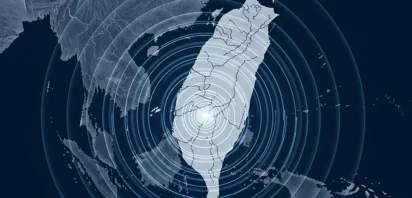
The reality behind Abe’s words is physical, not ideological. Japan relies on the sea. Nearly all its energy and over half its food pass through a corridor just 110 kilometers wide near Taiwan. Whoever controls those waters controls Japan’s electricity, heat, and supermarket shelves.
Taiwan is a strategic chokepoint. Japanese defense white papers consistently highlight the Taiwan Strait and the Ryukyu Islands as vital to regional stability. Geography shapes Japan’s security priorities, even as it deepens economic and political ties across the Indo-Pacific.
The core message that geography dictates security priorities has remained steady, but explicit mentions of Taiwan’s role have grown stronger recently in response to increasing regional tensions. Japan’s approach blends this geographic realism with deepening economic, technological, and political ties, reflecting a partnership based on both strategic necessity and shared democratic values to ensure regional stability.
2025 war games illustrate the fragility of Japan’s supply chains. A disruption would cause detours, higher costs, and potential crew shortages. Silence in a crisis does not ensure stability, it guarantees shortages. Japan speaks loudly not to comfort Taiwan, but to prevent domestic crisis.
Public opinion reflects this fear. Support for defending Taiwan has risen from roughly 33 percent a decade ago to around 40% today. This is not affection for Taipei: it is survival instinct. Empty shelves, depleted tanks, and disrupted energy grids terrify more than abstract principles.
Geography binds the two societies asymmetrically. Japan suffers if Taiwan falls. Taiwan falls if Japan hesitates. Abe’s eight characters may sound like solidarity. In truth, they are an alarm bell.
Unequal Burdens, Unequal Timing
Geography creates a stark asymmetry, reinforced by legal structures. The US–Japan Security Treaty covers the “Far East” but never Taiwan. Japan can provide intelligence or host US forces, yet direct combat requires legislation that can be delayed. Delay is an advantage for Japan; for Taiwan, it is risk.
Politics widens the gap. Two hundred Japanese casualties could destabilize a government. Taiwan would suffer losses immediately. Cities lie within artillery range, with no strategic depth. Civilians understand that Japan’s contingency unfolds over weeks, but Taiwan’s begins at once.
The November 2025 photograph made this tangible. Kanai met Liu Jinsong in Beijing; Liu stood hands in pockets while Kanai nodded. Millions saw it online. Japan endured minor embarrassment; Taiwan felt immediate unease. One image, two contingencies: Japan moves on bureaucratic timelines; Taiwan must respond in real time.
Same Sentence, Opposite Political Fate
The sentence that strengthened Japan weakens Taiwan. In Tokyo, Abe’s confession became policy fuel. Fear drove budgets, logistics, and youth support for defense reforms. Lawmakers debated munitions, fuel reserves, and Ryukyu vulnerabilities. Anxiety turned into action.
In Taipei, the statement became a constraint. Applause replaced preparation. Policymakers used foreign praise to delay conscription, energy, and civil defense reforms. Ordinary citizens prepared; elites sent children abroad. Willingness to defend persisted, but tolerance for being the frontline without accountable leadership declined. The Democratic Progressive party (DPP) approval fell from the high 50s to the low 30s.
Even in Japan, fear did not ensure consensus. November 2025 protests outside the prime minister’s office showed anxiety alone cannot sustain support.
On 24 November, the sentence yielded its first domestic counter-slogan. KMT Chair Zheng Liwen argued and advocated stability through dialogue rather than borrowed rhetoric. She accused President Lai of “adding fuel to the fire” for political gain. Lai replied on 23 November that China must “not become a troublemaker.”
The inversion revealed a split: one politics welcomes Japan’s alarm; another resists being volunteered as its frontline. Public opinion reflects neither resignation nor passivity. About 60 percent are willing to fight if invaded, yet fewer will support parties that treat them as expendable.
Japan metabolized fear into readiness. Taiwan metabolized applause into delay. Words substituted for responsibility; only preparation ensures security. A secure Taiwan will be built quietly and deliberately, long before any foreign voice promises safety.
The views expressed in this article belong to the author(s) alone and do not necessarily reflect those of Geopoliticalmonitor.com.