Since Donald Trump’s return to the White House, US foreign policy has been centered around the concept of the “equal deal.” This approach challenges traditional alliances, multilateral institutions and post-WWII agreements, which Trump argues have disadvantaged the United States. His administration appears intent on dismantling the established international order, replacing it with a transactional logic, driven by short-term gains rather than shared values or long-term stability.
A cornerstone of Trump’s 2024 campaign was the promise to end the war in Ukraine, a goal he claimed could be achieved “in a single day.” In practice, this has translated into overtures to the Kremlin, a reversal of blame onto Ukraine, and conditions for US aid based on Kyiv’s ability to secure natural resources to repay the estimated $500 billion Washington claims to have spent in Ukraine’s defense. International politics, under this framework, is reduced to a zero-sum financial negotiation – more akin to a business deal than a strategic partnership.
America First
For Trump, a “good deal” is one where US gains are maximized, even at the cost of allies’ security. In Ukraine’s case, no guarantees were made regarding territorial integrity. Instead, the U.S proposed an investment fund for reconstruction, jointly held by Kyiv and Washington – but with priority access for US companies.
This logic has also been applied to Taiwan. During the 2024 campaign, Trump declared, “Taiwan should pay us for their defense… We’re like an insurance company. They give us nothing,” In early 2025, he escalated further, accusing Taiwan of “stealing” the microprocessor industry from the United States – an industry he claims was once American before Taiwan “took it.”
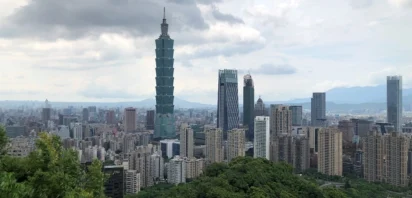
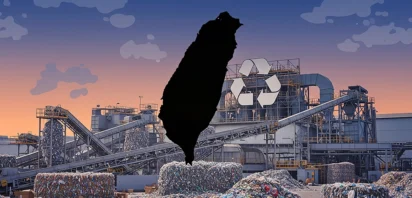
In truth, Taiwan’s success in this sector stems not from theft but from long-term industrial investment. The Hsinchu Science Park, home to over 560 companies and 150,000 workers – 82% of whom have advanced degrees in fields like semiconductors, telecommunications, and biotech – is a global hub of high-tech production. Taiwan now accounts for 63% of global chip manufacturing, contributing 8.5% to its GDP and 31% of its exports.
Ironically, this dominance benefits the US national economy. Revenue from chip exports allows Taipei to purchase advanced American defense systems – a key deterrent against Chinese aggression. Between 1990 and 2020, Taiwan ranked as the fourth-largest buyer of US arms, with over $20 billion in pending orders, including dozens of F-16s and ground-air missiles launchers. The narrative of a one-sided insurance relationship is not only misleading – it undermines a mutually beneficial security partnership.
Breakdown of the Post-WWII Order
The Ukraine war highlights serious questions about the Trump administration’s willingness and ability to confront authoritarian regimes. Despite months of talks since March 2025, no lasting ceasefire has materialized, with the only pause lasting a mere 12 hours.
Instead of pressuring Moscow, Washington has adopted a more accommodating stance. Trump’s rhetoric has weakened Ukraine’s position, and his administration’s ideological concessions – such as opening the door to recognizing Crimea as Russian territory – have signaled a retreat from core US commitments to sovereignty and international law. While the final critical minerals agreement acknowledged Russia as the aggressor and included commitments to Ukraine’s “long-term success,” Senator Marc Rubio has since warned the U.S. could withdraw from mediation unless Moscow and Kyiv offer concrete proposals soon.
Far from an impartial mediator, the Trump administration has repeatedly undermined Ukraine’s leadership, with Trump even labeling President Zelensky a dictator at one time. The failure to enforce clear red lines reflects a broader decline in US global leadership. The American empire that once championed liberal order appears adrift, unable or unwilling to defend the very system it helped build after World War II.
Taiwan in the New Geopolitical Normal
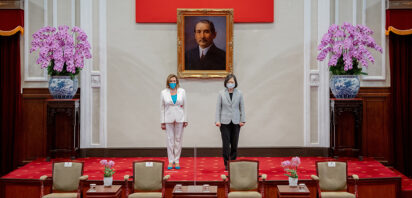
Despite Trump’s rhetoric, a complete abandonment of Taiwan does not appear imminent. Taiwan remains a symbolic outpost of liberal capitalism, a democratic bulwark standing in contrast to China’s authoritarian rise. In a subtle but significant shift, the US State Department recently removed the statement “we do not support Taiwan independence.”
Nevertheless, signs of strategic disengagement are mounting. The “Asia Pivot” initiated under the Obama administration is now little more than a memory. Chinese military exercises around Taiwan elicit muted responses from Washington. In a meeting with the British Prime Minister, Trump even appeared unfamiliar with the term “AUKUS” – the trilateral security pact under which the U.S. is to deliver nuclear powered submarines to Australia by 2030, in exchange for $4.78 billion and expanded tech-sharing on quantum and hypersonic weapons, in an effort to challenge Chinese expansionism in the south-east Asia region.
Meanwhile economic pressure on Taiwan continues. Trump imposed new tariffs despite TSMC’s pledge of $100 billion in new investments – on top of $65 billion already committed. And when asked in February 2025 whether the U.S. would defend Taiwan in case of invasion, Trump responded: “I never comment on that. I don’t want to put myself in that position.”
This shift had already been initiated by the 2022 Chips and Science Act, which pursued two main objectives: reshoring jobs to the United States and securing the microchip advances semiconductor manufacturing sector. Taiwan’s “silicon shield” strategy – centered on the development of its advanced semiconductor manufacturing sector – was intended to deter a Chinese invasion by increasing the island’s strategic value. However, the potential loss of control resulting from either a takeover by the Chinese Communist Party or the destruction of production facilities now appears to have been a miscalculation by public authorities. The growing assertiveness of China may in turn force companies like TMSC to relocate their production facilities, not where the labor is the cheapest, but closer to the markets like the U.S. or Germany.
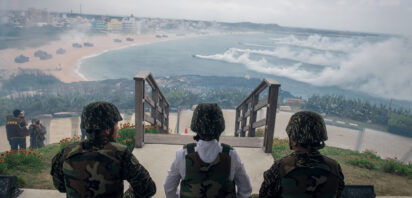
Since Trump’s return, China’s military activity has surged – likely a test of how far Beijing can push. In response, Taipei has sought new defense partnerships, engaging with Japan, Australia, and India. In May, during a meeting with a Japanese MP, President Lai Ching-Te stressed the need for deeper security and economic ties with Tokyo, citing the unpredictability of the United States. Australia, though limited to the military realm, is also investing in regional projection through AUKUS.
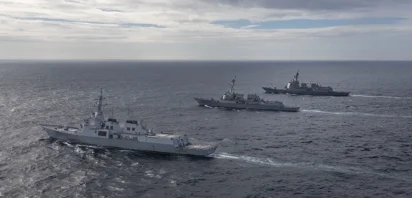
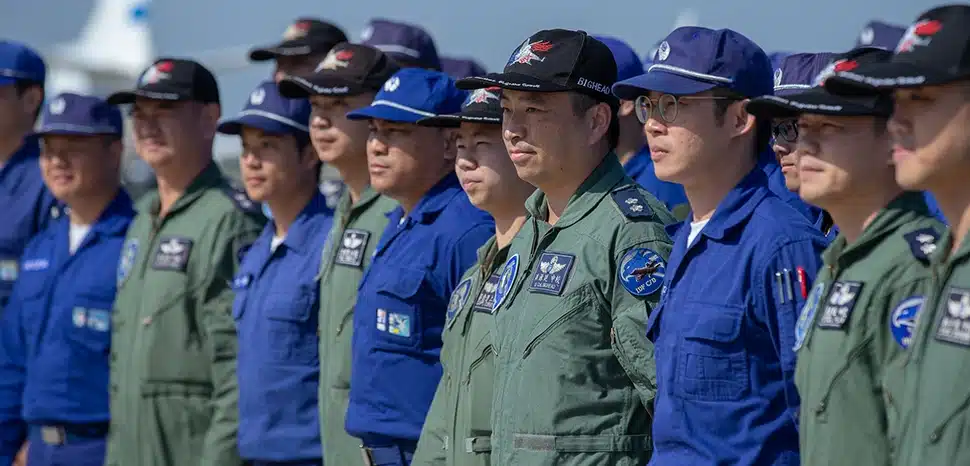
Still, without the U.S, these efforts may not be enough. Japan relies heavily on US security guarantees, with 53,000 US troops stationed in the archipelago – primarily in Okinawa – along with 24,000 in South Korea and 6,000 on Guam. Militarily, Taiwan lags China in nearly every category and could not withstand a full-scale invasion alone, despite once holding a technological edge. While an invasion is not imminent, with some experts warning of a window around 2027, Taiwan defense posture remains fragile in the present context.
For this reason, Taiwan has increased its defense spending, committing to invest at least 3% of its GDP, while the government continues to emphasize the critical role of the United States in Taipei’s deterrence strategy. In an interview with the NY Times, Taiwan’s Minister of Defense stated: “If we can make Beijing understand that the potential costs of a conflict would be extremely high, then it will be difficult for them to make the decision to resort to war.” In fact, the entire Indo-Pacific region would suffer from a US withdrawal, as the vacuum left behind would inevitably be filled by increased Chinese investments – primarily in the form of unconditional loans – and by a significant decline in US power projection capabilities.
Trump’s handling of the Ukraine war, and his broader approach to foreign policy, offers little reassurance for Taiwan. Failed peace efforts, cozy relations with Moscow, and an unwillingness to take firm stances for Ukraine’s territorial integrity cast doubt on Washington’s reliability. Like other traditional allies, Taipei must now seek alternative defense strategies; not due to ideological drift, but because the United States appears increasingly unwilling to uphold the very order it once led.
The views expressed in this article belong to the authors alone and do not necessarily reflect those of Geopoliticalmonitor.com.