The early July trade agreement between the United States and Vietnam, reducing tariffs on Vietnamese imports from a staggering 46% to 20%, is more than a bilateral trade tweak. It marks a dramatic pivot in Washington’s strategic posture in Southeast Asia—one that cannot be fully understood without looking through the lens of China’s expanding regional and global influence.
For years, US–Vietnam trade relations were marked by a quiet, consistent trajectory: low tariffs, deepening supply chain integration, and steadily rising volumes. Until this spring, Vietnamese goods entered the US market with minimal barriers—typically just 3–4% in tariffs. That changed abruptly in April, when Washington announced a sweeping tariff schedule hiking duties on Vietnamese imports to an eyebrow-raising 46%, coinciding symbolically with Vietnam’s “Liberation Day.”
The message was ambiguous: Was this a punitive gesture? A negotiating tactic? Or something else entirely?
Now, just a few months later, Washington has reversed course, slashing that figure to 20%, while simultaneously imposing a stiff 40% tariff on goods coming from third countries—presumably to prevent transshipment through Vietnam. These are not routine recalibrations. They are signals—and the intended audience is Beijing.
While this new agreement seeks to effectively block China’s strategies for bypassing tariff barriers, it is designed to harm both Chinese companies operating in Vietnam—who will now face 20% tariffs—and Chinese goods rerouted through Vietnam to the U.S., which will face a 40% tariff under anti-circumvention measures. In other words, Washington is tightening the net around what has become a common backdoor tactic in the ongoing US–China trade war: masking Chinese origin through regional partners like Vietnam.
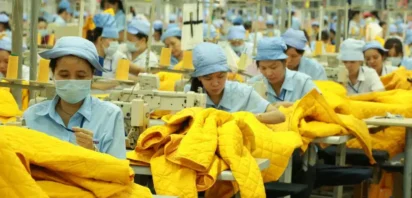
The true subtext of this trade agreement is geopolitical, not economic. Vietnam, once seen as a lower-tier trade partner, has become a crucial node in the global supply chain reshuffling triggered by US-China tensions. As US companies seek alternatives to Chinese manufacturing, Vietnam has emerged as a preferred destination. Its political stability, relatively low labor costs, and growing technical capabilities make it an attractive replacement for Chinese sourcing in sectors like electronics, textiles, and machinery.
But Vietnam is hedging its bets. In a parallel geopolitical signal, Hanoi has officially joined BRICS as a “partner country,” a new designation introduced under Brazil’s 2025 presidency of the bloc. While not a full member, Vietnam becomes the tenth nation to receive this status, granting it access to BRICS summits and other high-level discussions. Vietnamese Prime Minister Pham Minh Chinh attended the expanded BRICS Rio summit from July 6–7. His presence at the gathering—alongside leaders from BRICS’ now 11 full members including China, Russia, and India—highlights Vietnam’s effort to maintain strategic flexibility and deepen ties with multiple global power centers.
With the inclusion of partner countries like Vietnam, BRICS continues to broaden its footprint across Asia, Africa, and Latin America—complicating Washington’s calculus. As Hanoi draws closer to the U.S. on trade and security, it is simultaneously reinforcing ties with China and the Global South through BRICS. For US policymakers, this dual-track diplomacy is a reminder that Vietnam is not choosing sides—it is expanding its options.
Timing is everything in diplomacy, and the new US–Vietnam trade agreement appears carefully calibrated ahead of another significant moment: the anticipated visit of Communist Party Chief Tom Lam to the White House later this month. It would mark the latest in a series of high-level engagements reflecting a deepening US–Vietnam relationship, increasingly shaped by shared concerns about China’s assertiveness in the South China Sea and beyond.
However, the new agreement also reflects the uncertainty and complexity of modern trade policy. For Vietnamese officials, the tariff roller coaster—from ultra-low to ultra-high and now halfway back—raises concerns about reliability. For US importers, the 20% rate still represents a significant increase from pre-April levels, and raises questions about pricing, sourcing, and supply chain stability.
For both sides, the key question is how sustainable this “middle path” will be. Is the 20% rate a stable compromise or a temporary waypoint in a longer negotiation? And what happens if Vietnam is perceived as edging too close—or not close enough—to the US orbit? The fluidity of the moment makes it hard to read. This is trade policy as foreign policy, and it’s unfolding in real time.
In many ways, watching US–Vietnam relations today is like reading tea leaves. Every gesture is symbolic. Every policy shift carries subtext. The sharp reversal of the April tariff hike, the selective imposition of third-country duties, Hanoi’s deeper BRICS engagement, and the orchestration of To Lam’s visit all point to one truth: Vietnam is no longer just a trade partner. It is a strategic pivot point in a much larger game.
James Borton is a non-resident senior fellow at Johns Hopkins Strategic Advanced International Studies Foreign Policy Institute and the author of Harvesting the Waves: How Blue Parks Shape Policy, Politics, and Peacebuilding in the South China Sea.
The views expressed in this article belong to the author(s) alone and do not necessarily reflect those of Geopoliticalmonitor.com.