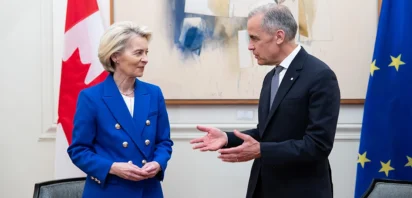
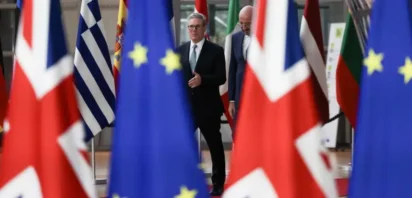
On June 23, the European Union and Canada signed a landmark security and defense cooperation pact in Brussels. Hailed as a “historic step” by both sides, the agreement covers a wide array of strategic priorities: cyber and space security, arms control, defense procurement, crisis response, and stronger support for Ukraine. While the agreement has rightly received praise as a practical step forward in transatlantic cooperation, its broader significance is underappreciated.
This pact represents a quiet but deliberate recalibration of the Western security architecture away from a US-anchored model toward a more distributed, multipolar strategic order. It suggests that key US allies are no longer content to rely solely on Washington’s leadership in an era of global volatility and internal American ambivalence. Instead, they are proactively building alternative partnerships that embed resilience, diversify defense dependencies, and modernize how the West collectively manages geopolitical risk.
Beyond NATO: Strategic Hedge or Complementary Layer?
One of the most striking aspects of the EU–Canada agreement is that it is distinct from NATO, even as it reinforces many of the alliance’s goals. NATO remains the bedrock of transatlantic defense, but its internal politics have grown increasingly fractious. Divergences over burden-sharing, ambiguous US commitments, and different threat perceptions have led some allies to seek additional platforms for cooperation.
For Canada, the rationale is clear. According to Prime Minister Mark Carney, 75% of Canada’s defense procurement spending is currently directed toward US manufacturers. In an era of increasing global instability and political unpredictability in Washington, Canada seeks to diversify both its defense partnerships and its supply chains. In practical terms, this agreement could open new channels for joint procurement, R&D, and military-industrial collaboration with European defense firms.
For the EU, the pact strengthens its evolving ambition for strategic autonomy. While full independence from NATO or the U.S. remains politically unfeasible and strategically undesirable for most member states, the EU is moving toward greater defense capability and cohesion. Initiatives such as the SAFE (Security and Arms for Europe) program, the European Defense Fund, and now the pact with Canada illustrate a bloc seeking not to supplant NATO, but to supplement it with a more autonomous European pillar.
A Multipolar West: Rethinking the Post-WWII Security Template
The agreement also reflects a deeper transition in the international system. The post-WWII security order was defined by a unipolar West, anchored by US hegemony. That model is now eroding. Great power rivalry, hybrid warfare, and technological disruption have revealed the limits of centralized leadership in managing contemporary threats.
Instead, what is emerging is a multipolar West, a networked alliance system with multiple centers of gravity. Canada’s deepening ties with the EU exemplify this. So does the recently expanded EU–Japan defense dialogue, the Franco-British defense renewal, and Australia’s parallel pivot toward defense ties with France and Germany. The result is not fragmentation, but diversification, a pragmatic adjustment to a world in which the U.S. cannot, and will not, carry the burden alone.
Implications for US Leadership and Global Norms
The EU–Canada pact does not signal a rejection of the United States. Rather, it reflects a growing recognition that American reliability can no longer be assumed. The Trump administration’s skepticism of alliances is forcing many Western partners to think beyond legacy structures.
For Washington, this shift presents both a challenge and an opportunity. On one hand, it may dilute US influence over the coordination of defense priorities. On the other, it could strengthen the West as a whole by building capacity, spreading risk, and enhancing resilience. US policymakers would be wise to interpret this development not as a rebuke, but as a reinforcement.
Moreover, this new pact underscores the shared commitment between Europe and Canada to defend the rules-based international order. Explicit references to Ukraine, the Indo-Pacific, arms control, and cyber norms indicate a unified front against authoritarian revisionism. In this sense, the pact represents not only a strategic alignment but also a normative reaffirmation.
Economic and Technological Dimensions
The agreement also reflects the growing convergence of economic and security policy. Defense is no longer just about tanks and troops, it is about technology, standards, and industrial resilience. In an era where cybersecurity, AI, and space are central to national security, collaborative innovation is essential.
Crucially, Canada and the EU have agreed to pursue a joint digital standards agreement, ensuring compatibility across key domains such as 5G infrastructure, AI regulation, and critical technology supply chains. This effort signals an emerging tech alliance, one that could become a powerful counterweight to both Chinese and US digital ecosystems.
Still, obstacles remain. Canada continues to face trade barriers within the EU due to the incomplete ratification of CETA. Ten EU member states have yet to approve the agreement, limiting Canadian firms’ access to European defense contracts. Until these issues are resolved, the full potential of this new security partnership will remain constrained.
Recommendations for Strategic Consolidation
To ensure the EU–Canada pact delivers lasting value, both parties should strategically consolidate efforts across key areas. Establishing a joint EU–Canada security council would institutionalize coordination, align priorities, and enable annual evaluations of strategic progress. Deepening industrial integration through harmonized defense procurement standards and co-development of next-generation technologies would strengthen mutual capabilities. Expanding digital cooperation by finalizing and implementing a shared digital standards pact is essential to ensure interoperability in emerging security domains. Additionally, addressing trade barriers by pushing for full ratification of CETA across all EU member states would unlock reciprocal market access and foster defense-sector investment. Finally, enhancing public communication is vital, both sides must clearly articulate the benefits of the partnership to domestic audiences to build enduring political support.
Looking Ahead
The EU–Canada security agreement is more than a diplomatic milestone; it is a strategic signal. It illustrates how Western allies are adapting to a less predictable world by creating new partnerships, diversifying their defense strategies, and strengthening their capacity to act independently and cooperatively.
As the global balance of power continues to shift, the transatlantic community must evolve in kind. Canada and the EU are showing what that evolution looks like, not by abandoning traditional alliances, but by complementing and modernizing them. If implemented effectively, this pact could become a model for 21st-century security cooperation – flexible, values-driven, and fit for a multipolar age.
The views expressed in this article belong to the author(s) alone and do not necessarily reflect those of Geopoliticalmonitor.com.