South China Sea Dispute Background
The South China Sea dispute is a complex and ongoing struggle to assert sovereignty over a strategic maritime region in Southeast Asia, involving China, Vietnam, the Philippines, Malaysia, Indonesia, and Brunei as claimants. Over the past 75 years, these claimants have vied for control over the region’s islands, reefs, and surrounding waters. At times this contest unfolded in diplomatic and legal forums like ASEAN and UNCLOS; however, more often – and most recently – hard power has become the lingua franca of the dispute, where claimants deploy irregular forces (coast guards, fishing fleets, maritime militias), hybrid warfare, and conventional navies to expand their presence and attempt to permanently alter the map of the South China Sea.
Why is the South China Sea important?
Control of the South China Sea brings economic, political, and strategic benefits. Nearly one third of all global trade passes through its waters every year. The region is also home to untapped energy reserves and rich fishing stocks that have sustained littoral populations for thousands of years. The militarization of islands and reefs establishes a forward military presence, of particular concern for China, which is otherwise hemmed in by US allies along the first island chain. And finally South China Sea claims are a point of nationalist pride for many of the littoral nations such that any setback real or perceived carries an element of political risk.
South China Sea Claimants
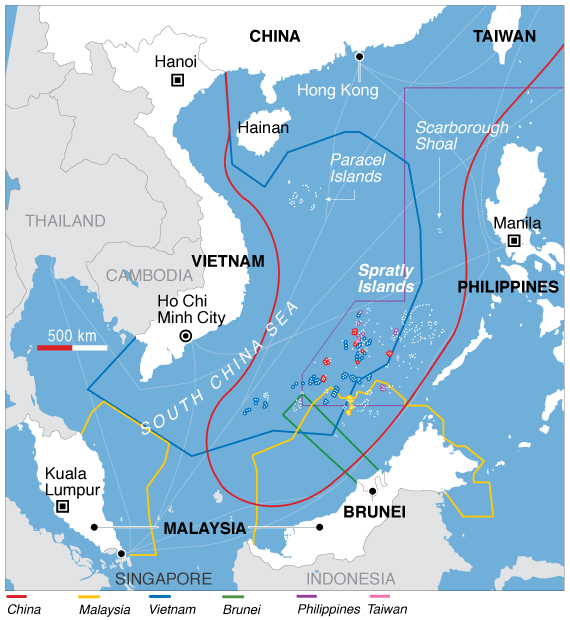
- China. Beijing advances the most assertive claims of any claimant in the South China Sea, encompassed by the so-called “nine-dash line,” encircling nearly 90% of the area and overlapping with the EEZs of several other states. China argues that the historical control exercised at different times by different dynasties translates into a modern legal basis for sovereignty. However, such claims are strongly disputed by some of China’s neighbors. They were also rejected outright by a 2016 ruling by the Permanent Court of Arbitration in The Hague. Despite the legal setback, China has continued to reinforce its position on the ground via military and civilian construction projects on various artificial islands and reefs, at times escalating geopolitical tensions with other South China Sea claimants. In doing so, Beijing has often leaned heavily on hybrid and gray zone warfare tactics to actualize sovereignty of the disputed waters, notably employing its maritime militia, merchant marine, and coast guard to drive opposing fishing and naval fleets back.
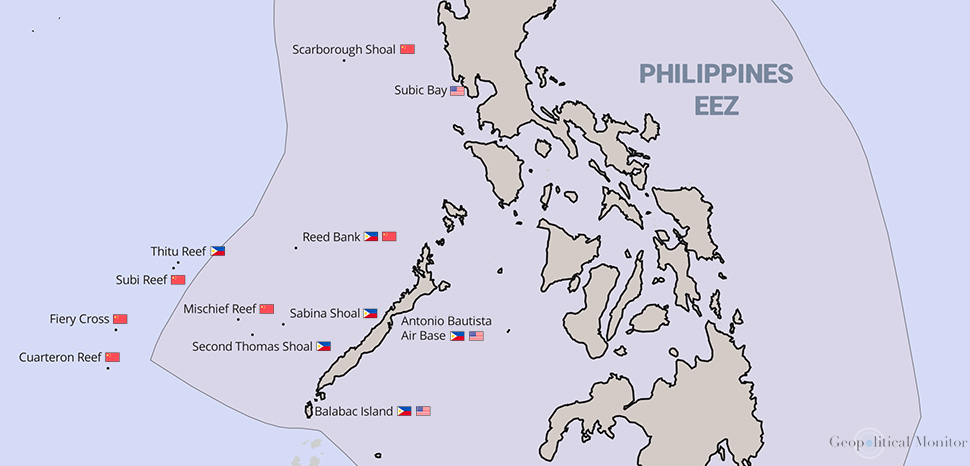
- Philippines. Manila is in many ways the frontline of the South China Sea dispute. It presides over a ‘hot’ and ongoing conflict against the PLA Navy and China’s irregular maritime forces, with features like the Scarborough Shoal, Second Thomas Shoal, and more recently the Sabina Shoal sites of frequent ‘gray zone’ clashes. The Philippines’ EEZ is home to some of China’s most ambitious claims given their geographic distance from the Chinese mainland. And this is the only instance of international law weighing in on the legality of South China Sea claims owing to a case brought against China at the Permanent Court of Arbitration in 2013. And finally, the fact that Manila is a treaty ally with the military backing of the US Navy adds significant weight to the conflict, increasing the geopolitical risk of any miscalculation or escalation.
- Vietnam. Hanoi’s role in the South China Sea dispute echoes thousands of years of fierce resistance to the military and cultural juggernaut to the north. It is marked by military conflicts – the 1974 Battle of the Paracels and 1988 Johnson Reef Skirmish – which helped draw the present-day map. But it’s also characterized by accommodative ‘bamboo diplomacy,’ which leverages improved relations with the U.S. to avoid domination by an ascendant naval power in China. A similar dualism is evident in Vietnam’s approach to advancing its territorial claim. On one hand it was an early supporter of negotiations under ASEAN and an advocate for a diplomatic solution. On the other, having learned bitter lessons from recent encounters with China’s naval power and hybrid warfare, Hanoi has been quietly expanding and fortifying its remaining holdings in the South China Sea to avoid a repeat of past defeats.
- Indonesia. The overlap between the China and Indonesia South China Sea may appear minor on a map, encompassing the northeast corner of the Natuna Sea, but the economic stakes are high given the resources involved. The waters in question contain no less than 16 oil and gas blocks. Eight of these blocks have a combined proven reserves of 47.2 trillion cubic feet of natural gas, and the East Natuna block in particular is thought to be one of the world’s largest untapped reserves of natural gas.
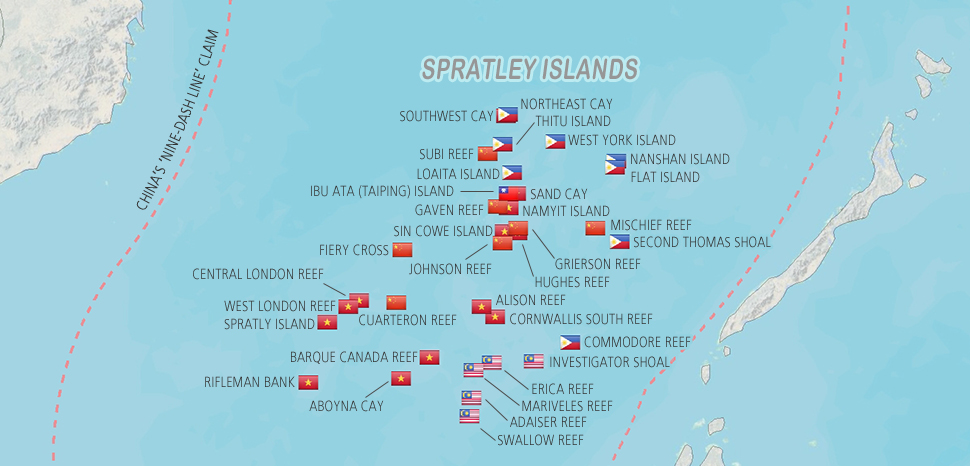
- Taiwan. Taiwan’s South China Sea claims run through the government’s historical legacy as the Republic of China. This has left Taipei in control of features that are both highly strategic, like Taiping/Ibu Ata Island, but also distant from the main island and therefore difficult to defend if ever contested.
- Malaysia and Brunei have smaller claims focused on areas near their coastlines, and while both have had disputes with China, they tend to pursue a more cautious diplomatic approach.
Geopolitical Stakes
The South China Sea dispute has sweeping geopolitical implications:
- Great Power Politics. As a key maritime route, the South China Sea is of keen interest to the United States, which does not want to see control pass to a competing power like China. Beijing on the other hand wants to push its defense line out from the coast and right up to the doorstep of the first island chain.
- Systemic Barometer. The region reflects the health of the global ‘rules-based order’ in a number of ways: its accessibility as either a globally navigable waterway or a ‘Chinese lake,’ the former interpretation being backed by freedom of navigation operations (FONOPS) by the US Navy and its allies; the relevance of international legal rulings based on UNCLOS, the global treaty tasked with regulating such disputes; and how the myriad of minor disputes stemming from the fishers and vessels of claimant states operating in close proximity are resolved (bilaterally, regionally in forums such as ASEAN, globally, or simply through force?).
- Conflict Flashpoints. Several flashpoints exist in the South China Sea that carry significant geopolitical risk in terms of potential escalation. One notable example is China’s gray zone tactics in the Philippines’ EEZ, where one accident or miscalculation could trigger the invocation of Manila’s mutual defense treaty with the United States. Another is the Taiwan-occupied Ibu Ata (Taiping) Island, where Beijing might decide to test the resolve of Taiwan and its allies by attempting to seize the island. But in a more holistic sense, the presence of two enemy navies operating in a restricted space always involves escalation risk, reflected in many close calls over the years.
Hybrid Warfare in South China Sea Dispute
The South China Sea theater was an early example of the kind of gray zone and hybrid warfare tactics that are increasingly commonplace in contemporary warfare, dating all the way back to the 1974 Battle of the Paracels. These successful irregular maneuvers have typically been employed by Beijing to establish a permanent presence in disputed waters and drive away counter claimants without triggering a conventional military response. The dual mantra is to go slow (‘slice the salami’ to change the status quo), and leverage unconventional military assets. Some notable examples of hybrid warfare tactics in the South China Sea include:
- Land Reclamation. Features are slowly expanded and fortified such that some now resemble military bases (Mischief Reef, Subi Reef, and Fiery Cross, for example). China has been prolific in its land reclamation activities since 2013, but Vietnam has also been rapidly expanding its holdings in the Spratlys since 2021.
- Militarized Coast Guard. China uses the largest coast guard cutter in the world to enforce its claims, outgunning the Philippines Navy as an ostensible policing vessel.
- Unconventional Maritime Forces. In addition to its militarized coast guard vessels, China can use its maritime militia and merchant marine to maintain a presence in contested waters.
- Non-Lethal Tactics. Chinese coast guard vessels employ a variety of non-lethal tactics designed to fall short of provoking an escalatory response. These include water cannons, lasers, rammings, and interdicting attempts to resupply opposing deployments.
- Operational Attrition. The PLA Navy and China’s irregular maritime forces are bigger, more numerous, and better resourced than rival claimants. This allows them to remain in contested zones when other navies need to rotate vessels out for repair; for example, the Philippines’ BRP Teresa Magbanua having to be pulled out of the waters around the Sabina Shoal after a ramming incident in 2024.





&BAP_Guise(CM-28).webp "Abukama class destroyers; cc MOD Japan, modified, https://en.wikipedia.org/wiki/File:JS_Abukuma%EF%BC%88DE-229%EF%BC%89%EF%BC%86BAP_Guise%EF%BC%88CM-28%EF%BC%89.jpg")