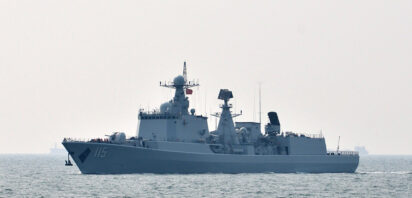
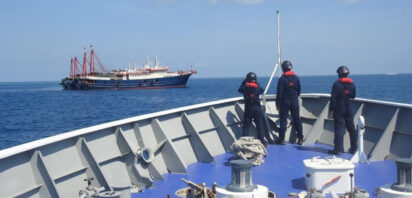
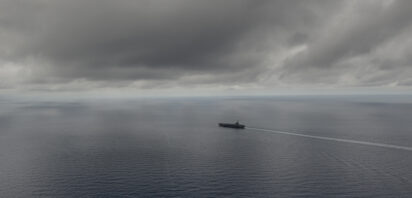
Somewhere in a quiet operations room in Beijing, on the morning of April 10, 2026, someone gave an order. It was not a dramatic order — no cameras, no press statement, no presidential declaration delivered to a live television audience. A 352-meter floating barrier was installed across the entrance to Scarborough Shoal in the South China Sea, accompanied by six maritime militia vessels inside the lagoon and three more positioned outside, sealing the entrance to what international law recognizes as a traditional Filipino fishing ground. The operation was completed in less than 24 hours. Then it paused.
Eight thousand miles away, in the situation room of a White House simultaneously managing a naval blockade of Iran, a fragile ceasefire in Lebanon, the aftershocks of an unprecedented military operation in Venezuela, and a domestic political calendar consuming its own oxygen, no one had much attention left for a floating rope in the Pacific.
That asymmetry — between the order quietly given and the attention not available to receive it — is not a coincidence of timing. It is the operating logic of a strategy built across decades, now visible in real time.
A Matter of Time
The contrast that analysts reach for instinctively is military: Chinese forces versus American forces, missile ranges versus carrier strike groups, gray zone tactics versus declarations of the rules-based order. This framing is not wrong, but it misses the more consequential difference, which is not about capability. It is about time.
The cowboy operates in crisis time. Every moment demands a response. The horizon is the next confrontation, the next headline, the next test of resolve that must be met before it becomes a precedent of weakness. In crisis time, the measure of power is the speed and force of reaction.
The engineer operates in project time. A floating barrier installed today is not today’s news. It is a data point in a construction sequence that began in 2012, when China first seized Scarborough Shoal in a standoff with Manila and never left, continued through 2023 when Beijing declared the shoal a national nature reserve — a legal instrument Philippine security officials immediately called “a pretext for occupation” — and proceeds now toward an endpoint that has never been publicly stated because it does not need to be. Engineers do not announce the building while it is under construction. They announce it when it is done.
The difference between these two temporal orientations is not a difference in intelligence or intention. It is a structural difference in how power is organized and how decisions are made. And it produces a systematic asymmetry that does not resolve itself through more military exercises, more carrier deployments, or more declarations of ironclad commitment.
Long-term Cause, Short-term Reaction
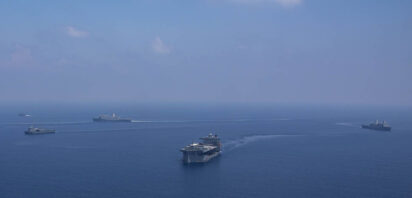
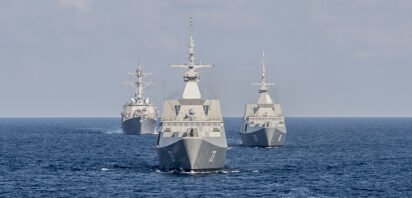
The US response to the Scarborough barrier arrived, as it reliably does, in the form of Balikatan 2026 — the largest iteration of the annual US-Philippines military exercise in its history. Seventeen thousand troops, seven nations, live-fire drills across air, land, sea, space, and cyber domains. Japan’s Self-Defense Forces participating for the first time with combat-capable units, deploying Type 88 surface-to-ship missiles in a maritime strike exercise — the first deployment of Japanese combat troops in the Philippines since the Second World War. Australia, Canada, France, and New Zealand alongside.
This is genuinely significant. The exercise is not theater. The operational integration it builds between US, Japanese, Australian, and Philippine forces represents a structural deepening of the alliance network that Beijing watches with real concern. When analysts from the International Crisis Group describe “rising regional anxiety about US defense commitment and capacity in the Indo-Pacific region,” they are describing the pressure that produced Balikatan’s expansion — a recognition, translated into military coordination, that Washington’s bandwidth cannot be taken for granted.
But here is what the exercise cannot solve. Balikatan begins on April 20 and runs until May 8. The floating barrier was installed on April 10. China removed it over the weekend — but the Philippine Navy says its patrols continue, and ten Chinese coast guard vessels were sighted at the shoal between April 5 and April 12. The barrier was a probe, not a permanent installation. Its purpose was not to hold the entrance indefinitely. Its purpose was to test, document, and normalize. Each probe extends the baseline of what counts as routine Chinese presence. The exercise responds to the probe. The probe is already the next step ahead of the exercise.
This is what project time looks like from the outside: you are always responding to what was done last week while the next step is already being prepared for next month.
Unwavering Intent, Unknown Capacity
The timing was not subtle. Diplomats monitoring the South China Sea said the drills and broader tensions were being closely watched “amid fears that China could take advantage of perceptions that the US is distracted by the Iran conflict.” The French Navy reduced its Balikatan involvement precisely because its vessels were needed closer to the Middle East. Washington’s Lt. General Christian Wortman went out of his way to insist that the exercises proved US focus in the Indo-Pacific remained “unwavering” — which is precisely what you say when you are aware that the question is being asked.
The question being asked, in capitals across Southeast Asia, is not whether the United States intends to honor its commitments. Intentions are not in doubt. The question is whether a state that operates with fragmented decision-making — whose military is pursuing one logic in Hormuz while its diplomatic envoys pursue another, whose domestic political cycle demands visible victories on a schedule incompatible with strategic patience — can serve as a reliable anchor for a regional security architecture that requires exactly the quality China is demonstrating: consistency across time. The author has analyzed this fragmentation in depth elsewhere, tracing how competing institutional logics within Washington produce outcomes none of its actors individually intended.
This is not a military problem. It is an institutional one. The network of alliances being built around the Philippines — Japan’s expanded role, the Reciprocal Access Agreement that came into force in September 2025, the deepening of multilateral coordination — represents a genuine structural response to Chinese pressure. But a network is only as coherent as its central node. And the central node is currently managing simultaneous crises across three theaters while undergoing a domestic institutional restructuring that has complicated the coordination mechanisms that once kept its various agencies speaking to each other.
A Security Architecture under Stress
The fourteenth-century Arab historian Ibn Khaldun would have recognized the pattern. An empire in the late phase of its cycle does not lose its military capacity first. It loses the binding coherence — what he called asabiyya — that converts capacity into coordinated strategy. The weapons remain. The alliances remain. The exercises remain. What erodes is the capacity to translate all of it into a single, durable posture that adversaries must calculate against across decades rather than news cycles. This dynamic, in the context of American imperial overreach, was examined in an earlier analysis covering the historical pattern from Manifest Destiny to Venezuela.
For the Western reader, this analysis might feel like a counsel of strategic despair — an argument to accept Chinese expansion as inevitable. It is not. The regional pushback is real, the alliance deepening is real, and China’s gray zone strategy carries its own costs. Beijing is accumulating legal violations, diplomatic friction, and regional resentment at a rate that its patient engineering has not fully accounted for. The 2016 Permanent Court of Arbitration ruling against China’s expansive claims has not been enforced — but it has not been forgotten.
But the Western reader who wants an honest account of this moment must sit with a structural question that is uncomfortable precisely because it resists resolution by the next electoral cycle: What does it mean to build a regional security architecture anchored to a power that operates in crisis time, against a competitor that operates in project time?
The architecture being built around the Philippines is impressive in its multilateral scope. Japan’s first combat participation in Balikatan is historically significant. The network of overlapping bilateral agreements is becoming something more than the sum of its parts. But a network of allies deepening coordination partly because they are anxious about Washington’s long-term bandwidth is also, by definition, a network that is hedging against the anchor it is built around.
That hedge may be wise. Distributed security architectures can be more resilient than hub-and-spoke systems dependent on a single guarantor. But the patient engineer in Beijing is watching that hedge develop and drawing his own conclusions. A network that hedges against its center is a network with a gap where its center used to be. And gaps, in project time, are opportunities waiting for the right moment.
The barrier across Scarborough Shoal was 352 meters long. The opportunity it was designed to probe is considerably larger. And the next probe is already being planned, quietly, in a room where no one is distracted.
Nayef Sha’aban is Research Director of the Applied Arab-Heritage Models Project at the Istiqlal Forum for Political and Strategic Studies — IFSS Damascus, and a Fellow at the Levant Centre for Studies and Research, London.
The views and opinions expressed in this article are those of the author alone and do not represent those of Geopoliticalmonitor.com