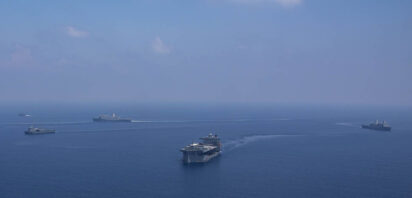
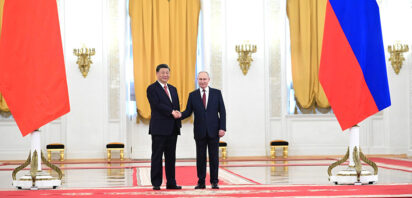
The South China Sea has long stood as the world’s premier case study in maritime gray-zone conflict. It is where sovereignty gets stretched, international law gets tested, and presence—not principle—determines control. For years, strategists analyzed the region for what it reveals about China’s ambitions, US deterrence, and the weakening of global norms. But the story of the South China Sea is no longer just about Asia. Its lessons now surface across the Western Hemisphere.
Latin America and the Caribbean, while rarely treated as maritime flashpoints, face sovereignty challenges paralleling those in Southeast Asia. They unfold not through missiles or standoffs but via offshore oil licenses in contested waters, industrial fishing fleets under flags of convenience, and infrastructure projects that blur the line between development and surveillance. From Guyana’s coast to Peru’s ports and Argentina’s space stations, the region faces a quiet test of resilience.
Five parallels stand out: contested maritime zones, dual-use infrastructure, fragile alliances, narrative power, and the rise of strategic ambiguity. Each reflects how power operates today—less through force, more through friction. The gray zone extends across oceans and narratives, reshaping the Americas.
Competing Maritime Sovereignties and Resource Control
China advances sweeping claims with harassment of foreign vessels, maritime militias, and symbolic gestures like naming underwater features. These do not necessarily spark war but steadily erode legal norms. A similar dynamic plays out in Latin America.
The clearest parallel lies off Guyana. Venezuela has claimed the Essequibo region for more than a century, but the dispute escalated after ExxonMobil’s 2015 oil discoveries offshore. By late 2023, Venezuela held a referendum to formalize its claim and issued exploration licenses in waters already contracted by Guyana. Though the International Court of Justice ruled Caracas cannot act unilaterally, the maneuver reflects the same “administrative assertion” China uses to normalize disputed claims.
Farther south, hundreds of industrial fishing vessels—many Chinese-flagged—operate in or just outside the exclusive economic zones of Ecuador, Peru, and Argentina. They target squid near the Galápagos in such volume that stocks strain, overwhelming local enforcement. Like China’s maritime militia, these ostensibly civilian fleets blur the line between commerce and coercion.
The lesson is clear: sovereignty requires presence. Latin American states, like their Southeast Asian counterparts, lack the capability to enforce norms at sea. Legal frameworks may be sound, but without enforcement, they amount to paper promises.
Infrastructure as Strategic Leverage
China did not just contest territory in the South China Sea—it built it. Artificial islands in the Spratlys, complete with airstrips and radar domes, shifted the balance without firing a shot. Civilian infrastructure masked military purpose, making confrontation diplomatically awkward. A version of this strategy now appears in Latin America, where foreign-backed projects carry strategic implications.
Chinese firms, backed by Belt and Road financing, have secured stakes in major regional ports. In Peru, COSCO’s new megaport at Chancay is described as a “gateway” for Chinese trade into South America. In Argentina, Chinese firms seek port access near Tierra del Fuego, close to the Drake Passage. Ostensibly commercial, these projects raise familiar questions about dual use.
Space facilities deepen the ambiguity. In Neuquén, Argentina, China operates a space tracking station that local lawmakers cannot inspect. Its design suggests potential surveillance applications. These developments echo South China Sea “fishing shelters” that quietly evolved into radar installations.
Latin American regulatory frameworks lag behind, leaving countries vulnerable to ownership and access arrangements with opaque oversight. As in Asia, the most consequential power shifts arrive not through confrontation, but through construction crews and contracts signed with little scrutiny.
Fragile Alliances and the “Ironclad” Illusion
Washington reassures allies with “ironclad” commitments, especially to the Philippines. Yet Southeast Asian states hedge, uncertain whether US promises will translate into action when harassment falls below the threshold of war. The same ambiguity appears in Latin America, where alliances are no less fragile.
Honduras illustrates the trend. In 2023, it cut ties with Taiwan and recognized Beijing, signaling doubts about Washington’s reliability. Despite decades of US-friendly relations, economic incentives from China tipped the balance. Washington protested, but too late.
Elsewhere, Brazil balances between Chinese investment, BRICS membership, and polite relations with Washington. The strategy resembles ASEAN hedging: diversify partnerships not out of preference but necessity.
In both regions, the core concern is reliability. Treaties or history matter less than consistency. Influence endures not through declarations but by showing up when it counts.
Who Owns the Map? Who Owns the Story?
Control of territory begins with control of narrative. In the South China Sea, China defends sweeping claims through maps and myths of civilizational return. The infamous nine-dash line rests on history more than law.
Latin America mirrors this narrative logic. Venezuela portrays its Essequibo claim as a patriotic mission rooted in Bolívar and colonial grievance. In 2023, President Nicolás Maduro unveiled a new map of Venezuela that included Essequibo, as if printing it made it real.
Mexico’s energy policy reflects another version. Former President Andrés Manuel López Obrador cast foreign investment limits as violations of national dignity, framing legal disputes as struggles over sovereignty.
Both regions show how narratives of grievance and destiny mobilize domestic support, justify noncompliance, and delegitimize outside pressure. International law struggles against stories of pride and injustice. The contest is not only over borders, but over truth itself.
Strategic Contests Without a Theater Curtain
Influence spreads most effectively when others hesitate. In Southeast Asia, US engagement oscillates, leaving gaps China fills with loans, schools, telecoms, and state media. Latin America shows the same pattern.
From Santiago to Port of Spain, Confucius Institutes teach Mandarin, Chinese broadcasters provide subsidized content, and Chinese-designed 5G networks shape communication. These acts of positioning embed influence in education, information, and governance.
Meanwhile, regional institutions like CELAC and Mercosur assert more independence, seeking space untethered to any one power. Latin America no longer behaves like a periphery. It builds its own center of gravity.
As the South China Sea shows, influence requires consistency, imagination, and persistence. The contest is not about dominance but saturation. The question is not “who rules?” but “who never left the room?”
Why This Matters
The parallels between the South China Sea and Latin America are not abstract. They point to an emerging reality in which sovereignty erodes quietly, not through open conflict but through presence, infrastructure, and narrative. If left unchecked, these gray-zone strategies could reshape Latin America’s political autonomy, weaken democratic resilience, and dilute US influence in its own hemisphere.
For regional governments, the danger lies in strategic dependencies that may take decades to unwind. For Washington, the risk is that hesitation today will cement conditions tomorrow that no amount of late engagement can reverse. And for the international system, the stakes involve more than disputed waters or port concessions—they involve the survival of norms that restrain power and protect smaller states.
What happens in Latin America will not remain regional. Gray-zone tactics practiced here will influence how power operates globally, setting precedents that stretch far beyond the Americas.
In both regions, sovereignty is less a legal status than a performance, maintained through presence and perception. Control requires staying power, not conquest. China has made this clear in the South China Sea, and its strategies now echo across the Americas.
To see the South China Sea clearly is to recognize it as an early warning. Its playbook has traveled—adapted and embedded in new contexts. The question for the Western Hemisphere is not whether confrontation looms, but whether erosion already underway can be recognized in time to matter.
The views expressed in this article belong to the author(s) alone and do not necessarily reflect those of Geopoliticalmonitor.com.