China’s People’s Liberation Army (PLA) is currently ranked as the third most powerful military in the world, behind only the United States and Russia. Its naval arm, the People’s Liberation Army Navy (PLA Navy), is actually larger than the US Navy, currently consisting of an active duty battle force of around 370 platforms. Moreover, that number is a likely underestimate since it does not include smaller-scale vessels that can be equipped with anti-ship cruise missiles (ASCMs) in a hypothetical conflict near Taiwan; for example, the Type 022 (Houbei Class) patrol boats that pose a credible risk to blue water platforms while not being able to traverse the open oceans themselves. Nor does it include the irregular forces that could be brought to bear in any conflict in China’s littoral waters, such as the People’s Armed Forces Maritime Militia (PAFMM).
How the PLA Navy continues to expand over the short- and medium-term is a matter of mounting concern for US policymakers and military strategists. China’s ongoing shipbuilding and force modernization programs expect to grow the PLA Navy to 395 ships by 2025, and 435 ships by 2030. In contrast, the US Navy was fielding 296 battle ships as of August 2024, and US efforts to catch up are complicated by the yawning gap in shipbuilding capacity between China and the United States. Just how big is this gap? According to a leaked US Navy briefing, China has a domestic shipbuilding capacity 232 times greater than the United States.
The PLA Navy may be winning in terms of quantity, but the US maintains a qualitative edge, albeit one that is rapidly diminishing over time. To quote an unclassified US naval intelligence briefing on China’s shipbuilding program in 2020: “Chinese naval ship design and material quality is in many cases comparable to [US Navy] ships, and China is quickly closing the gaps in any areas of deficiency.” There is some fog of war here in that the PLA Navy remains untested by actual combat with a peer adversary, and the opaque nature of China’s politics typically obscures any disclosure that might suggest the modernization program is not a rousing success, with some notable exceptions such as the reported sinking of a cutting-edge submarine while in dock in September 2024.
This backgrounder will break down the PLA Navy by vessel type, examining force structure, capabilities, new platforms, respective roles in China’s overall maritime strategy:
Aircraft Carriers

China currently possesses three aircraft carriers, the Liaoning, Shandong, and Fujian. These carriers, with their expansive flight decks, are central to the PLA Navy’s power projection capacity, enabling the launch and retrieval of fixed-wing aircraft and rotorcraft.
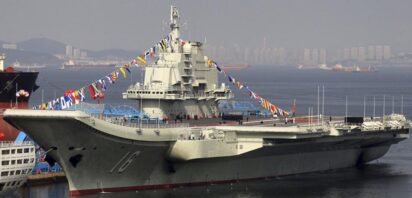
The PLA Navy’s first aircraft carrier was the Liaoning (Type 001). Commissioned in 2012, the Liaoning is a refitted Soviet Kuznetsov-class vessel. It serves mainly as a training and weapons testing platform, though it remains fully operational for combat.
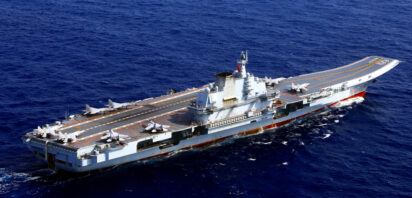
The Shandong (Type 002), commissioned in 2019, is China’s first domestically built carrier and is regarded as an improved version of the Liaoning, featuring more advanced systems. The ship weighs around 70,000 tons at full load and is both longer and heavier than the Liaoning. In a modification from the original Kuznetsov design, the Shandong swaps out missile launch capacity for a larger air wing, which consists mostly of Shenyang J-15s jets (an estimated 36), along with Changhe Z-18 and Harbin Z-9 helicopters. Neither the Shandong nor the Liaoning are equipped with a catapult, limiting the potential loadouts of their air wings.
The most recent addition to the PLA Navy is the Fujian (Type 003), launched in 2022, which represents a significant leap in capability with its flat-top design and electromagnetic catapults, representing an advance on the steam-powered catapults used in most US carriers. The Fujian is believed to weigh in at around 80,000-85,000 pounds at full capacity, making it the largest conventionally powered carrier in the world. Its large flight deck and catapult allow for a larger and more advanced air wing, which was revealed in 2025 to include Shenyang J-15Ts (modified for catapult takeoff and recovery), Shenyang J-35s (the PLA’s fifth-generation stealth fighter), and notably the Xian KJ-600 airborne early warning (AEW) aircraft. The KJ-600, which only made its maiden flight in 2020, will greatly extends the radar horizon of the carrier group and coordinate protection from incoming threats.
Concerns have recently been raised about certain aspects of the Fujian’s design, which limit the carrier’s aircraft launch rate compared to US carriers. These include having only two launch catapults (the USS Ford has four); an island placement that limits deck space; and aircraft elevators that are too forward placed. All issues trace back to the Fujian’s conventional propulsion and will presumably be addressed in future, nuclear-powered models. They could also be remnants of a shift from steam-powered to electromagnetic catapults, which reportedly happened midway through the design process. The Fujian’s electromagnetic catapults were widely celebrated as evidence that the PLA was closing the qualitative gap with the US Navy. Incidentally, the catapults have since become a political issue in the United States, with President Trump frequently calling for a return to steam catapults and hydraulic elevators due to reliability issues that plague the new Ford-class systems.
A fourth PLA Navy aircraft carrier is currently under construction. Early satellite photos suggest that the new carrier will be larger than even the US Navy’s Ford Class, with space for an air wing of up to 100. It is also believed to be the first Chinese model to feature nuclear propulsion; however, there are indications that significant technical challenges have yet to be solved. Looking ahead, there are plans to field a total of 5-6 carriers by the 2030s.
China’s aircraft carriers differ from their US counterparts in that they are designed to operate exclusively under the protective “bubble” created by China’s anti-access/area-denial (A2/AD) systems, particularly within the first island chain. These A2/AD systems intend to restrict the US Navy from entering key areas, allowing China’s carriers to function in a more localized context, supporting power projection closer to home. The carriers, therefore, are not the core of China’s fleet but rather play a supporting role within a broader defensive strategy aimed at controlling regional waters and limiting US naval reach. The strategy strikes a contrast to that of the United States, which employs carriers as the central plank of a blue water projection capacity.