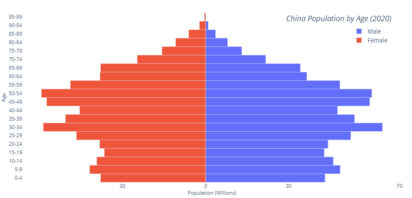
China’s demographic decline is a tale long foretold by the country’s aging population, low birthrate, lack of outside immigration, and the legacy of the one-child policy. But it wasn’t meant to happen quite so soon.
The results of the latest Chinese census are expected to show that the national population has dipped under 1.4 billion, below the 2019 total. The inflection point came seven years ahead of the schedule previously laid out by UN projections, which saw a peak in 2027. It even caught policymakers in China by surprise: the 2016 five-year plan originally foresaw a 2020 population of 1.42 billion, up on an expected birth bump following the relaxation of the one-child policy. China’s population was 1.38 billion in 2015.
The decline marks the advent of a demographic trend that will continue reverberate through China’s economy – and society – for decades to come.
Analysis
From an economic standpoint, declines in absolute population mean fewer new workers to replace the old ones who are retiring and becoming dependent on state and/or family assistance. This dynamic – amplified by the tendency of retirees to live ever-longer lives– is nothing new, and has been witnessed in other advanced economies, particularly in the West, for decades.
However, there is an important distinction to be made when comparing China to Western countries: immigration policy. Western countries can make up for demographic shortfalls at home by increasing their immigration quotas; China, in its present social-political context, cannot. This is how a country like Canada can maintain a growing population despite an abysmal birth rate of 1.47 births per woman (down from 3.94 in 1959). Thus, China’s demographic outlook is treated as cause for concern, despite a birth rate that’s relatively higher than many other demographically ‘healthy’ advanced economies.
What exactly is that birth rate? Like many sensitive data points, the picture is somewhat muddied. The official rate is 1.8, but this was contravened by a report from the People’s Bank of China last week that put the rate close to 1.5. In a rare candid appraisal from PRC officialdom, the report concluded: “The challenges brought about by China’s demographic shift could be bigger [than expected].”
China’s working-age population already peaked in absolute terms in 2012, and since then it has ceded ground proportionally to retirees. By some estimates, the country will shed some 35 million workers over the next five years as the total number of citizens eligible for retirement reaches an eye-boggling 300 million. By 2050, up to a third of the population is expected to be over the age of 60.
A dwindling pool of workers will impact the competitiveness of Chinese exports, as labor shortages inevitably give way to increased wages, and this may further amplify the trend of multinationals offshoring China-based manufacturing due to the geopolitical risk of US-China tensions.
Low-cost migrant labor was one of the pillars of China’s economic miracle and, incidentally, another pillar – easy access to foreign technology – is also being chipped away at in US government-led attempts to halt forced technology transfers.