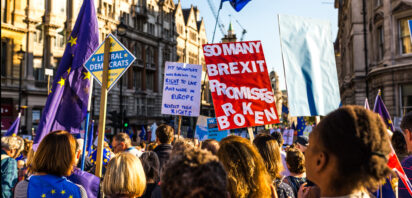
Elections for the European Parliament will be taking place between May 23-26.
Over three days, voters will elect 751 representatives across 27 countries, including 73 seats for the United Kingdom. The original plan was to reduce the total number of Members of European Parliament (MEPs) to 705 and redistribute 27 of the UK’s seats to other EU countries. However, since the UK’s future status in the EU is yet unresolved, the election is scheduled to go ahead under the original make-up of 751 seats. When (if) the United Kingdom leaves the EU, the total will be reduced to 705.
Elected MEPs are aligned with a political group – ideological blocs that contain a minimum of 25 MEPs representing at least a quarter of EU states. Prominent political groups from the previous parliament include the European People’s Party (EPP), which is broadly center-right, and the Progressive Alliance of Socialists and Democrats (S&D), which is center-left. The EPP and the S&D were the largest groups in the previous parliament with 217 and 189 seats respectively. They were followed by the European Conservatives and Reformists (ECR), a eurosceptic group with 74 seats, and the Alliance of Liberals and Democrats for Europe (ALDE), a liberal group with 68 seats.
Political groups in the European Parliament are in constant flux, with the top three groups in the previous parliament only having been established in 2009. Yet as an institution, the parliament has always been dominated by a coalition of pro-Europe parties that lean toward the center of the political spectrum.
With populist upheavals playing out in countries across the continent, this precedent could be tested in the upcoming election.
The composition of the European Parliament might also determine the presidency of the European Commission. Under the spitzenkandidate (‘lead candidate’) system, this is exactly what’s supposed to happen: the political groups put forth their preferred candidate, and the candidate of the largest group is approved by the European Council (the heads of the EU governments) and becomes the Commission president. However, a February summit between all 27 EU leaders agreed that the 2019 selection process won’t necessarily be bound by the spitzenkandidate system. Herein lies one of EU’s central institutional fault lines: whether the Commission president should be selected by the popularly elected EU Parliament, or the national heads of government.