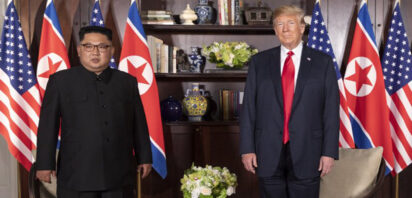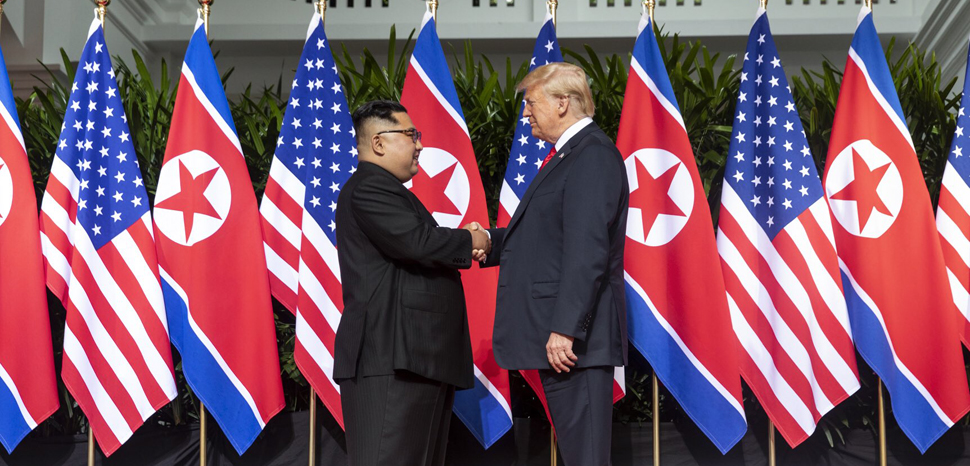
During his recent State of the Union speech, Trump confirmed longstanding rumors that a second US-DPRK summit is in the works. It even has a firm date locked in: Trump and Kim will be meeting from February 27-28 in Vietnam.
The announcement comes amid the usual mixed signals regarding North Korea’s intentions. On one hand, US negotiator Stephen Biegun announced that the North had pledged to destroy all its nuclear enrichment facilities. On the other, the National Intelligence director Dan Coats recently testified to the Senate that the North leadership is “unlikely to give up” its stockpiles or production capacity as the regime equates them with its own survival.
Though President Trump subsequently tweeted that his own intelligence community was naïve and should “go back to school,” the Coats assessment is the standard orthodoxy regarding the North Korean nuclear issue, and dismal progress toward denuclearization since the first Trump-Kim summit has only reinforced this view.
Here’s what we can expect from the second Trump-Kim summit:
Impact
First, a quick recap: nothing terribly significant has happened since the first summit in June 2018.
The June agreement contained one concrete concession: the decommissioning of the Dongchang-ri missile testing facility at Sohae on the west coast. The dismantling began in July 2018, halted in August, and then took tentative steps toward being reversed in November, when the installation of advanced ventilation equipment suggested new tunneling activity at the site.
Even those accommodating enough to call Sohae a shutdown would have to admit that it could be reversed at any time.
Then came the confidence-building measure of an invitation for inspectors to visit the “decommissioned” nuclear testing site at Punggye-ri. However, the move was widely dismissed as empty diplomatic theater. Not only is the site already well-known to the international community, but intelligence sources believe the last nuclear test there in September 2017 rendered the mountain structurally unstable, ruling the site out for any future nuclear testing.
Now as we approach a second summit, a sense of hope is building on the wings of the North’s pledge to destroy its nuclear enrichment facilities. However, now as in the past, these pledges must be taken with a grain of salt. In nuclear negotiations, it’s not the vague end goal that’s important (remember that all NPT parties have pledged themselves to an eventual nuclear-free world), but the concrete timeline for realizing said goal. In the context of North Korea, this timeline raises a few intractable questions: How long will it take to shutdown these facilities? Will it be verifiable and irreversible? And perhaps most importantly: Are there secret facilities that the US government doesn’t know about?