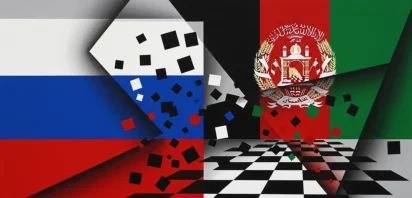
Afghanistan is known as the graveyard of empires for a reason.
Occupying prime geopolitical real estate as a land bridge between Europe and Asia, the country has figured into continental trade routes for as long as humans have been trading. This geography is still highly relevant today, evident in the regional trade schemes lining up to incorporate Afghanistan: China’s Belt and Road (BRI), India’s North-South Transport Corridor (NSTC), and the Lapis Lazuli corridor to name a few.
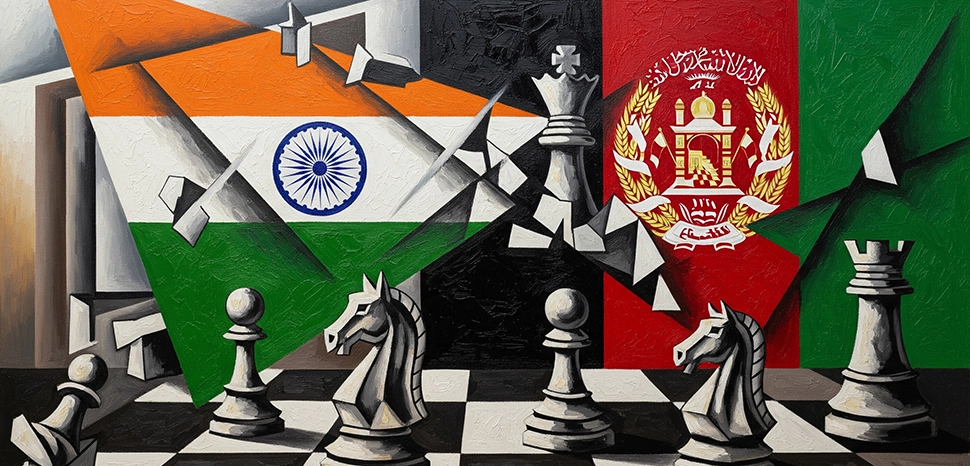
Now that the United States is heading for the exits, Afghanistan will once again become a coveted piece on the geopolitical chessboard of regional heavyweights. This series will examine their goals and motivations. It continues with India, a country that bet big on Afghan reconstruction only to be broadsided by recent Taliban talks with the United States.
Background
India’s Interests in Afghanistan
India is looking flex its muscles as a regional and eventually global power, and Afghanistan is a natural place to start.
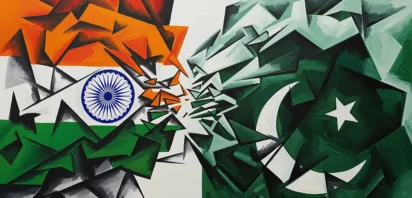
In terms of security, Afghanistan is a critical arena in which India-Pakistan competition plays out (this is explored in further depth in the article focusing on Pakistan). By invoking the possibility – however slim – of a two-front war for Pakistan, an India-friendly government in Kabul provides strategic leverage to New Delhi. It also decreases the likelihood of jihad groups being nurtured in the AfPak borderlands to eventually infiltrate and attack India-administered Kashmir.
The longstanding desire of the Pakistan security establishment to foster “strategic depth” in Afghanistan is well-known at this point. Less so are the consequences for Pakistan’s support for the Taliban and other militant groups in wider Afghan society. Generally speaking – and stressing the general since nothing resembling advanced polling exists in the country – Afghans maintain a favorable view of the Indian government, which they see as extending financial support with fewer strings attached than Pakistan. Where Afghanistan’s bilateral relations with Pakistan are fraught with border tensions, ethnic rivalries, and a proto-colonial one-sided trade dynamic, relations with India are more agreeable given the absence of any serious disputes.
India’s generous assistance program has helped fuel these positive perceptions. India is Afghanistan’s biggest donor, having given over $3 billion so far. Indian money has financed a long list of reconstruction projects, including the Doshe and Chrikar power plants, new power transmission lines, the Salma dam, civilian and security training programs, and a new parliament building, just to name a few. This generosity on the part of New Delhi isn’t strictly altruistic. A stable and prosperous Afghanistan would benefit the International North-South Transport Corridor, India’s own Asia-Europe regional trade initiative and answer to Belt and Road. Afghanistan is already a member of NSTC and New Delhi has invested heavily in new infrastructure connecting Afghanistan to Iran’s Chabahar port. Most importantly, India financed the Delaram–Zaranj two-lane highway connecting Afghanistan’s ring road with a highway system ending at Chabahar port in Iran; the Afghan leg opened in 2009. The new highway allowed for Afghan trade to be routed through Chabahar, much to the detriment of Pakistan, which previously profited from its monopoly on the Afghan market. India is now building a $1.6 billion rail link between Chabahar and Zahedan at the Iran-Afghanistan border, with plans for more extensions of the rail network in the future.
New infrastructure between Chabahar and Afghanistan is already diverting trade flows away from Pakistan. By one estimate, 80% of Afghan cargo traffic has shifted from Karachi to the Chabahar and Bandar Abbas ports in Iran. The diversion is reflecting in trade volumes: in the July-December period last year, Pakistani exports dropped over 17.5%. Imports from Afghanistan dropped 22% over the same period.
Finally, there are broader political considerations behind India’s engagement with Afghanistan. Located in India’s immediate neighborhood, the country represents a natural partner. That New Delhi would seek to carve out an economic, and perhaps eventually even security role for itself in the post-NATO order is to be expected given India’s rise as a regional power. Much like how China has become more assertive in its dealings with ASEAN countries and in the South China Sea dispute, India is also throwing its weight around in its geopolitical backyard, albeit to a much lesser extent. Afghanistan has become emblematic of this newly assertive foreign policy posture, with debates in domestic politics often revolving around the question of whether the profligate aid expenditures is money well spent.
Will the Taliban Gamble Come Back to Haunt New Delhi?
Much like the United States, India shunned the Taliban in the period following the 2001 invasion. But whereas Washington can shift gears and rehabilitate the militant group to save face before an abrupt exit, New Delhi has to maintain high-level engagement with a government that could soon include a sizable Taliban contingent – and that’s the best-case scenario. In the worst-case scenario, Afghanistan descends into civil war, the Pakistan security establishment continues to nurture its militant proxies in the borderlands, and all of India’s best laid plans for regional trade vanish in a three-billion-dollar puff of smoke.
India may have ended up with some unreliable Afghan partners, as both could be gone in the very near future. The Trump administration, which is not below openly berating its Indian allies, is said to be planning a major troop withdrawal. A drawdown would spell the end of direct US involvement in the country. And though the civilian government has also been able to count on strong support from India, there are indications that it could be replaced by an interim caretaker government that includes Taliban representation, paving the way for a new constitution and elections. In one of many blows to the Ghani government of late, members of the Taliban and the Afghan opposition, including former President Hamid Karzai, are meeting in Moscow this week to discuss the future of Afghan politics – all without any official representation from the civilian government.
The Indian government has sent informal feelers to the Taliban, but it will continue to play a game of catch-up having spurned the militant group for over a decade.
New Delhi now faces an Afghan outlook that’s clouded with uncertainty. Reliable partners are few and far between, and even the political system they’ll be operating within is a giant unknown at this point. What is certain is that the security situation will deteriorate following the US withdrawal, and New Delhi lacks comparable proxies to Pakistan and a nearby capacity to leverage its own military assets. As a result, though India has considerable military, political, and economic interests in Afghanistan, it will be hard-pressed to protect them in the tumultuous post-NATO period.