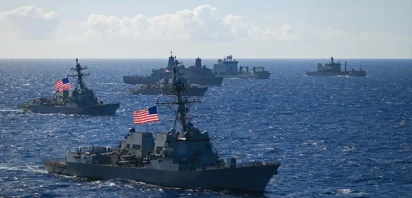
The US Navy has occupied a centerpiece in the Trump administration’s military aspirations. In December of 2025, President Trump announced a new fleet of US warships: the eponymous ‘Trump-class.’ Shortly thereafter, the Navy functioned as the linchpin of Operation Southern Spear, a vast maritime buildup which culminated in the sea-to-land capture of Venezuela’s President Maduro. Washington’s attention has since turned thousands of miles eastward, where the US Navy was, until recently, waging war against Iran. Dozens of warships and three aircraft carriers were engaged in this operation, with US forces having struck over 13,000 targets and sunk more than 60 Iranian vessels.
The US Navy has become a crucial instrument in how Washington projects military power. Yet US maritime ambitions face a crucial constraint, and one that will prove remarkably difficult to overcome – US shipbuilding capacity.
A Fleet in Freefall
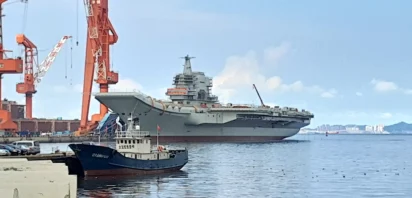
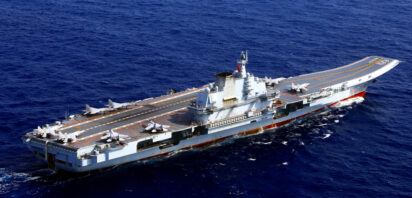
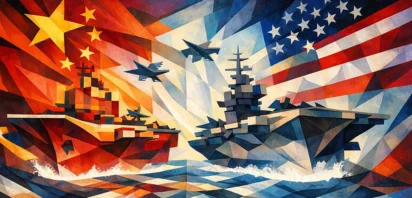
At its peak, the United States was responsible for producing nearly 90% of the world’s ships. Today, that number has fallen to less than 0.13%. China, by contrast, fulfills 71% of all global shipbuilding orders, producing over 232 times the tonnage of the United States. This manufacturing advantage has led to the People’s Liberation Army Navy (PLA Navy) overtaking the US Navy as the world’s largest maritime fighting force, boasting 234 warships to the US’ 219. By 2030, the PLA Navy is expected to harbor a colossal 435 vessels, a clear indicator that Chinese naval expansion has no plans of slowing.
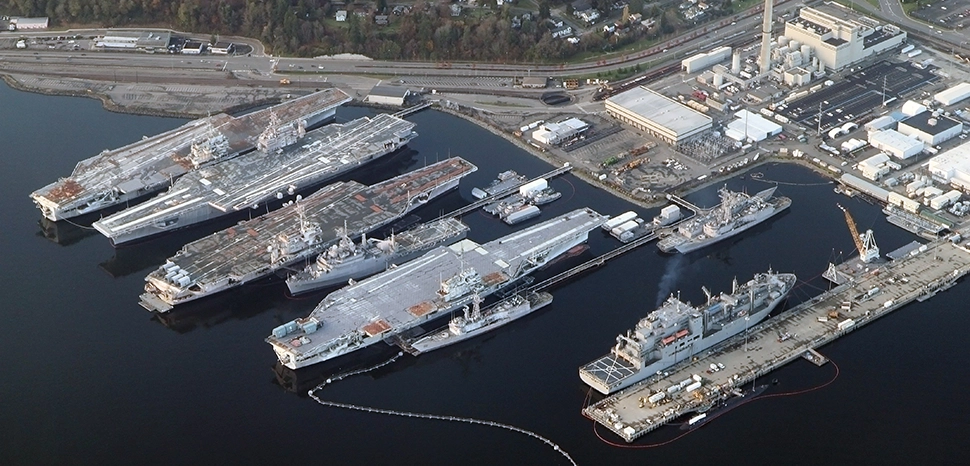
The United States seems to be moving in the opposite direction. Through 2025, the US Navy commissioned just two new ships whilst decommissioning 19, a net loss of 17 vessels. Fleet shrinkage is expected to continue over the next three years, with the Navy retiring 13 more ships than it commissions.
The trend is even more negative when capabilities are considered. The PLA Navy’s newest warship, the Type 055, carries 112 vertical missile cells, which are both larger and deeper than those on US destroyers. The US Navy’s newest Arleigh Burke Flight III carries just 96. The Type 055 also comes equipped with hypersonic missile capabilities through the YJ-21, an anti-ship missile capable of travelling up to Mach 5. The United States is yet to field this weapon class on any surface combatant, with at-sea hypersonic missile testing scheduled for 2027.
The Anti-Drone Deficit
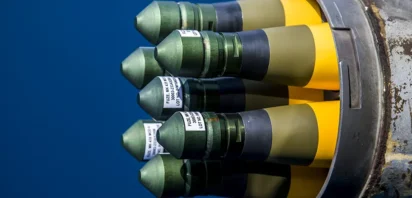
With the recent cessation of the Iran war, the US Navy gains a period of respite. This follows nearly two months of sustained operations in the Arabian Sea, in which the Navy’s anti-drone capabilities were exposed as woefully inadequate. US ships, lacking sufficient counter-UAV weaponry, were forced to fire multimillion-dollar missiles to counter cheaper drones. In just the first 16 days of the conflict, US ships expended over 400 SM-2, SM-3, and SM-6 naval interceptors against deluges of cheap Iranian drones and missiles, making for a brutal cost asymmetry of nearly 1,400 to one. An Iranian Shahed-136 kamikaze drone costs just $20,000 to produce, while the American interceptors fired to destroy it cost a anywhere from $2 million to $28 million each. Not only are these interactions financially unsustainable, but they exhaust vital missile stockpiles that could otherwise be used to counter more pressing threats.
Shipbuilding constitutes a vital part of this equation. Because the Navy is not able to produce ships quickly, it lacks the ability to rapidly adapt changes in naval technology. Instead, it relies on retrofitting old ships with anti-drone technology, a process that is as timely as it is expensive. Directed-energy systems such as the HELIOS laser have been deployed on only a handful of vessels, while the majority of the fleet continues to rely on costly missile-based defenses. Close-in weapon systems and electronic warfare suites offer some protection, but such systems were never intended to counter mass drone swarms at the scale deployed in recent conflicts.
Another drawback of retrofitting is that modern ships lack the electrical capacity to support high-energy laser weaponry. A 2021 report by the United States Naval Sea Systems Command found that “directed energy weapons and next-generation sensor systems require more robust hotel power and energy systems to meet new demands.”
A navy capable of rapidly constructing new vessels would be able to account for this increased electricity demand, producing ships at a pace commensurate with evolving threats. Newer vessels could be produced from the keel up for the realities of drone warfare, instead of relying on palliative measures that fail to address the underlying deficiencies in American shipbuilding.
China, which harbors a far more robust shipbuilding apparatus, is able to quickly construct ships with the necessary technology and defensive capabilities required for modern naval warfare. The People’s Republic has developed a ‘Great Wall’ of counter UAV measures, designed to protect its naval assets. Although many specifications are not publicly available, analysts suspect that China’s newest vessels come equipped with the “electrical power generation, cooling capacity, and internal volume” necessary for high power anti-air weaponry. More importantly, China’s vast shipbuilding capacity enables these capabilities to be integrated into new construction far more rapidly than the US’ retrofit-dependent approach. From the outset, Chinese ships will have adequate protection against drone swarms, ensuring they don’t fall victim to the same pernicious cost asymmetry as the United States.
Not Ready for Modern War
Perhaps the most worrisome consequence of the US shipbuilding discrepancy is that in the event of a protracted conflict, the United States may not be able to keep up. During World War 2, the United States demonstrated an almost unparalleled capacity for industrial mobilization, producing over 1,000 warships between 1941 and 1945. This included 18 fleet carriers and hundreds of destroyer escorts. Such an explosive surge was enabled by a deep pool of skilled labor and a wartime manufacturing base that could quickly pivot between commercial and military production.
Neither of those conditions exist today. Modern warships are exponentially more complex than their mid-century predecessors; they require advanced electronics, better propulsion systems, various types of armaments, and most chiefly, far more money. A modern destroyer takes roughly five to seven years to move from contract to commissioning. A submarine takes even longer. Granted, the government will surely look to expedite this process come wartime. But even under the most optimistic assumptions about industrial mobilization, the United States could not meaningfully compress those timelines within the window of a fast-moving conflict. Today, the US houses only 8 military shipyards, a far cry from the nearly 58 of 1945. Even if the United States wished to build more vessels, they would first have to construct shipyards capable of building them.
Consequently, the calculus of attrition is sobering. In a protracted conflict with a near-peer adversary, the United States would almost certainly lose ships faster than it could replace them. Even in relative peacetime, its naval fleet is consistently deteriorating; when compounded by enemy-inflicted losses, the shrinkage would prove disastrous. Wargames run by the Center of Strategic and International Studies found that in a hypothetical Chinese invasion of Taiwan, the United States would lose between 7 and 20 surface warships. At current replacement rates, those surface warships would take years, if not decades, to replace. Even in those hypotheticals where China lost more ships comparatively, the PLA Navy was able to continue a contentious naval battle. China’s vast fleet affords it the ability to simply absorb losses and continue fighting unabated. In order for the United States to enjoy a similar advantage, much work remains to be done.
Military power ultimately rests not only on the strength of a nation’s armed forces, but also on the capacity of its industrial base to replenish them. If the United States wishes to maintain its naval advantage, it must do so by building – and building fast. If not, any protracted conflict against a peer adversary risks putting the US Navy in dire straits.