Canada Military News & Analysis

New Submarines, No Mission: The Doctrine Gap Behind Canada’s Procurement Debate
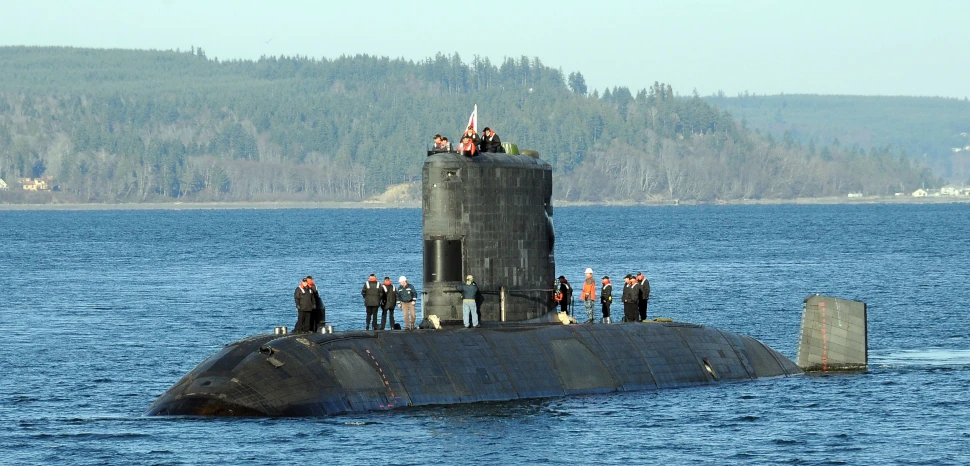
BANGOR, Wash. (Dec. 12, 2011) The Royal Canadian Navy long-range patrol submarine HMCS Victoria (SSK 876) arrives at Naval Base Kitsap-Bangor for a port call and routine maintenance. The visit is Victoria's first to Bangor since 2004. (U.S. Navy photo by Lt. Ed Early/Released) / https://commons.wikimedia.org/wiki/File:US_Navy_111212-N-GU530-103_The_Royal_Canadian_Navy_long-range_patrol_submarine_HMCS_Victoria_%28SSK_876%29_arrives_at_Naval_Base_Kitsap-Bangor_for_a_po.jpg

As it looks to replace Canada’s aging fleet of Victoria-class submarines, Ottawa must answer doctrinal questions before committing to a supplier. If not, the blanks will be ultimately filled in by operational constraints that delineate RCN capacity for decades to come.

A Gatekeeper in Washington: The Limits to Canada’s EU Defense Pivot

cc Ahunt, modified, A wooden mock-up of the Lockheed Martin F-35 Lightning II in Canadian Forces markings at the Classic Air Rallye, Canada Aviation and Space Museum, Rockcliffe Airport, Ottawa Ontario, Canada - https://commons.wikimedia.org/wiki/File:Lockheed_Martin_F-35_Lightning_II_mock-up_04.JPG

After decades of near total dependence on the United States, Canada is now looking to Brussels to diversify its defense relationships. But decades of supply chain and regulatory integration with the US defense industry will limit what’s achievable in the short-term.

Capability Gaps and Uneven Implementation: Canada’s Indo-Pacific Strategy

PORT ANGELES, Wash. -- The Canadian Coast Guard hovercraft Siyay demonstrates its capabilities off the coast of Washington Aug. 23, 2009 as part of the North Pacific Coast Guard Forum. Canada, Japan, Russia, and the United States sent ships to take part in the Forum, while two members of the forum, China and South Korea, participated as observers. The partner nations conducted simulated search and rescue, aids to navigation, law enforcement and security operations during the three-day event. U.S. Coast Guard photo by Petty Officer 3rd Class Cory J. Mendenhall. VIRIN = 090823-G-#####-001 - https://commons.wikimedia.org/wiki/File:Canadian_Coast_Guard_hovercraft_Siyay_-_090823-G-------001.jpg

Canada is present in the Indo-Pacific, but its engagement lacks the policy and material discipline required to shape outcomes. The costs of this approach will only increase as China consolidates its influence in the region.

Win-Win for Defense Industry? Canada Joins EU SAFE Instrument

On 23 June 2025, Ursula von der Leyen, President of the European Commission, participates to the 20th EU-Canada Summit, alongside António Costa, President of the European Council, and Mark Carney, Canadian Prime Minister., modified, https://commons.wikimedia.org/wiki/File:Mark_Carney_at_the_20th_EU-Canada_Summit_-_2025_-_P067331-991490_%28cropped%29.jpg

The involvement of Canadian defense firms in EU’s SAFE instrument could serve as a genuine bridge between two defense industrial bases that have historically operated in separate ecosystems. But the path to Brussels is paved with grand plans that never came to fruition.

South Korean Sub Docks in Canada as Decision Looms on RCN Procurement

ROKS Dosan Ahn Changho class submarine, modified, https://commons.wikimedia.org/wiki/File:ROKS_Dosan_Ahn_Changho_class_submarine.png

A port visit at CFB Esquimalt by a Dosan Ahn Changho-class submarine is meant to demonstrate strategic and industrial benefits of the Hanhwa Ocean bid ahead of Ottawa’s final decision on who will supply the next generation of RCN submarines.

Canada Looks to Join Global Combat Air Program
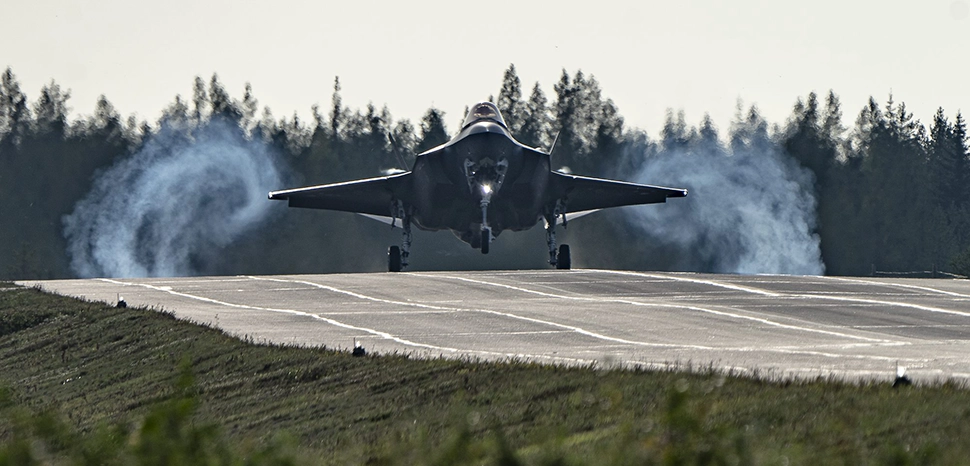
Canada is reportedly joining the Global Combat Air Program (GCAP) and seeking permanent observer status. The reported status was based on a meeting that took place on March 6 in Tokyo between Japanese Defense Minister Shinjiro Koizumi and Canadian Defense Minister David McGuinty. According to GCAP policy, observer status allows a nation “to obtain information from the three core countries to consider deeper involvement later, which could include manufacturing, procurement or even joining the development phase.” A meeting is planned for June 2026, involving defense ministers from Britain, Italy, and Japan, where an announcement on Canada’s inclusion as an observer is expected. Canada’s participation in GCAP would allow them to potentially procure and develop more advanced aircraft for the Royal Canadian Air Force (RCAF) in the likely case that the RCAF would pursue acquiring GCAP-based aircraft. Ottawa’s participation comes on the heels of tensions over security and trade between Canada and the United States, where a procurement review of Canada’s first batch of F-35A fighters has figured prominently. To this end, joining GCAP as an observer would allow Ottawa to expand its military and defense relations with Tokyo, London, and Rome, thus diversifying security relations while modernizing the RCAF. News of Canada’s planned observer status in GCAP did not come out of the blue. On March 13, Minister of National Defence David McGuinty said that Canada is considering fully joining GCAP when asked by reporters in Ottawa during a press conference. Back in January, Minister McGuinty and Japanese Ambassador to Canada Kanji Yamanouchi signed the Agreement between the Government of Japan and the Government of Canada Concerning the Transfer of Defense Equipment and Technology. The agreement serves as legal bilateral framework for transferring defense equipment and technology in order to “implement projects to be jointly determined, including those contributing to international peace and security.” In a Politico news report from December 2025, Canadian High Commissioner to London Ralph Goodale stated that Canada was trying to find ways to participate and contribute to the GCAP project. He also mentioned that Canada’s potential participation would not replace their planned acquisition of the F-35, but instead would represent a “progression.” Confidential information from the project will also be shared once Canada has been conferred with observer status. As far as Ottawa is concerned, the appeal is clear. Through the signing of agreements and diplomatic engagements, Canada can position itself to become deeply involved in next-generation defense initiatives while maintaining previous commitments to the F-35 program. Even if Canada joins GCAP without becoming a full partner, Canadian defense companies can benefit from the R&D aspect of the program, notably in aerospace engineering. This can even help Canadian companies that manufacture F-35 components, as there are similar economic and industrial benefits to be gained should they manufacture and sell GCAP fighter components for partner nations. In turn, this involvement creates opportunities for the Canadian defense industry to build its reputation over time. Moreover, even a limited presence from Canada can be of benefit to the overall program, as reduced airframe costs can benefit GCAP when GCAP fighters are manufactured and delivered. Lower costs increase the chances of GCAP realizing its full potential. Finally, membership in GCAP allows Canada to enhance interoperability status between the RCAF and allied air forces for joint operations in future conflicts. There are however concerns in Japan that adding new full partners like Canada risks dragging out program timelines. Japanese officials are already worried about GCAP meeting its current 2035 deadline for deploying its first jets. More members means more views that must be aligned regarding how the aircraft should operate. Whatever the ultimate extent of involvement in the program, Canada’s engagement with GCAP represents a strategic step toward diversifying security partners and modernizing the RCAF. It signals new momentum toward replacing the RCAF’s fleet of CF-18s with modern sixth-generation fighter jets amid shifting geopolitical dynamics. In addition, it advances domestic Canadian fighter development and strengthens security ties with Japan, the UK, and Italy, creating new opportunities for the defense industry without jeopardizing previous commitments to acquire the F-35. When Canada is given observer status, it will likely serve as both a test of long-term defense priorities and a signal of intent to play a more active role in next-generation military collaboration.

Canada’s reported engagement with the Global Combat Air Program (GCAP) would strike a balance between developing domestic defense industries while keeping F-35 procurement intact.

Diego Garcia Was the Warning Shot Canada Cannot Afford to Ignore

DIEGO GARCIA, British Indian Ocean Territory (Dec. 10, 2013) - U.S. Air Force KC-10A Extenders and C-17 Globemaster III aircraft sit on the airfield aboard U.S. Navy Support Facility (NAVSUPPFAC) Diego Garcia Dec. 10, 2013. NAVSUPPFAC provides logistic support to multi-theater forces operating in multiple areas of responsibility in support of Operation Enduring Freedom and overseas contingency operations. (U.S. Navy photo by Mass Communication Specialist 3rd Class Caine Storino) / https://www.flickr.com/photos/us7thfleet/11918116503

The takeaway from Diego Garcia is not that the strike was a failure; rather, it’s that existing defenses are now being tested by increasingly capable systems. Canada must take note and adapt.

Geopolitics Weekly (Trump and Venezuela, Syria Assassinations, China’s Treasury Dump)

GeopoliticsWeeklyHeader

This week we examine Trump’s embrace of the Chavista regime in Venezuela, reports of multiple assassination attempts targeting President al-Shaara in Syria, Beijing’s accelerating efforts to offload US debt, and new indications in Europe and Canada of a fundamental realignment in global defense industries.

Carney Moves to Overhaul a Moribund Canadian Military
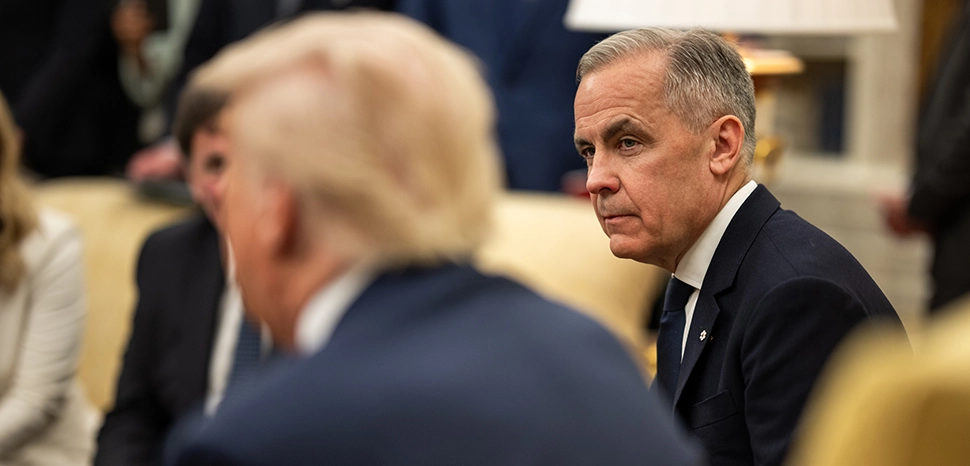
: President Donald Trump meets with Canadian Prime Minister Mark Carney, Tuesday, May 6, 2025, in the Oval Office. (Official White House Photo by Daniel Torok) / https://commons.wikimedia.org/wiki/File:President_Donald_Trump_meets_with_Canadian_Prime_Minister_Mark_Carney_in_the_Oval_Office_%2854501166867%29.jpg

In his efforts to overhaul the Canadian military, Prime Minister Carney must thread the needle between strategic autonomy and political reality, all while carefully avoiding backlash from Washington.

Canada-EU Security and Defence Partnership: Toward Canadian Strategic Autonomy

English: On 17 and 18 may 2025, Ursula von der Leyen, President of the European Commission, had several meetings in Rome, around the solemn Ceremony of the Inauguration of the Pontificate of Her Highness Pope Leo XIV in Vatican City on 18 May. / cc European Communities, modified, https://commons.wikimedia.org/wiki/File:Ursula_von_der_Leyen_with_Mark_Carney.jpg

The Canada-EU Security and Defence Partnership may not represent a systemic shift, but it’s an important step toward correcting the strategic imbalance that has left Ottawa (and Brussels) vulnerable to coercion by Washington.

Canada Should Withdraw from the Conventions on Land Mines and Cluster Munitions

When only one side abides by global norms, national interests are put at risk. The global environment has shifted, and it’s time for Canada to adapt.

EU–Canada Pact: A Quiet Reshaping of the Western Strategic Order

On 17 and 18 may 2025, Ursula von der Leyen, President of the European Commission, had several meetings in Rome, around the solemn Ceremony of the Inauguration of the Pontificate of Her Highness Pope Leo XIV in Vatican City on 18 May. / cc European Communities, modified, https://en.m.wikipedia.org/wiki/File:Ursula_von_der_Leyen_and_Mark_Carney.jpg

The recent EU–Canada pact is more than a diplomatic milestone; it is a strategic signal. It illustrates how Western allies are adapting to a less predictable world by creating new partnerships, diversifying their defense strategies, and strengthening their capacity to act independently and cooperatively.

CAF: A Poor Man’s Army Sitting on a Mountain of Gold?

A Canadian Armed Forces member of the Royal Canadian Air Force’s 3 Canadian Space Division 7 Wing (Space) joins a multinational space operations team comprised of allies, partners and five U.S. service branches in support of Valiant Shield 2024 (VS24), June 10, 2024, at Joint Base Pearl Harbor-Hickam, Hawaii. Throughout Exercise VS24, U.S. Space Command will plan, execute, and integrate military space power into multi-domain operations. Exercises such as VS24 provide Indo-Pacific Command Joint Forces an opportunity to integrate with allies and partners to conduct precise, multi-axis, multi-domain effects that demonstrate the strength and versatility of the Joint Force. (U.S. Air Force photo by Tech. Sgt. John Linzmeier)

The paradox of the Canadian military is clear: it has resources but lacks the means to deploy them effectively.

CYBERCOM: Canada’s CAF Gets Serious About Cyber Defense

JOINT BASE PEARL HARBOR-HICKAM, Hawaii -- Canadian Armed Forces members teamed up with U.S. Airmen to work together with allies, partners and five U.S. service branches on the multinational space operations team in support of Valiant Shield 2024 (VS24), June 10, 2024, at Joint Base Pearl Harbor-Hickam, Hawaii. Throughout Exercise VS24, U.S. Space Command will plan, execute, and integrate military space power into multi-domain operations. Exercises such as VS24 provide Indo-Pacific Command Joint Forces an opportunity to integrate with allies and partners to conduct precise, multi-axis, multi-domain effects that demonstrate the strength and versatility of the Joint Force., https://www.pacaf.af.mil/News/US-Space-Forces-Indo-Pacific-News/Article/3806910/canada-joins-multinational-team-for-valiant-shield-24/

With the establishment of the Canadian Armed Forces Cyber Command (CYBERCOM), Canada joins eleven other global militaries with a cyber-based command.

Canada Expanding Its Role in Global Arms Trade
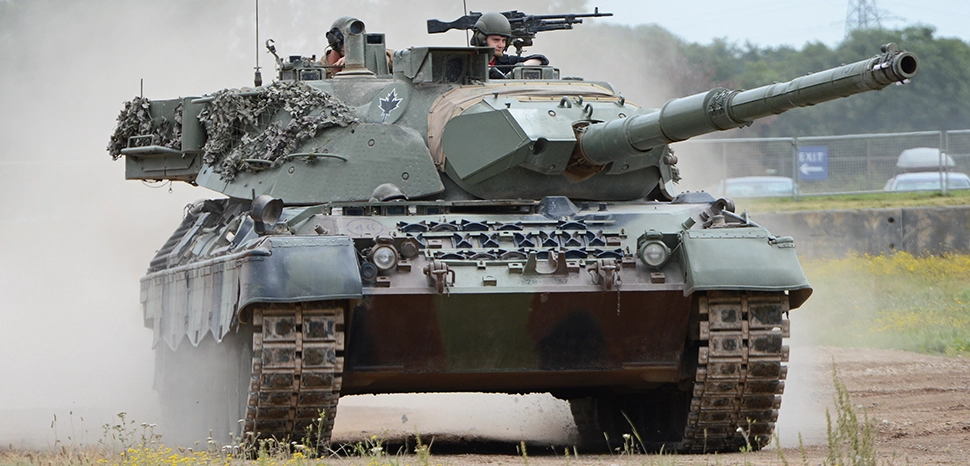
cc Alan Wilson from Stilton, Peterborough, Cambs, UK, modified, Leopard 1A5 Main Battle Tank. Chassis serial No 18016. Turret serial No 0020A. Canadian Army registration 78-85137. One of two donated to the museum directly from the Canadian Army. Seen during a demonstration at The Tank Museum, Bovington, Dorset, UK. / https://commons.wikimedia.org/wiki/File:Ex_Canadian_Leopard_C2_%E2%80%98137%E2%80%99_%2828712416021%29.jpg

Contrary to its own history of arms control, Canada is becoming a major player in the global arms market.

Canadian Military Still Suffering a Capabilities Gap

Canada military abstract, Generated by Google Gemini on July 31, 2025.

Not a lot has changed in terms of Canadian military capabilities despite several years of Conservative rule.

Arctic Geopolitics: State Interests and Claims

Generated by Google Gemini on July 25, 2025.

Rising global temperatures and melting Arctic ice are changing the geopolitical reality in the far north. In the span of a decade, the Arctic has gone from being considered a ‘global common’ to a hotly contested economic goldmine

Canada’s Role in NATO Operation in Afghanistan
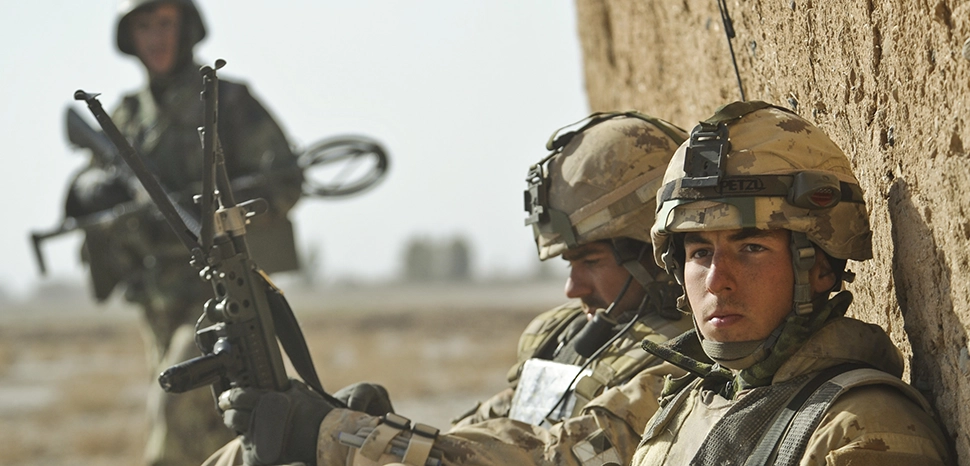
cc ISAF, modified, https://commons.wikimedia.org/wiki/File:Canadian_and_Afghan_National_Army_soldiers_patrol_in_Badula_Qulp_during_Operation_Moshtarak.jpg

Canada’s combat role in Afghanistan will almost certainly end in a little over two years, if not sooner, due to a convergence of recent events.

More Canada Military Articles