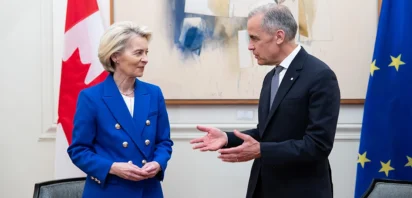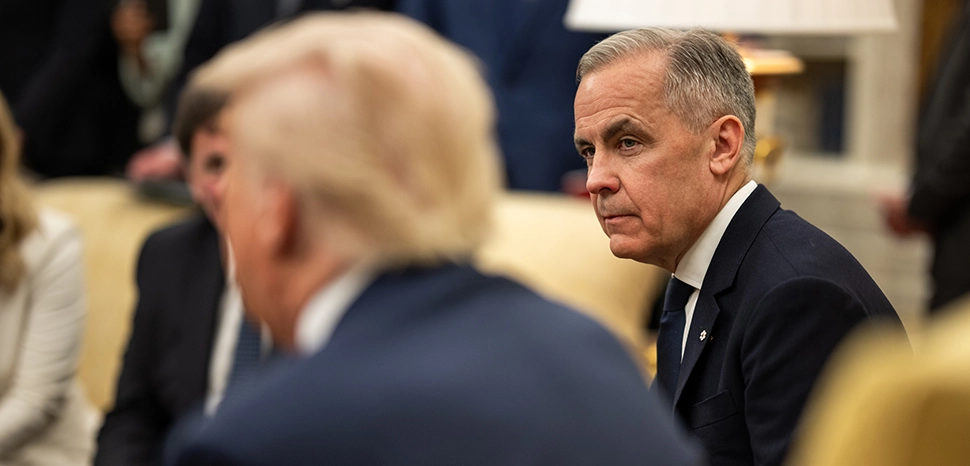
Since taking office in Aprile 2025, Prime Minister Mark Carney has faced two intertwined defense challenges:
- Closing the investment gap by raising Canada’s historically low military spending
- Reducing dependency on the United States, whose Trump administration has taken an openly adversarial stance toward Canada
Canada’s Surging Defense Spending
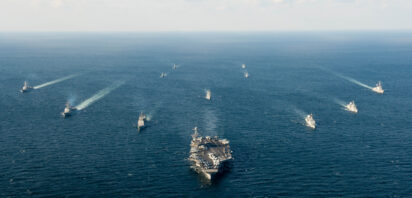
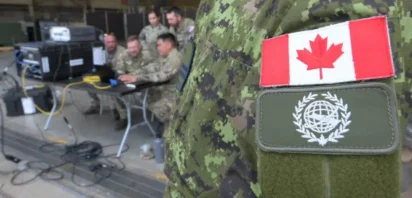
In June 2025, Ottawa unveiled a sweeping defense investment plan aimed at modernizing the Canadian Armed Forces (CAF) and strengthening domestic industrial capacity. The program includes better pay and benefits to improve recruitment and retention, purchase of new aircraft and armored vehicles, investments in Arctic monitoring, and drone capabilities.
Canada’s short-term target is to reach 2% of GDP in defense spending by the end of 2025. Although still below the 3.5% benchmark set at the NATO summit in The Hague, it represents a decisive break with Ottawa’s traditional underinvestment. In fact, for decades Canada ranked near the bottom of NATO members, committing just 1.4% of GDP in 2024. If this posture could have been tolerated during the post-Cold War unipolar moment, today, due to the rapid evolution of the global security landscape, it is no longer sustainable. Prime Minister Carney has framed the increase not as an accounting adjustment but as a strategic realignment. The 2025/26 plan includes over CA$9 billion in expenditure, while the long-term goal is to reach 5% of GDP by 2035, equivalent to CA$150 billion annually.
Weighing the Political Costs
Carney’s pledge was reiterated during the June 2025 visit to Warsaw, where he met with Polish Prime Minister Donald Tusk. Poland, allocating 4.7% of GDP to defense, is NATO’s top spender in terms of GDP. Carney openly praised Warsaw’s rearmament and showed his ambition to follow a similar path. Yet achieving such results will demand political resolve, and there are important ways in which the Canadian and Polish cases diverge. For one, as Ambassador Catherine Godin emphasized, the two countries face different geographies and threat perceptions. Poland shares over 400 kilometers of border with Belarus and lives under the shadow of Russia’s Kaliningrad exclave. These realities have been pushing Warsaw, especially after the 2022 invasion of Ukraine, to elevate defense spending, often taking precedence over fields such as healthcare, education, and social reforms. Importantly, Polish public opinion mostly aligns with the strategy.