When US President Donald Trump described a pending arms package to Taiwan as a “negotiating chip” at his May 2026 summit with Xi Jinping in Beijing, Taiwan’s security establishment reacted with alarm. The reaction is understandable, but anyone who has followed this relationship closely would have recognized something familiar in what Trump said.
Since 1979, US arms transfers to Taiwan have operated on a principle his predecessors preferred not to state in public: provide enough to complicate a Chinese assault but manage the relationship with Beijing carefully enough that Taiwan remains dependent on Washington’s continued support.
The Legislative Yuan’s passage of a NT$780 billion special defense budget in May 2026, historically large but stripped of all domestic production, co-production, and joint R&D funding, is the latest expression of how thoroughly that dependence has taken hold; it is now shaping Taiwan’s own procurement decisions as much as it shapes Washington’s.
The Framework That Shapes Everything
The Taiwan Relations Act (TRA) of 1979 remains the foundation. Statutory rather than treaty-based, it obliges the United States to make available defense articles and services “in such quantity as may be necessary to enable Taiwan to maintain a sufficient self-defense capability.” The key words are “sufficient” and “capability.” Neither demands optimal systems, platform-for-platform parity, nor guaranteed intervention. The TRA set a floor, not a ceiling. Every administration since Carter has chosen where to operate within those bounds.
The 1982 US-China Joint Communiqué and the Six Assurances further defined the practice. The Communiqué set a notional qualitative ceiling on sales, linked to Beijing’s peaceful approach. Successive administrations maintained the standard, even as PLA exercises, gray-zone tactics, and Xi’s directive that the PLA be ready by 2027 made it hard to credit. The Six Assurances barred prior consultation with Beijing on arms sales. They said nothing about factoring in Beijing’s likely reactions when approving systems, pacing deliveries, or setting qualitative levels. Every withheld platform and delayed shipment across 47 years reflects that practical distinction.
Presidential disposition, more than legal text, has always determined the real policy. Reagan’s 1982 classified memo conditioned restraint on China’s behavior while projecting unconditional commitment in public. Trump’s Beijing remark simply made the same conditionality explicit and public. The calculation itself has barely changed. What shifted is the willingness to state it openly, stripping away the ambiguity that once made the arrangement tolerable for all sides.
Sufficient but Not Optimal: Four Decades of Deliberate Constraint
Across four decades, US arms policy has delivered enough to raise invasion costs, but never enough for strategic self-sufficiency. It worked through two channels: withholding cutting-edge systems and supplying aging platforms, often with long delivery lags that turned approvals into paper deterrence.
The Carter and Reagan administrations established the pattern. The systems sent to Taiwan, F-5E/F fighters, Hawk surface-to-air missiles, and TOW anti-tank weapons, were already aging at the time of delivery. The F-5E/F was a 1960s design being withdrawn from front-line US Air Force service, and the Hawk dated to the late 1950s.
Against a PLA still flying Soviet-derived J-6 and J-7 fighters, they held the line. Taiwan was receiving yesterday’s aircraft against an adversary only beginning to modernize, and the gap was, for the moment, manageable.
The aircraft Washington declined to sell tell a different but related story. F-16C/D variants entered US Air Force service in 1984 and would have given Taiwan a clear air combat edge over PLAAF J-6 and J-7 fleets for at least a decade. They were withheld. The 1982 Communiqué’s qualitative ceiling was the formal reason.
The more pressing consideration was that the Reagan administration needed Beijing as a counterweight to Moscow, and Taiwan’s procurement list was a variable in that calculation. When the Soviet Union collapsed in 1991, the rationale for that calculation vanished. The ceiling remained, held by institutional habit and Beijing’s continued pressure, long after the reason it existed had gone.
The Bush Sr. and Clinton years saw the largest arms sale of the relationship while exposing its inherent limits.
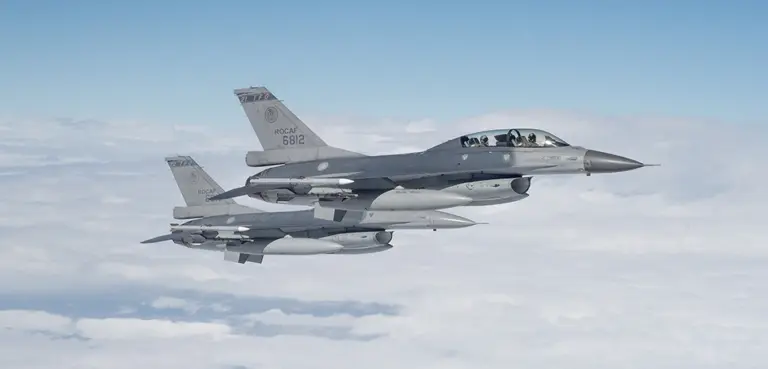
The 1991 Gulf War highlighted the PLA’s weaknesses in modern warfare. Concern over China’s acquisition of Russian Su-27 fighters helped drive President Bush’s 1992 approval of a US$6 billion package of 150 F-16A/B fighters, together with E-2T Hawkeye early warning aircraft and Patriot PAC-2 missiles. The sale strengthened Taiwan’s air capabilities and helped preserve stability during the 1995–96 Taiwan Strait crisis.
Yet the advantage proved short-lived. Taiwan had sought more advanced F-16C/D fighters but received older F-16A/Bs instead. As China fielded Su-30s, developed the J-10, and deployed beyond-visual-range missiles, Taiwan’s fleet increasingly fell behind. Aircraft considered adequate in 1992 were already showing their age by 2000. The US$8 billion F-16V upgrade approved in 2019 was, in many ways, the delayed cost of the compromise made in 1992.
The Bush Jr. and Obama years opened the widest gap in the relationship’s history.
As the PLA built out its anti-access and area-denial capabilities, ballistic missiles, a growing submarine fleet, fourth-generation fighters, and precision munitions in volume, Taiwan received P-3C Orion maritime patrol aircraft, decommissioned Kidd-class destroyers, and Patriot PAC-3 upgrades. The P-3C was a 1960s airframe approaching 40 years old at delivery. The Kidd-class ships were 1970s-era vessels removed from US Navy service, their radar and combat systems two generations behind the fleet’s current standard.
Against the PLA’s growing ballistic missile inventory, they offered little protection. These were not simply lesser alternatives to Aegis-equipped destroyers. They were ships nearing the end of their useful service life when they arrived.
The submarine question caused the greatest long-term setback. Although diesel submarines were approved under Bush Jr., none were delivered because of US industrial limits, political disputes, and the lack of a third-country supplier willing to risk Beijing’s retaliation. European shipbuilders largely stayed out of the Taiwan market, reflecting both Chinese pressure and limited US efforts to change that.
Taiwan has spent two decades since then developing its Indigenous Defense Submarine program, which has run into serious cost overruns and repeated delays. The deeper problem lies in the timing: submarines delivered in the early 2000s would have given Taiwan an undersea capability when PLA anti-submarine warfare was still relatively immature. Two decades later, that capability would face a far more sophisticated opponent.
Under Obama, slower arms notifications gave the PLA more time to modernize. By 2016, the cross-strait conventional military balance had shifted in China’s favor for the first time since the TRA took effect. Since 2016, US policy changed. Rather than matching the PLA platform for platform, Washington emphasized an asymmetric strategy built around mobile, survivable, and dispersed systems to make an invasion prohibitively costly.
The 2019 F-16V upgrades helped keep Taiwan’s air force credible. The US$11.1 billion package announced in December 2025 including precision rocket artillery, mobile howitzers, anti-armor weapons, and loitering munitions was better suited to Taiwan’s defense needs than most earlier sales. According to the CSIS “First Battle of the Next War” wargames, these capabilities could inflict heavy losses on PLA amphibious forces during the opening phase of an invasion.
Recurring Structural Failures
Whether that strategy holds depends on three conditions the current moment puts in doubt. They do not exist in isolation; each reinforces the others.
The delivery backlog is deep and longstanding. Since the 1990s, US industrial constraints, competing global demand, and the bureaucratic complexity of the Foreign Military Sales process have repeatedly delayed arms deliveries. In the past, systems simply arrived late. Today, some may arrive after the period in which they are most needed. Taiwan has paid for an estimated US$20–32 billion in undelivered weapons. If a crisis occurs around the PLA’s 2027 readiness target, much of that inventory could still be in production, contributing little to deterrence.
The asymmetric strategy deepens the problem. It assumes Taiwan can rapidly produce drones, stockpile munitions, and sustain combat through its own industrial base, despite decades of dependence on US weapons. A follow-on arms package, expected to include advanced air defense systems and other asymmetric capabilities, has also been delayed, leaving Taiwan’s NT$480 billion procurement budget without corresponding purchases.
Taiwan’s dependence on a single supplier reflects both US policy and limited alternatives. From 2019 to 2023, about 99 percent of Taiwan’s major conventional arms came from the United States. Four decades of tightly managed procurement left few backup options. When Washington delayed the next package during US-China negotiations in May 2026, Taiwan discovered how constrained its choices had become.
The legislative cycle magnifies all of these problems. Between 2004 and 2007, the KMT-controlled Legislative Yuan blocked the Chen Shui-bian administration’s special defense budget more than fifty times, and the submarine program was abandoned. The same political deadlock reappeared in May 2026. Taiwan has spent ten of the past twenty-six years under divided government.
The May 2026 Budget: Historical Pattern, Contemporary Expression
The pattern is driven less by bad faith than by the realities of coalition politics.
The NT$780 billion special defense budget passed on May 8, 2026 runs along every pattern this piece has traced. It authorizes NT$300 billion for the December 2025 US arms package and NT$480 billion for a future package not yet announced. The first annual installment of NT$8.81 billion cleared the legislature on May 29, two days before the HIMARS payment deadline.
Coming that close to a contract lapse says more about the obstruction cycle than any formal analysis could: months of legislative positioning over a budget that passed anyway nearly caused a procurement to lapse not over strategy but over politics.
What the bill cut matters as much as what it funded. The KMT-TPP majority removed every domestic procurement item: drone production, joint research and development, co-production arrangements, the T-Dome air defense system, the “Strong Bow” anti-ballistic missile program, ISR capabilities, and peacetime munitions expansion.
The KMT’s stated rationale, certification disputes and fiscal discipline, does not hold across the full list. Programs without active disputes and with modest price tags were cut alongside contested ones. Whatever drove each individual decision, the aggregate effect was to eliminate every route through which Taiwan might have begun reducing its reliance on US foreign military sales. At the moment that reliance is most visibly at risk, the budget deepened it.
The fracture within the KMT is worth noting. Chao Shao-kang observed publicly that the outcome was nearly identical to the NT$800 billion he had proposed and asked what the months of resistance had accomplished, adding that the party’s approach had played into the DPP narrative of the KMT being pro-China and anti-US. Whether that challenge gains traction will partly depend on what the November 2026 local elections return.
What the History Explains
The Six Assurances barred formal consultation with Beijing over arms sales, but not consideration of how Beijing might react to their scope, timing, or sophistication. In practice, Washington routinely made such calculations.
Trump’s “negotiating chip” remark was therefore less a policy shift than an unusually candid admission. Earlier administrations managed the same trade-off through limits on capability, delayed notifications, and diplomatic discretion. Trump simply said it openly.
Since 2016, Washington has urged Taiwan to adopt an asymmetric strategy built on domestic drone production, larger munitions stockpiles, and a stronger defense industry. Yet this sits uneasily with decades of policy that encouraged Taiwan to buy rather than build, and to depend rather than diversify. Taiwan now cannot deter effectively without the porcupine strategy, but the industrial base it requires remains underdeveloped, owing to setbacks such as the Indigenous Defense Submarine program and decades of institutionalized dependence.
Within months of approving the largest US arms package ever, its successor was paused as diplomatic leverage with Beijing, while Taiwan’s May 2026 budget cut domestic programs that could have reduced that dependence.
Taiwan’s predicament is not the result of one administration, one party, or one summit remark. It is the cumulative outcome of a security relationship that provided enough capability to avoid defeat, but rarely enough autonomy to reduce dependence. For nearly half a century, “sufficient” has been the guiding standard. As the PLA’s timeline accelerates, the question is whether sufficient still is enough.