Debates over China’s sixth-generation program in Western defense circles usually focus on timing and scale: who fields capability first, how production rates compare, and whether the US F-47 remains on track against Chinese progress. These are reasonable questions, but they are somewhat removed from the realities of a Western Pacific conflict.
Open-source assessments of the J-36 point to a different challenge. Rather than focusing solely on air combat, the aircraft appears designed to threaten the infrastructure that enables US air power across the Pacific.
It’s likely targets are tanker aircraft, airborne early warning platforms, and the networks that support long-range operations beyond the first island chain. Its exact capabilities remain uncertain, but the design seems intended to disrupt the system behind a US intervention rather than fight directly for control of Taiwan’s airspace.
That shifts the question. The United States will likely field aircraft comparable to China’s. The decisive factor may not be the aircraft, but the system behind them. If bases, satellites, and tanker fleets are disrupted, platform parity becomes far less important.
The Mechanism and Its Limits
Air denial over the Taiwan Strait is not primarily about destroying fighters. It is about disabling the systems that make air power possible: tanker aircraft, AWACS platforms, and the logistics networks that sustain operations beyond the first island chain.
If those enablers are degraded, even the most advanced fighters lose much of their effectiveness. The key deterrence question is therefore less about aircraft performance than about the resilience of the operational system behind them.
Three things shape whether allied intervention is possible, and all three receive less analysis than the aircraft numbers question.
Modern aircraft such as the F-47 and GCAP are not self-contained systems. They depend on a wider network of satellites, sensors, communications links, and data-sharing systems that must continue functioning during combat.
China has spent years developing capabilities designed to disrupt that network before a conflict even reaches the air. Its anti-satellite weapons, electronic warfare systems, and other counter-space capabilities are intended to weaken the information architecture on which Western airpower depends.
In that environment, an F-47 operating at long range with degraded satellite connectivity may hold little obvious advantage over a J-36 supported by intact ground-based networks.
The critical asymmetry is not between the aircraft themselves, but between the environments in which they operate. One is designed to fight as part of a highly connected network. The other may be fighting after that network has already been degraded. This is the problem that much of the deterrence debate continues to overlook.
Basing is the second problem. Andersen Air Force Base in Guam and Kadena in Okinawa are the principal operating locations for any serious US air campaign in a Taiwan conflict, and the PLA Rocket Force has been orienting against both installations for decades.
Sixth-generation aircraft require specialized maintenance infrastructure and controlled environments for stealth coating preservation that resist rapid dispersal to austere forward strips. The emerging US posture in the Philippines adds operational depth but also adds a third set of fixed installations to a targeting problem that has no clean solution.
The third constraint receives far less attention than it deserves. Taiwan’s air force operates ageing aircraft from a limited number of runways and air bases that the PLA Rocket Force has studied for decades. The island has only nine military air bases and a small number of civilian airports that could support military operations in an emergency.
Research modelling missile strikes under conservative assumptions, like using only systems already in China’s inventory, suggests many of Taiwan’s runways could be put out of action for the first two to three weeks of a conflict. An air force grounded at the outset of a war will struggle to shape events in the critical period that follows.
This is important because allied aircraft would not be arriving to reinforce an air force already in the fight. They would be entering a battlespace where much of Taiwan’s airpower had been suppressed before they arrived. That is not a peripheral concern. It is one of the defining conditions of any intervention scenario, yet much of the deterrence literature largely sidesteps it.
The Weight of Workshare
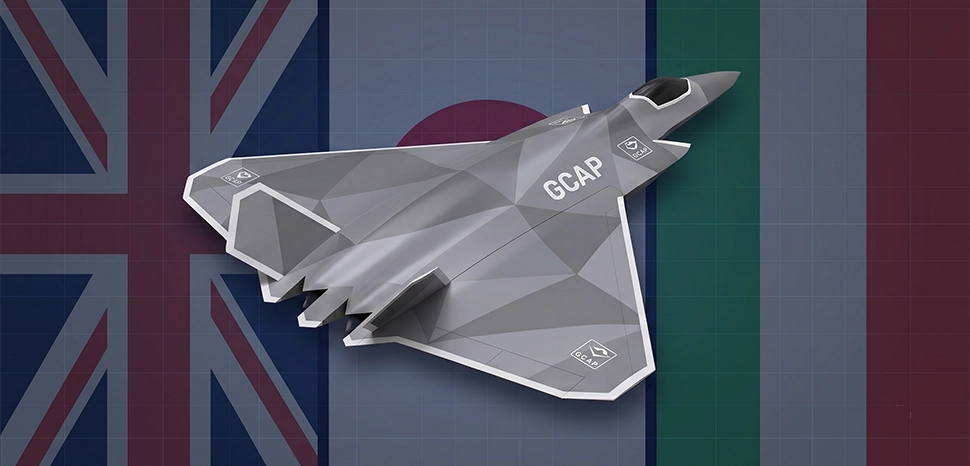
The Global Combat Air Programme (GCAP) began in 2022 with competing political priorities already embedded in its design. Britain, Italy, and Japan entered with different industrial constraints and different expectations of what participation should deliver. Tokyo sought to avoid a repeat of the F-2 experience, where key design authority remained elsewhere, while London and Rome aimed to preserve domestic aerospace capabilities within a shared framework. Questions of workshare and design sovereignty became central before the aircraft itself had been fully defined.
The Future Combat Air System (FCAS) program exposed the same tensions more starkly. France wanted a carrier-capable aircraft to support its independent nuclear deterrent, while Germany prioritized a conventional air-superiority platform and had already acquired F-35As for NATO nuclear-sharing. Dassault insisted on overall design authority while Airbus resisted a subordinate role. Political compromise came first; aircraft design followed.
In June 2026, those tensions finally broke FCAS apart. Germany cancelled the Next Generation Fighter after years of disputes with Dassault, despite efforts by Friedrich Merz and Emmanuel Macron to save the project. Germany has since backed a new Team Gen 6 initiative at the ILA Berlin Air Show, while France appears to be moving toward a national solution.
South Korea’s KF-21 illustrates why some programs survive similar disputes. Indonesia, originally a 20 percent development partner, fell far behind on payments and became embroiled in disputes over technology access. Yet the program survived because South Korea was the dominant partner. Seoul reduced Indonesia’s role, limited technology transfer, and effectively shifted Jakarta from co-developer to future customer.
FCAS had no such option. Dassault and Airbus were too evenly matched for either side to yield on design authority, and the program ultimately broke apart. GCAP sits somewhere in between. Its partners are close enough in industrial weight to defend their own interests, but none is strong enough to impose a common direction.
Sovereignty disputes appear manageable when one partner can absorb them. They become far harder to resolve when the partners are too evenly balanced to compromise.
The broader challenge is interoperability. Allied programs routinely promise compatibility, yet differences in classification rules, data architectures, and system integration continue to limit how seamlessly they can operate together.
Program structures reflect political and industrial compromises as much as operational requirements. Taiwan does not shape these decisions directly, yet it remains an implicit justification for many of them. The result is a persistent gap between how these aircraft are being designed and the conditions under which they may eventually be expected to fight.
Japan’s Contingent Bet
By mid-2026, GCAP remained in an uncertain position. A temporary £686 million funding arrangement signed in April kept design work moving, while the UK’s long-awaited Defence Investment Plan had yet to provide a long-term financial commitment against a reported £28 billion funding gap.
Against that backdrop, Japanese officials were reportedly discussing contingency options, including additional F-35 purchases and extending the service life of the F-2, in case GCAP failed to meet its 2035 target and left a capability gap.
Japan is also the only GCAP participant whose air force would play a major role in a Taiwan contingency. British and Italian aircraft are unlikely to be present in the Western Pacific in numbers that would materially affect the balance. In practical terms, Japan’s commitment is the operational center of gravity for the program’s Indo-Pacific relevance.
For Tokyo, GCAP has always been about more than acquiring a new fighter. It is an attempt to escape the dependency relationship created by the F-2 program. Japan paid heavily for co-development, yet key design authority remained in American hands. GCAP promised genuine co-design authority over a platform Japan could own, modify, and develop according to its own requirements.
Even South Korea, building a fighter explicitly meant to escape dependency on a foreign prime, has not fully escaped Washington’s reach: the KF-21 relies on the American GE F414 engine, which requires US government approval under International Traffic in Arms Regulations (ITAR) for any export sale.
Sovereignty ambitions in fighter programs rarely clear that last hurdle entirely. That is why program delays matter.
If Japan is forced to bridge the gap with additional F-35 purchases, the dependence GCAP was meant to reduce could become entrenched for another decade. Even if GCAP ultimately enters service in the late 2030s or early 2040s, prolonged reliance on the F-35 would shape industrial relationships and procurement decisions in ways that are difficult to reverse. Japan would have paid the diplomatic and political costs of pursuing an independent path without fully securing the autonomy that path was intended to deliver.
The funding picture may look different by the time this article is published. What matters more is what the debate itself reveals. Throughout the first half of 2026, the program’s only operationally significant Indo-Pacific participant was openly considering alternatives.
A long-term funding settlement may resolve the immediate contract issue, but it cannot automatically restore confidence if doubts about the program’s trajectory have already taken root.
What the Discourse Is Avoiding
The risk-window argument assumes that Chinese decision-making is largely driven by military capability: Beijing will act once it gains an advantage it does not yet possess. The historical record is less straightforward. The 1995–96 Taiwan Strait crisis was triggered by a US visa decision, not a sudden shift in the military balance.
Over the past three decades, Chinese coercive behavior has often tracked more closely with domestic political priorities, leadership consolidation, and perceived signals from Washington than with specific readiness thresholds. The frequently cited 2032–2038 window may be a useful way to think about military trends while still proving a poor guide to when, or even whether, Beijing decides to act.
The second issue is that the tools China is most likely to use against Taiwan do not depend on sixth-generation aircraft. Economic leverage, grey-zone pressure, and information operations aimed at Taiwan’s political cohesion have been refined over decades and remain central to Beijing’s approach.
This does not make sixth-generation programs unnecessary. But they are designed to address a military challenge while the political challenge evolves along a different track. Greater clarity is needed about what these programs can realistically solve and what they cannot. Too often, discussions about future airpower blur that distinction, treating military capability as an answer to problems that are only partly military in nature.
The Coherence Challenge
The challenge is not building sixth-generation aircraft. The United States, China, and their partners will field advanced platforms on different timelines and with different trade-offs. That much is expected.
The harder question is whether those aircraft can operate effectively in the environment they are being built for. In the Western Pacific, outcomes will depend as much on basing, logistics, and network resilience as on the aircraft themselves. Those capabilities remain unevenly distributed across allies and are not automatically aligned through joint procurement programs.
The main constraint, therefore, is not technological. It lies in the gap between industrial design, political priorities, and operational realities. Advanced aircraft can strengthen deterrence, but they cannot by themselves solve the problem of coalition coherence.