Japan’s accelerating military buildup is colliding with a structural weakness that no amount of budget expansion can easily solve: a shrinking and increasingly reluctant recruitment base.
The contradiction was briefly exposed earlier this month during a parliamentary committee session, when opposition lawmaker Chikage Koga suggested that children from poorer households were more likely to join Japan’s Self-Defense Forces (SDF), while those from wealthier families often did not. The remark triggered immediate backlash, with politicians across party lines condemning it as discriminatory. Defense Minister Shinjiro Koizumi called the remark unacceptable. Koga apologized and withdrew the statement.
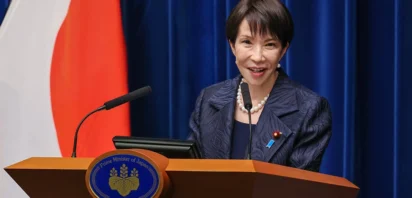
Yet the controversy revealed a deeper strategic problem. Japan’s military is struggling because not enough people are joining at all. This matters because Japan is in the midst of its most significant defense transformation in decades. Under Prime Minister Sanae Takaichi, Tokyo has accelerated plans to raise defense spending to 2 percent of GDP ahead of schedule, while continuing to build long-range strike capabilities and expand its operational role amid intensifying regional threats. China’s military modernization, North Korean missile activity, and uncertainty over long-term US strategic bandwidth have all reinforced Japan’s shift toward a more active deterrence posture.
But military expansion requires personnel. In fiscal year 2023, the SDF met just over half of its recruitment target, the lowest rate on record. The shortfall was especially severe at the lower end of the force. Among fixed-term enlisted personnel serving as privates or their equivalent, the SDF recruited only 3,221 against a target of 10,628, a fulfillment rate of 30 percent. By contrast, recruitment for the noncommissioned officer track held up better, reaching 4,969 against a target of 7,230, or 69 percent.
This is not simply a temporary shortfall but reflects long-term demographic realities. Since the mid-1990s, Japan’s population aged 18 to 26 has fallen by around 40 percent, and the number of physically eligible and recruitable young adults will continue shrinking for decades. This creates a strategic paradox: Japan’s threat environment is worsening at precisely the moment its manpower base is narrowing.
The problem extends beyond demographics. Japan’s labor market has become exceptionally tight, with employers across sectors competing aggressively for workers. In fiscal 2023, there were 3.52 job openings for every new high-school graduate seeking work, underscoring just how competitive the market for young labor has become. Historically, military service could function as a stable route for social mobility, particularly for those with limited alternatives. That logic has weakened. Younger Japanese now face a labor market that often offers higher pay, greater flexibility, and lower personal risk than military service.
This reflects a broader transformation in advanced democracies. As societies age, labor itself becomes scarcer and more valuable, raising the opportunity cost of enlistment. Governments may increase defense budgets, but they cannot easily generate additional young citizens.
Japan also faces a deeper social paradox. In a government survey released in January 2026, favorable impressions of the SDF exceeded 90 percent, making it one of the most respected public institutions in the country, particularly for its role in disaster relief. Yet that broad public support has not translated into a willingness to serve. A 2024 WIN/Gallup International survey found that only 9 percent of Japanese respondents said they would be willing to fight for their country in the event of war, among the lowest figures recorded globally.
This gap between support and service reflects broader social changes. While Japan sits at the extreme end, the wider pattern of declining military obligation in wealthy democracies is increasingly visible. Individualism, work-life balance, and personal autonomy now carry greater weight for younger generations than older collective notions of sacrifice and duty.
Part of this gap also reflects institutional factors. The SDF’s appeal has also been dented by a series of scandals, most prominently the case of Rina Gonoi, a former Ground SDF soldier whose account of being sexually assaulted by colleagues led to the 2023 conviction of three former members and a military-wide probe that uncovered more than 1,300 reported cases of harassment and bullying.
Japan’s recruitment problem therefore operates at three levels: demographic, economic, and cultural. The policy responses are limited. In December 2024, the Ishiba cabinet adopted a basic policy to raise SDF pay and improve working conditions in direct response to worsening recruitment shortfalls, acknowledging that compensation and workplace conditions had become part of the problem. But such measures can only do so much against deeper demographic and labor market pressures.
That leaves a narrower set of longer-term options. Expanding female recruitment is another option, but it requires changes to institutional culture and family support systems. Greater reliance on technology may reduce some manpower requirements, but even highly automated militaries still depend on human operators, maintainers, and logistics networks. More radical alternatives, such as greater reliance on foreign recruits, would carry major political and legal complications in Japan’s immigration-sensitive environment.
None of these options offer quick relief. For Tokyo, the immediate consequence is a widening gap between strategic ambition and operational capacity. A state can buy missiles, warships, and drones relatively quickly. Building human capital for defense is slower, harder, and more politically constrained.
This gap may become one of the defining military challenges of the coming decade. Japan’s recruitment crisis is not simply a domestic personnel issue. It is a strategic warning. In aging advanced democracies, the future limits of military power may be determined not by industrial output or fiscal capacity, but by demographics, labor markets, and social willingness to serve.
The views and opinions expressed in this article are those of the author alone and do not represent those of Geopoliticalmonitor.com