According to the open source WarSpotting database, Russia’s visually confirmed losses in Ukraine exceed 3,000 tanks, 8,000 infantry fighting vehicles and armored personnel carriers, and 1,000 artillery systems, alongside severe casualties among aircraft, helicopters, electronic warfare, naval assets, and logistics. While real losses are likely higher, this unprecedented post-Soviet destruction raises critical questions about Moscow’s ability to replenish and modernize its arsenal under wartime constraints.
However, these losses carry uneven strategic weight and industrial difficulty. Russia actively manufactures replacements for conventional equipment like tanks, armored vehicles, artillery, and missiles. Conversely, many Soviet-era platforms are permanently out of production, though newer systems occasionally patch those gaps. Most critically, Russia cannot reproduce its most complex military systems at scale due to deep industrial, technological, and personnel limitations. These structural failures predate the war; the conflict simply exposed and accelerated decay that had been worsening long before 2022.
This article examines these distinct loss categories, evaluates Moscow’s replenishment options, and analyzes what this uneven recoverability reveals about the future limits of Russia’s military-industrial complex.
What the Russian Defense Industry Can Still Replace
Despite the scale of Russian battlefield losses, there are multiple categories of military equipment that Russia clearly retains the industrial capacity to replenish.
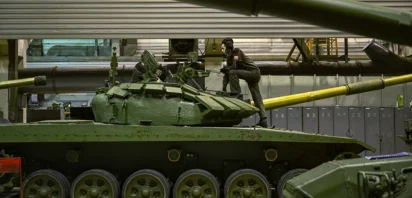
One of the most notable examples is the T-90M “Proryv,” Russia’s most advanced serially produced main battle tank currently in active service. WarSpotting lists more than 110 confirmed losses of T-90M tanks in Ukraine, which is significant given the relatively limited pre-war inventory of the platform. However, Russia’s Uralvagonzavod defense enterprise continues producing T-90M tanks at high tempo and appears capable of covering at least a substantial portion of battlefield losses, demonstrating that Russia still maintains viable production capacity for certain categories of modern armored systems.
A similar pattern can be observed with infantry fighting vehicles. Russia has suffered more than 3,000 confirmed losses among various BMP-series IFVs during the war, including large numbers of Soviet-era BMP-1 and BMP-2 variants. While these older models are no longer produced from scratch, Russia actively manufactures the more modern BMP-3 variant and reportedly increased production significantly during the war. Although the BMP-3 is not a direct one-to-one replacement for every older BMP platform lost in Ukraine, the continued mass production of modern IFVs nevertheless allows Russia to partially compensate for the enormous attrition suffered by its ground forces.
Russian aircraft losses also demonstrate that at least some sectors of the country’s military-industrial complex remain functional despite wartime pressures and sanctions. Russia has lost many modern combat aircraft in Ukraine, including at least 7 Su-35S multirole fighters, yet production of these aircraft continues at the Komsomolsk-on-Amur Aircraft Plant. In early 2026, another batch of newly produced Su-35S fighters was reportedly delivered to the Russian Aerospace Forces, indicating that Russia still retains the industrial base necessary to continue serial production of several advanced combat aviation platforms.
Systems Russia is Losing Without Replacement
At the same time, there are categories of military equipment that Russia is steadily losing without currently possessing active production lines to fully replace them.
One of the clearest examples is the T-80 tank family. Despite being a Soviet-era platform, the T-80 retains several technical advantages over other Russian tanks, mainly its mobility and reverse speed, making it a valuable asset for the Russian Armed Forces. However, Russia has suffered extensive T-80 losses in the Ukraine war while serial production of the platform itself remains inactive. Although restarting production is theoretically possible, reopening dormant production lines after decades of inactivity would likely require substantial investment, industrial reorganization, and personnel recovery. As a result, Russia may ultimately choose to continue replacing these losses with tanks already in active production, such as the T-90M, rather than attempting to fully revive T-80 manufacturing.
A similar issue exists within Russian military aviation. The Su-25 close air support aircraft, which remains an important battlefield platform in Ukraine, is no longer mass produced, and Russia currently lacks a directly comparable replacement among its actively manufactured combat aircraft. While modernization and refurbishment programs allow existing Su-25 fleets to remain operational, long-term replacement of losses becomes increasingly problematic when production lines remain inactive for extended periods.
There are also platforms that Russia likely still possesses the technical capability to manufacture, but whose production may be constrained by sanctions, supply chain complications, or the complexity of their electronic components. One possible example is the Palantin electronic warfare system, one of Russia’s more modern and sophisticated EW platforms, which entered service only in 2019. Russia has already suffered three confirmed losses of these systems in Ukraine, yet there is very limited open-source information regarding current production rates or replenishment efforts. Given the complexity of modern electronic warfare systems and their potential dependence on foreign-made microelectronics and components, sanctions and restricted access to advanced technologies may complicate future production and expansion of such systems far more than in the case of conventional armored vehicles or artillery.
Critical Platforms Russia Cannot Effectively Reproduce
While some categories of military equipment can either be replaced directly or substituted with newer alternatives, there are also platforms whose loss represents a much more serious and potentially irrecoverable blow to Russia’s long-term military capabilities.
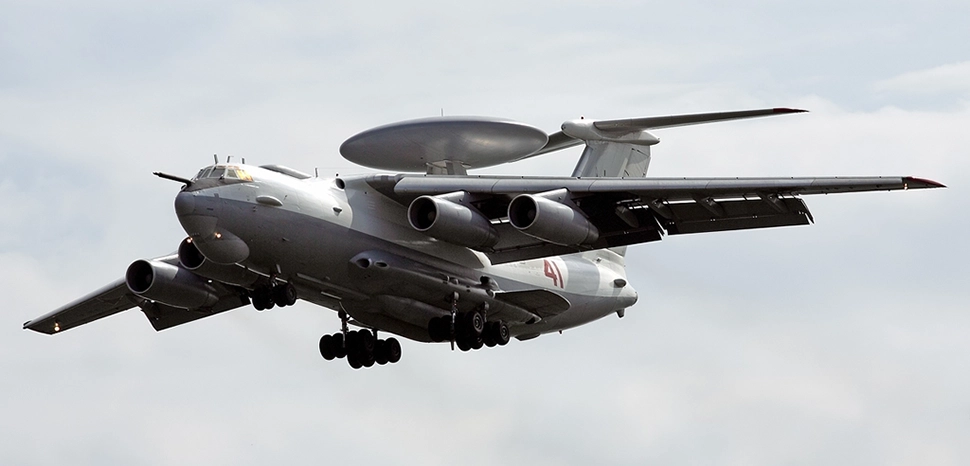
One of the clearest examples is Russia’s fleet of A-50 airborne early warning and control (AWACS) aircraft. The A-50 was originally produced in Soviet Uzbekistan rather than Russia itself, meaning that Moscow effectively lost direct access to the original production ecosystem following the collapse of the Soviet Union. Before the war, Russia reportedly operated a fleet of roughly 12 A-50 aircraft, three of which were later destroyed by Ukraine. Since then, Russia has focused primarily on modernizing surviving aircraft into the upgraded A-50U variant rather than producing entirely new platforms. Although Russian officials at the United Aircraft Corporation (UAC) periodically announced intentions to restore production of the aircraft, the UAC Deputy General Director Sergey Korotkov acknowledged in late 2025 that Russia currently lacks sufficient technical and industrial resources to resume serial manufacturing. The war has also exposed the vulnerability and aging nature of the platform itself, while Russia’s future replacement project, the A-100 AWACS, remains delayed and underdeveloped. The destruction of the program’s only flying testbed during Ukrainian drone strikes on Taganrog further complicated a project that had reportedly struggled with sanctions and technological limitations for years even before the war.
A similarly problematic situation exists within Russia’s strategic bomber fleet. The Tu-95 bomber, which remains one of the core components of Russia’s strategic aviation forces, is no longer produced and reportedly faced maintenance and availability issues even before the invasion of Ukraine. Since 2022, Russia has additionally lost at least seven Tu-95 bombers, further reducing an already aging fleet. Analysts increasingly argue that restarting large-scale production of the bomber would be extraordinarily difficult due to the collapse of Soviet-era supply chains, the disappearance of specialized industrial infrastructure, and shortages of trained personnel. Russia’s future strategic bomber replacement project, the PAK-DA, remains at an extremely early development stage with no confirmed operational prototypes, while its production would require immense financial and industrial investment under conditions where Russia already struggles to sustain several ambitious defense programs simultaneously. The situation is similar with the Tu-22M3 bomber fleet. Although Russia continues refurbishing and modernizing surviving Soviet-produced airframes, there is very little evidence that the country retains the ability to manufacture entirely new Tu-22M3 bombers in meaningful numbers. In practice, many “new” additions to the fleet are in reality refurbished Soviet-era aircraft rather than newly constructed platforms.
The Russian Navy faces comparable structural limitations. The sinking of the cruiser Moskva represented not merely the loss of a flagship vessel; it also highlighted Russia’s inability to replace certain major naval assets. Defense analyst Yuri Fedorov argued that Russia currently lacks the shipbuilding infrastructure necessary to construct another cruiser of the same class within the foreseeable future. The primary Soviet shipyard capable of producing vessels of this scale was located in Mykolayiv, now part of Ukraine, leaving Russia without direct access to the industrial facilities originally responsible for building many of its largest warships. Recreating such shipbuilding capacity domestically would require enormous long-term investment, specialized infrastructure, and industrial resources that Russia currently appears unable or unwilling to mobilize under wartime conditions.
Moscow’s Strategic Choice: Middle Power or Superpower?
The capabilities provided by platforms such as AWACS aircraft or strategic bombers are not strictly necessary for a regional middle power, but for a state that presents itself as a global military superpower, they are close to indispensable. Russia will likely eventually face a difficult strategic choice between attempting to restore production of these older systems or investing into entirely new replacement platforms, both of which would require enormous industrial, financial, and technological resources. At the current stage of the war, however, Moscow remains heavily focused on producing equipment that is immediately relevant for sustaining frontline operations, including tanks, artillery, ammunition, missiles, and conventional battlefield systems. Under such circumstances, expensive modernization efforts and long-term development programs like the A-100 AWACS receive significantly lower priority. Importantly, many of these ambitious projects already struggled with delays, underfunding, and industrial limitations long before 2022, suggesting that the current difficulties reflect deeper structural problems within the Russian military-industrial complex rather than temporary wartime disruptions alone.
If restoring domestic production proves unrealistic in the near future, Russia effectively retains two broad strategic options. The first would involve relying more heavily on external partners for technology, expertise, or even direct procurement of certain advanced systems, with China representing the most likely candidate. Beijing has already demonstrated willingness to export some advanced military aviation platforms abroad, including the KJ-500 AWACS aircraft reportedly offered to Pakistan. Nevertheless, it remains unclear whether China would be willing to transfer highly sensitive high-technology systems to Russia at meaningful scale, particularly in sectors directly tied to strategic military superiority. There is also the question of whether Moscow itself would accept such dependence, as abandoning domestic production of critical military assets in favor of foreign procurement would represent a major symbolic and industrial setback for Russia’s defense sector.
The second option would involve gradually redefining parts of Russia’s force structure and replacing some traditional military capabilities with newer and cheaper alternatives. In this regard, recent battlefield developments provide Russia with certain advantages. The growing effectiveness of long-range strike drones like the Geran-2 is increasingly allows some functions traditionally performed by strategic aviation platforms to be conducted through unmanned systems instead. Russia in particular has demonstrated notable progress in the production and operational use of long-range drones during the war in Ukraine. However, while these emerging systems can partially compensate for some traditional capabilities, they cannot fully replace the broad operational flexibility, endurance, command-and-control functions, and strategic signaling value provided by platforms such as AWACS aircraft, strategic bombers, or major naval assets. As a result, even successful drone and missile development is unlikely to completely solve the long-term structural gaps emerging within Russia’s more traditional high-end military capabilities.
Long-Term Consequences and Outlook
The war demonstrates that Russia can sustain and replace conventional frontline losses like tanks, armored vehicles, artillery, missiles, and ammunition. However, its most strategically critical, high-end platforms are near-impossible to reproduce. Sanctions, financial constraints, supply chain disruptions, and a shortage of specialized personnel make serial manufacturing highly unfeasible for years to come. The conflict did not create these structural weaknesses; it simply accelerated decay that began long before 2022.
Consequently, these military disruptions will endure long after active fighting stops. Russia must operate with degraded capabilities in key areas while choosing whether to revive dormant assembly lines, rely on foreign tech partnerships, or restructure its forces around uncrewed alternatives like drones. While Moscow’s long-term adaptability remains uncertain, the war has already proven that Russia’s most valuable military assets are far more fragile than previously assumed.