India’s call this week for the United States and Iran to return to restraint and diplomacy came as an Indian tanker turned back near the Strait of Hormuz following fresh attacks on commercial shipping off the coast of Oman. The two developments capture how India’s West Asia dilemma has shifted.
The region is no longer just a theatre where New Delhi balances separate relationships with Israel, the Gulf, and Iran. It is now a region where India’s own economic interests are directly exposed to every new flare-up. For years, India’s West Asia strategy rested on careful balancing. It deepened defense and technology ties with Israel, built strong partnerships with the Gulf monarchies, and maintained a working relationship with Iran despite sanctions, pressure, and periodic crises. That approach served India well. It allowed New Delhi to speak to rival camps without getting trapped in their quarrels.
The Old Paradigm Breaks Down
The old balancing model is under strain because India’s stakes in the region have changed. The Gulf is no longer just where India buys oil and sends workers. It has become central to India’s economic future. It supplies a large share of India’s energy, hosts millions of Indian citizens, sends back billions in remittances, and is emerging as a major investor in Indian infrastructure, manufacturing, and technology. The India-Middle East-Europe Economic Corridor, or IMEC, has further elevated the Gulf from an energy supplier to India’s western economic gateway.
Israel matters for a different but equally important set of reasons. It remains a trusted partner in defense technology, intelligence, cybersecurity, agriculture, water management and innovation. Iran, meanwhile, is important not just because of Chabahar Port or old strategic rhetoric, but because no serious Indian policy toward the Gulf can ignore the power sitting astride the Strait of Hormuz. That is the crux of the problem. India can no longer think of Israel, the Gulf, and Iran as three separate relationships to be managed in parallel.
Gulf-Iran stability, Gulf-Israel normalization, and India’s own engagement with Tehran are now tied together by India’s economic exposure to the region. A US-Iran confrontation that spills into the Gulf threatens Hormuz, energy flows, shipping costs, insurance premiums, Indian workers and Gulf investment into India. The same instability can also chill Gulf-Israel cooperation, slowing IMEC, port connectivity, and trilateral projects that depend on a reasonably stable regional climate. And if Iran remains central to that instability, India cannot protect its Gulf interests while treating Tehran as a marginal relationship managed only through protocol. That is why this is no longer just a diplomatic balancing exercise. It is an economic security problem for India.
Precisely because the current flare-up is still largely confined to the US and Iran and has not yet widened into regional hostilities, New Delhi still has a narrow window to act more actively with both sides before a bilateral crisis hardens into a wider regional disruption. Gulf-Iran stability, Gulf-Israel normalization, and India’s own engagement with Tehran are becoming intertwined parts of the same strategic question.
If the Iran war escalates again, India’s interests are among the first to feel the heat. Hormuz is not a distant chokepoint on someone else’s map. It is one of the main arteries through which oil, gas, and commercial shipping move to India. Any disruption there pushes up freight costs, insurance premiums and energy prices.
Rethinking New Delhi’s Iran Strategy
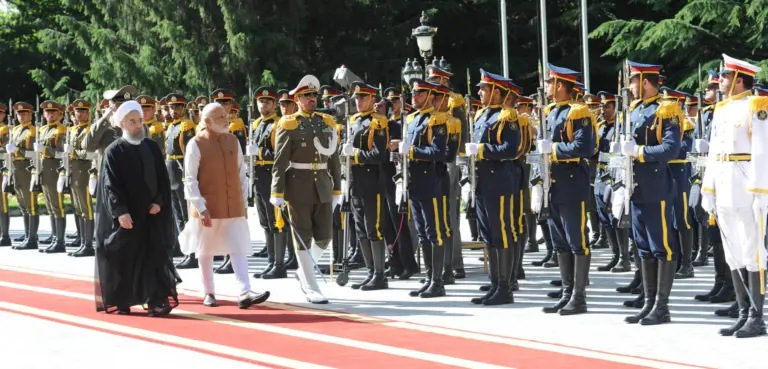
This is why India’s relationship with Iran also has to be rethought. If Tehran is central to Gulf stability, then India cannot protect its interests in the Gulf while allowing Iran ties to shrink into a token relationship managed only through protocol. Deeper India-Iran engagement does not mean tilting towards Tehran. It means recognizing that India needs working political access to Iran if it wants to protect shipping, retain strategic room for maneuver, and remain relevant in moments of regional crisis.
The present flare-up gives India a narrow opening. There is still a brief window in which India can engage both Washington and Tehran actively without pretending to mediate a wider Middle East conflict.
What does this mean in practice?
First, India should start treating Gulf stability as an economic priority, not just a diplomatic preference. That sounds obvious, but it matters because Indian rhetoric still often lags behind Indian interests. New Delhi should frame Hormuz, Gulf shipping, and IMEC-style connectivity as part of India’s core economic security. That would justify a more active diplomatic posture in moments of crisis, including sharper private messaging to all sides when escalation threatens shipping, energy flows or Indian nationals.
Second, India should use its access to Washington, Tehran, and Gulf capitals for quiet crisis diplomacy. Not public mediation or grand summits, but quiet, sustained engagement. India has enough credibility with the Gulf, a functional channel with Iran, and a strong strategic relationship with the US to make the case that a wider Gulf conflict would impose costs far beyond the battlefield. That case should be made not in abstract moral language but in hard economic terms: energy disruption, commercial shipping risks, damage to regional investment, and the chilling of long-term connectivity plans.
Third, India should push harder to build the economic architecture that makes stability more valuable than confrontation. If India can help create projects that tie Gulf capital, Israeli technology, and Indian manufacturing together, it creates constituencies with a stake in keeping the region reasonably calm. The sectors are obvious enough: green hydrogen, fertilizers, food security, logistics, water management, AI and digital infrastructure. India’s value to the Gulf is already expanding beyond oil and labor. It is a major aviation market, a destination for sovereign investment, a source of skilled professionals and a partner in diversification. For Israel, India is both a large market and a route into wider Asian supply chains. The more these interests are tied together, the higher the cost of regional breakdown.
This is the larger shift now facing Indian policy. For decades, success in West Asia meant maintaining good ties with everyone and avoiding a choice between rival camps. That still matters. But it is no longer enough. India is now too invested in the region’s economic future to remain just a careful balancer watching crises from a safe distance. It implies that treating Gulf-Iran stability, Gulf-Israel normalization, and India-Iran engagement not as separate diplomatic files but as parts of one connected strategy.
The real test is whether New Delhi is willing to act on that reality. If India’s energy security, shipping routes, diaspora, investments, and connectivity ambitions are all vulnerable to Gulf instability, then India now has a stake in preventing the region’s rivalries from colliding with its own future.
The views and opinions expressed in this article are those of the author alone and do not represent those of Geopoliticalmonitor.com