For much of the modern era, geography was destiny. States projected power largely within their neighborhoods, and rivalries remained tethered to physical proximity. That assumption is quietly eroding. Across the Eastern Mediterranean, a new strategic logic is emerging — one where distance matters less than perception, and where influence is exercised not through conquest but through the careful manipulation of a rival’s strategic psychology.
India’s Strategic Inversion in the Eastern Mediterranean
India’s rising naval presence in the Mediterranean, as well as its strengthening defense partnerships with Greece, Cyprus, and Israel, should be viewed through this lens. On the surface, these developments appear to be minor: naval exercises, port visits, intelligence collaboration, defense-industrial negotiations, and increased interest in Indian weapons systems like the BrahMos missile. When considered together, they indicate something more substantial. They demonstrate the birth of a uniquely 21st-century kind of statecraft: deterrence by association.
This is not about India preparing for conflict with Türkiye. It is about India reshaping Ankara’s strategic environment. The roots of this shift lie far from the Aegean Sea. Relations between India and Türkiye have deteriorated steadily as Ankara deepened its strategic partnership with Pakistan.
President Recep Tayyip Erdoğan’s increasingly vocal support for Pakistan on Kashmir, combined with expanding defense cooperation between Ankara and Islamabad, transformed what was once a largely cordial relationship into a growing geopolitical rivalry. Türkiye and Pakistan signed dozens of cooperation agreements in 2025 spanning defense, infrastructure, and technology, while Turkish military exports and joint exercises with Pakistan have become increasingly prominent.
For New Delhi, these developments are not viewed as symbolic diplomacy. They are perceived as direct contributions to Pakistan’s military capabilities and diplomatic leverage. Rather than confronting Türkiye head-on, however, India has chosen a more sophisticated response.
It is strengthening every actor that constrains Turkish freedom of maneuver. The result is a remarkable geopolitical inversion. A country located more than 4,000 kilometers from the Eastern Mediterranean is becoming an increasingly relevant variable in regional calculations surrounding Greece, Cyprus, and Israel. This is not because India possesses territorial interests in the region. Rather, it has been discovered that influence in a rival’s strategic backyard can generate leverage at relatively low cost.
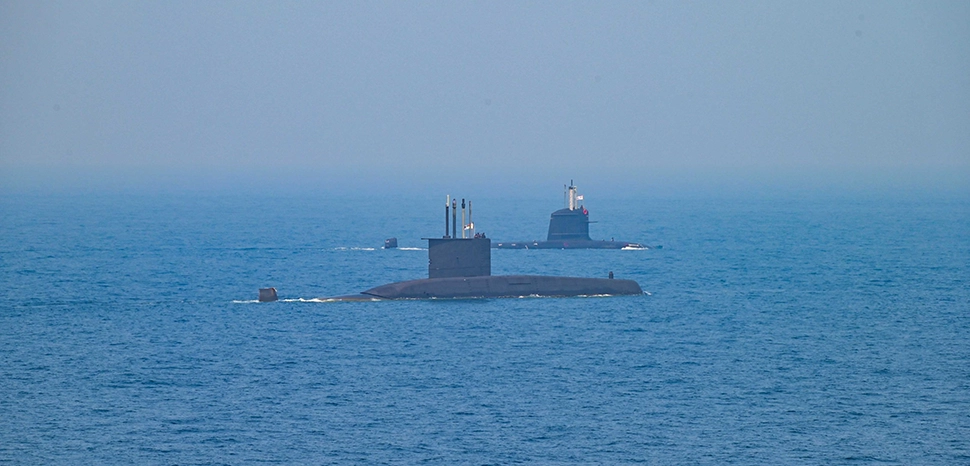
The Mediterranean has therefore become a theatre of indirect signaling. When Indian warships participate in exercises with Greece, dock at ports such as Souda Bay in Crete, or deepen cooperation with Cyprus and Israel, the immediate military value is limited. India is not seeking permanent military basing rights. Nor is it attempting to establish dominance in waters that remain overwhelmingly shaped by NATO, European, and regional actors.
The value lies elsewhere. Every Indian destroyer operating in the Mediterranean sends a psychological message to Ankara: actions taken in South Asia can generate consequences in the Eastern Mediterranean.
India’s Deterrence by Association in the Eastern Mediterranean
This is the essence of deterrence by association. Rather than threatening Türkiye directly, India quietly increases the capabilities, confidence and diplomatic backing of states already engaged in disputes with Ankara. Greece and Cyprus become more secure. Israel gains another strategic partner. Türkiye, meanwhile, faces the prospect of a more interconnected network of states sharing intelligence, conducting exercises and aligning diplomatic positions.
Power projection, in this context, becomes less about military outcomes than cognitive effects. International relations scholars have long argued that perceptions shape strategic reality. The emerging India–Türkiye dynamic demonstrates this principle in action. New Delhi does not need to challenge Turkish naval forces directly. It simply needs Ankara to believe that every expansion of Turkish influence in South Asia will encourage deeper Indian engagement in the Eastern Mediterranean.
That perception alone alters behavior. The symbolism becomes particularly potent when viewed alongside discussions surrounding potential defense exports. Reports of Greek and Cypriot interest in the BrahMos supersonic cruise missile have attracted attention precisely because they represent more than commercial transactions. Whether or not such deals ultimately materialize, the very possibility forces Turkish strategists to contemplate a future in which Indian defense technology contributes to regional military balances on Ankara’s doorstep.
The strategic message is difficult to miss. A decade ago, few would have imagined India emerging as a relevant player in Eastern Mediterranean security discussions. Today, it is increasingly part of the conversation.
When Middle Powers Redraw Each Other’s Strategic Maps
This trend also reflects broader changes in the international system. The post-Cold War era was often characterized by assumptions that globalization would reduce geopolitical competition. Instead, a more fragmented and fluid order has emerged. Middle powers are becoming increasingly ambitious. They no longer accept strict geographic limitations on their strategic reach.
India is hardly alone in this regard. Türkiye itself has expanded its presence across Africa, the Gulf, Central Asia and South Asia. The United Arab Emirates projects influence from the Horn of Africa to the Eastern Mediterranean. Saudi Arabia increasingly shapes developments well beyond the Gulf. Australia, Japan and South Korea have similarly expanded their strategic footprints.
What distinguishes India’s Mediterranean approach is its subtlety. Rather than creating formal military blocs, it relies on flexible networks. Rather than announcing containment strategies, it cultivates partnerships. Rather than deploying overwhelming force, it leverages symbolism, access agreements, intelligence cooperation and defense-industrial relationships.
This approach is particularly suited to an era where outright military confrontation remains extraordinarily costly. Nuclear deterrence, economic interdependence and political risk all encourage states to seek alternative forms of competition.
Strategic friction has become a weapon in its own right. The implications extend beyond India and Türkiye. The Mediterranean sits astride some of the world’s most critical trade and energy corridors. Around 12 per cent of global trade passes through the Suez Canal system connecting Europe and Asia. Instability in the Eastern Mediterranean increasingly affects supply chains stretching from Mumbai to Rotterdam and from Haifa to Singapore.
The Indo-Pacific Echo in the Eastern Mediterranean
As a result, regional rivalries are no longer regional. The Indo-Pacific and the Mediterranean are becoming connected strategic theatres. Security relationships in one region increasingly influence calculations in another. What happens in Kashmir reverberates in Cyprus. What unfolds in the Aegean shapes perceptions in New Delhi. Geography remains important, but strategic interdependence increasingly transcends it.
This is perhaps the most important lesson from India’s Mediterranean turn. The future of deterrence may not be defined by military alliances or territorial disputes alone. It may instead revolve around the ability of states to reshape the strategic environment of rivals indirectly — not by attacking them, but by strengthening those who already oppose them.
In that world, perception becomes structure. India does not need to challenge Türkiye directly to alter Turkish calculations. It only needs to convince Ankara that support for Pakistan carries consequences elsewhere. Every naval visit, intelligence-sharing arrangement, defense dialogue and strategic partnership contributes to that message.
No shots are fired. No red lines are crossed. Yet the geometry of power changes nonetheless. And that may prove to be one of the defining characteristics of the emerging international order: a world in which middle powers increasingly project influence across distant theatres, not to fight wars, but to shape how rivals think about them.
The views and opinions expressed in this article are those of the author alone and do not represent those of Geopoliticalmonitor.com