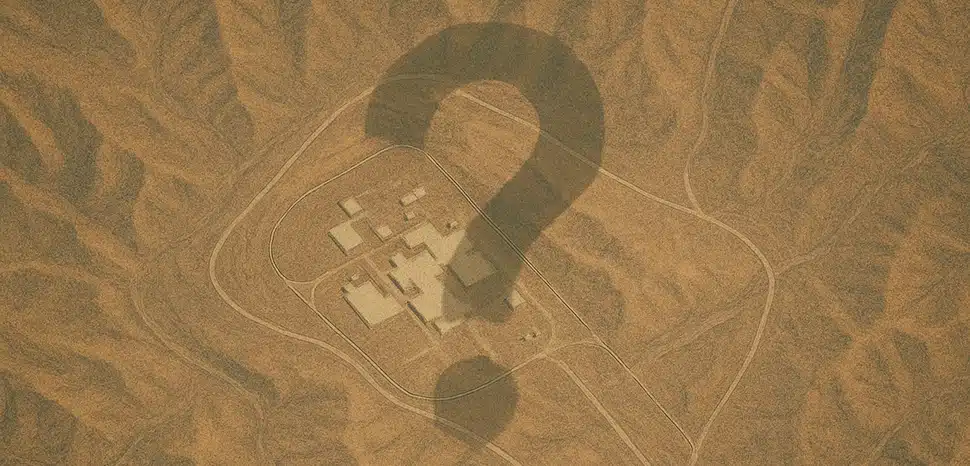
The Fordow Fuel Enrichment Plant exemplifies engineered inaccessibility, deliberately designed to resist modern airstrike capabilities. Built into the base of the Zagros Mountains near Qom, Fordow is located between 80 and 100 meters underground and is encased in multiple meters of reinforced concrete and rock. This design is not incidental but a direct response to historical precedents, most notably Israel’s successful 2009 and 2010 cyber and physical sabotage campaigns against the Natanz enrichment site. Fordow was conceived as a strategic hedge. Its survival would ensure the continuity of Iran’s nuclear program under the harshest external conditions.
Its role is central to Iran’s posture of nuclear latency, a condition in which a state possesses the technological capability and enriched material necessary for weaponization, while deliberately avoiding open violation of the Non-Proliferation Treaty. Fordow houses advanced IR-6 centrifuges and older IR-1 units, giving Iran the capacity to enrich uranium well beyond civilian energy requirements. At current rates of operation, the site can enrich uranium to near-weapons-grade levels within weeks, depending on feedstock purity.
Attempts to neutralize Fordow must contend not only with its formidable defenses but also with its symbolic and operational centrality. A successful strike could undermine Iran’s latent nuclear capabilities. However, it would also risk provoking a military and political backlash with regional and potentially global repercussions.
The One Weapon That Might Breach Fordow
Among conventional military options, only the United States possesses the technological capability to credibly threaten Fordow’s destruction. The GBU-57 Massive Ordnance Penetrator (MOP), a 30,000-pound precision-guided bomb, is uniquely engineered to penetrate hardened underground structures. Deployed exclusively by the B-2 Spirit stealth bomber, this weapon was designed for targets exactly like Fordow.
The MOP employs a hardened steel casing, GPS-guided flight, and layered inertial navigation to strike targets with extreme precision. Upon impact, it can burrow through approximately 60 meters of reinforced concrete or dense rock before detonation. This makes it theoretically capable of reaching some of Fordow’s critical infrastructure. Yet this is not a certainty, as the full architectural layout of the facility remains classified.