Global geopolitical trends we’re tracking this week:
Key Dates
November 29 – Spain and Germany CPI for November.
November 29 – Canada Q3 current account.
November 29 – US pending home sales for October.
November 29 – US comments from Fed Chair Jerome Powell.
November 29 – Japan industrial production for October.
November 29 – China manufacturing and non-manufacturing PMI for November.
November 30 – France and Italy Q3 GDP.
November 30 – Germany unemployment for November.
November 30 – Italy CPI for November.
November 30 – Euro zone CPI for November. This will be one to watch given October’s doubling of the ECB target rate, coming in at 4.1%.
November 30 – Canada Q3 GDP.
November 30 – Australia Q3 GDP.
November 30 – China Caixin manufacturing PMI for November.
December 1 – US crude oil inventories.
December 1 – South Korea CPI for November.
December 1 – Euro zone PMI for November.
December 2 – OPEC meeting. Expect a cautious posture from the cartel given the severe volatility in global oil markets to close out last week.
December 2 – Brazil Q3 GDP.
December 2 – US initial jobless claims.
December 2 – China Caixin services PMI for October.
December 3 – Spain and Italy services PMI for November.
December 3 – UK composite PMI for November.
December 3 – Euro zone retail sales for October.
December 3 – Brazil industrial production for October.
December 3 – US non-farm payrolls for November.
December 3 – US and Canada unemployment rate for November.
World
COVID-19 fast facts
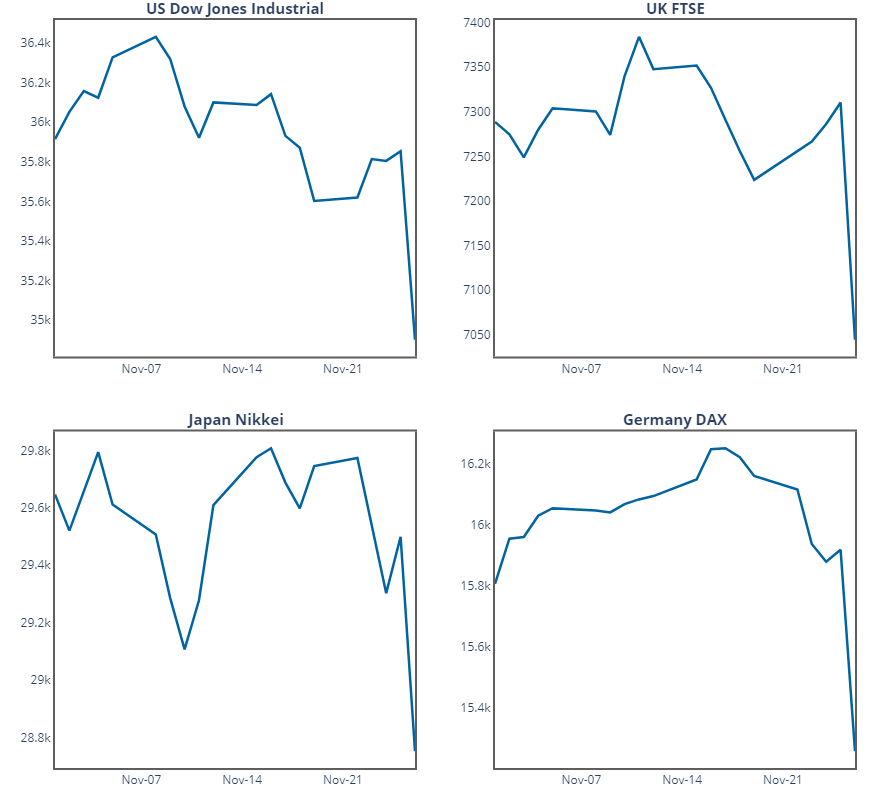
- All eyes will be on preliminary testing involving the omicron variant in the week ahead, with the sudden cratering of global equity and energy markets on Friday providing a stark reminder of the sky-high stakes involved. It should be noted that omicron’s emergence comes against the backdrop of an already worsening epidemiological outlook across Europe.
- Countries have begun to impose travel bans on South Africa, where omicron was first identified, along with nearby southern African states. For example, Canada, Australia, Russia, Thailand, Singapore, the United States, South Korea, and the United Kingdom have all imposed flight bans. Israel has gone so far as to ban all visitors to the country.
- New cases of omicron are cropping up outside of Africa, and have now been found in Belgium, the UK, Germany, Italy, and the Netherlands, the latter of which has identified as many as 13 cases.
- As yet there is no definitive answer as to what the high number of mutations in omicron mean for the variant’s transmissibility and potential ability to evade vaccine protections. For its part, the World Health Organization has been warning governments not to overreact to the variant’s emergence, as the threat it poses is still largely hypothetical.
Africa
Civilian and military authorities return to square one after abortive Sudan coup
Deposed Prime Minister Abdalla Hamdok has praised a deal to reinstate his civilian administration following the abortive coup of October 25, an agreement that effectively reboots the original transitional arrangement that prevailed after the fall of Omar al-Bashir. The episode is ultimately a textbook example of the military overplaying its hand in the misguided belief that post-coup protests would either be muted given the country’s ongoing economic upheavals and widespread political disillusionment, or controllable by coercive means. Neither proved true in the end, as citizens successfully mass mobilized despite widespread internet shutdowns. Looking ahead, expect the civilian wing of the government to be newly empowered, and Prime Minister Hamdok could pick up where he left off by attempting to integrate paramilitary elements into the armed forces and/or disentangling the military from its sprawling industrial interests – moves that helped trigger the latest power-grab by military authorities in the first place. Looking ahead, a key date to keep in mind is July 2023, when the country’s first new democratic elections are scheduled to be held.
Ethiopia civil war threatens to spill over border
As fighting intensifies between Tigrayan rebels and their allies and the armed forces of Ethiopia, a skirmish on the northwestern fringes of the conflict hints at the possibility of a wider regional conflict. Toward the end of the week, the Sudanese government reported that its troops had ‘repelled an attack’ in the disputed border region of Al-Fashaqa, in fighting that resulted in six deaths on the Sudanese side. The attackers were reportedly a mix of Ethiopian armed forces and local sectarian militias, likely the Amhara, who have long accused the formerly Tigray-led government in Addis Ababa of forfeiting key swathes of Amhara-held fertile land to Sudan. The region stands as a potential flashpoint in the ongoing Ethiopian civil war, and given longstanding tensions between Sudan – strongly backed by Egypt – and Ethiopia over the Grand Ethiopian Renaissance Dam, it’s not outside the realm of possibility that we could see wider clashes between these two state militaries, particularly if Amhara militias attempt to re-take the land by force.
Europe
Turkey in the grips of a worsening currency crisis
Volatility in the Turkish lira has become par for the course over the past few decades; however, recent policy decisions have combined with a deteriorating economic outlook to test the limits of what the economy can easily absorb. The lira is now down against the US dollar by one fifth in just two weeks, establishing a series of new record lows. Specifically, recent volatility is – once again – being pinned on pressure from President Erdogan to enact a loose monetary policy, even when the economic fundamentals do not allow for one. This, in Erdogan’s words, is an ‘economic war of independence’ from the ‘money barons,’ one that will be carried out despite worsening economic metrics, particularly inflation, which is now north of 20% by official accounts.
Data Snapshot
Global indices tanked to close out the week, amid fears that omicron could fuel a resurgence of COVID cases around the globe.