Geopolitics Weekly analyzes emerging geopolitical trends around the world, distilling the cacophony of global events into one easy reader. It lands in the inbox of Geopolitical Monitor subscribers every week. This week’s edition has been made available to all our readers.
Americas
A Week of Limbo in Venezuela
What Happened
President Trump convened a high-profile meeting with oil executives, tankers were boarded on the high seas, and global responses continued to filter in, but on the ground in Venezuela the picture remains the same: paramilitary colectivos cracking down in Caracas and a regime that remains fixed in-place, so much so that the State Department is urging US citizens to leave the country amid reports they are being actively targeted.
Why It Matters
Dynamics that are coming into sharper relief after last week’s ‘decapitation’ regime change in Venezuela:
- US Cyberattack Capacity. The Trump administration pulled the curtain back and offered a rare glimpse of US cyberattack capacity last week. In comments to reporters, chair of the Joint Chiefs of Staff General Dan Caine remarked that US space and cyber commands ‘layered different effects’ to ‘create a pathway’ to the operation, alluding to the power outages that preceded the main attack. It would be naive to assume that the U.S. had ever really lacked such a capacity, though its open acknowledgement is notable, especially at a time when geopolitical competitors are ramping up their cyber operations. The space angle is also remarkable in that it could make it more difficult for New Space players to present themselves as geopolitically neutral when chasing global contracts. We can see why, for example, the European Union invested heavily in the development of Galileo as a GPS alternative. Such systems are inextricably tied to state power projection.
- PLA Air Defense Falls Short. Conflict is a laboratory for testing the capabilities of modern weapons, whether it’s China’s J-10/PL-15 in Kashmir or Patriot missiles and drone warfare in Ukraine. The US Venezuela operation was no different; however, unlike in Kashmir, the showcase fell flat this time. The US military was able to circumvent or disable air defenses that included advanced radar and missile platforms like China’s JY-27 and Russia’s S-300VM. (For analysis on the technical, geographic, and human factors behind the S-300VM’s failure, this article is worth a read). Bear in mind that a military contingency involving US air power has been both expected and actively planned for by the Venezuelan side for decades, giving rise to the layered defenses of critical targets like the presidential palace. Venezuela accounted for 90% of China’s weapons sales to the Americas from 2010-2020 and has benefit from ample financial and economic assistance from Moscow and Beijing. The fact that, despite all of this support and planning, the operation still went off without a hitch is as much a tactical triumph for Washington as it is a strike against competing arms industries.
- First Steps into the Unknown. Events over the past week have underscored how little the ground-level situation has changed despite the removal of Maduro. A state of emergency has been declared and acts of dissent are being stamped out. The coercive structure of the regime persists, and it remains unclear how this structure could be dismantled by a peaceful political process. Venezuela is not a typical state with robust institutions, where power can be transferred cleanly to an opposition movement. The security forces maintaining order owe their loyalty to the ruling PSUV party; they are sustained and enriched by rent-seeking and black-market criminality. This is to say: they won’t pack up and leave without a fight. And what’s more, the some-odd eight million Venezuelans who may have been inclined to mobilize against the regime have already left the country over the past decade. This is why the country remains ‘un-investible’ to Exxon, despite President Trump’s assurances of ‘total safety’ for US oil companies that re-engage in Venezuela. Safety grows from the ground level, from confidence that refineries, pipelines, and shipping won’t be targeted by guerilla attacks, that contracts won’t be arbitrarily annulled. The US government cannot provide this kind of safety without significant injections of capital, political will, and military might – and as not-so-distant history teaches, perhaps not even then either.
Middle East
Protests Spread across Iran
What Happened
Protests are spreading and intensifying across Iran. Notable events over the past week include:
- Internet Blackouts. Communication blackouts started to be reported on Friday, which the Guardian notes that they are unprecedented in their extent (mobile phone signals and data both down) and the sophistication of their geographic targeting. Starlink service is also being partially blocked, unlike during the 2022-23 wave of Mahsa Amini protests.
- Khamenei Speech. Supreme Leader Ali Khamenei spoke on Friday, the first time since the protests broke out. The speech took a hard line against the protest movement, painting it as the result of external meddling and warning that the authorities would not back down. The tone strikes a contrast with President Masoud Pezeshkian, who had made attempts at a negotiated compromise and recently urged restraint toward protestors. The divergence indicates disagreements within the regime on the best path forward, which are both expected and possibly consequential moving forward.
- Intensifying Crackdown. The intensity of the protests and the perceived weakness of the regime is a volatile cocktail, lending an existential quality to the events where the Islamic Republic is fighting for survival by any and all means. On Friday, Amnesty International warned that Internet blackouts may be providing cover for violence against protesters; by the agency’s count, at least 28 protestors and bystanders had been killed by security forces between December 31 and January 3. State repression of the movement has clearly accelerated over the weekend: protestors are being arrested; forced confessions broadcast on state television; and some 109 members of the security forces were killed through the weekend, according to the state. According to US-based rights groups, the verified protestor death toll stood at 490 on Sunday, with 10,600 arrests over the past two weeks.
- Calm Before the (Next) Storm. The Iranian state is projecting confidence on Monday, with Foreign Minister Abbas Araghchi asserting ‘total control’ and promising that Internet connectivity will be restored ‘shortly.’ The accuracy of his assessment remains to be seen. However, assuming the regime has regained something resembling control, keep in mind that: One, the fundamental economic issues that triggered the protests in the first place still exist and defy any easy answer. In fact, they could deteriorate further if the crackdown translates into new sanctions from the European Union. And two, in large part because of these economic issues, a new wave of protests could break out at any time.
Africa
BRICS Plus Naval Exercises Held in South Africa
What Happened
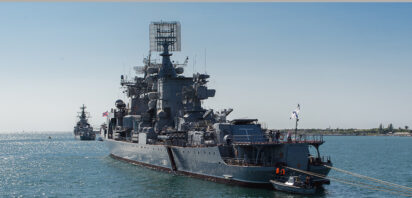
China, Russia, South Africa, and Iran commenced a week of joint naval exercises in waters off of South Africa on Saturday. The ‘Will for Peace 2026’ exercises were branded a BRICS Plus operation with the goal of ‘ensuring the safety of shipping and maritime economic activities.’
Why It Matters
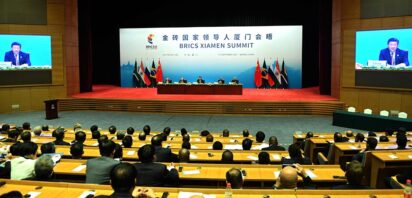
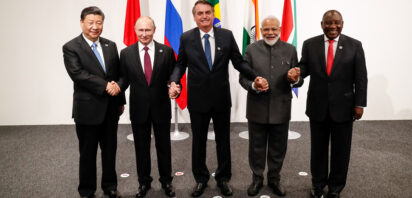
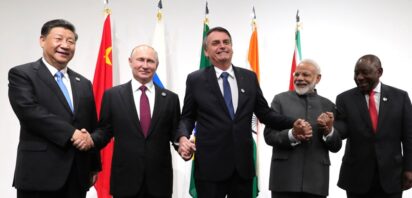
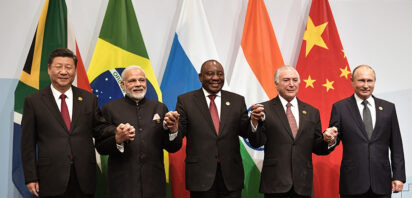
- A Fluid BRICS Plus Bloc. Iran, China, and Russia are at the heart of the naval exercises. The drills previously fell under a trilateral state-to-state framework (Exercise Mosi) before being rebranded as a BRICS Plus exercise, opening the door to wider participation… Yet BRICS heavyweights like India and Brazil have opted out, exposing the central contradiction of the BRICS Plus framework: different member states have different core interests, and the bigger the bloc, the more potential for conflict. In this case, India and Brazil are navigating a tempestuous trade relationship with Washington, one where the BRICS bloc itself has become a diplomatic point of contention. In this light, the military exercises are more an exercise in branding, signaling a possible future role for BRICS in the military realm without institutionalizing the collective defense or inter-operability frameworks that could guarantee it. As such, looking ahead, the BRICS branding could vanish as quickly as it appeared. Interestingly, this is not the first time these drills have been useful for signaling, as the Mosi II exercises were roundly criticized in the West for helping to rehabilitate Russia’s diplomatic reputation one year after the outbreak of the Ukraine war.
- ‘The Safety of Shipping and Maritime Economic Activities.’ The timing of the rebrand coincides with the US naval blockade of Venezuelan oil exports, though the announcement came before the dramatic seizure of the Russia-flagged tanker ‘Marinera’ in the Atlantic Ocean. Here we see the post-Cold War global order evolving in real time. Where sanctions were once enforced through the (inexpensive) voluntary compliance of external actors, all operating under shared circuits of global finance, now, (expensive) kinetic enforcement such as maritime boardings is increasingly necessary to achieve the same effect. Projecting into the future, it’s not hard to imagine a global economy where naval power is needed to escort trade flows (the Marinera, for example, was reportedly being escorted by a Russian sub). In this context, military cooperation between allied states will be essential for mitigating costs. But it still very much remains to be seen whether BRICS Plus will become the banner under which these operations are carried out.