Colombia has elected right-wing populist Abelardo de la Espriella as president by a thin margin. He promises a rapid securitization plan that he claims will restore territorial control within 90 days. But the realities of governing without the backing of a political party and the immense challenge of bringing order to a country that hosted the world’s longest civil war will make it nearly impossible to deliver.
Espriella won 49.7% of the votes, one percent more than his left-wing rival and Pacto Histórico candidate Iván Cepeda secured. He won the majority in the center of Colombia, which includes all the major cities. Cepeda won on the coast and the periphery, which is most affected by insecurity and organized crime.
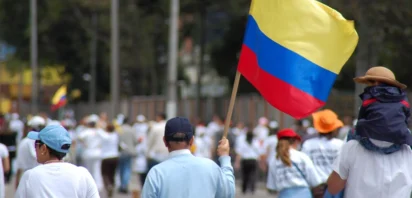
In the days before the election, I travelled from Cali to the Ecuadorian border in Nariño. As I drove, the density of “Firme por la Patria” posters faded to be replaced by Cepeda murals. On the day of the election, I witnessed a street party in the border city of Pasto, Nariño, of people dancing to classic left-wing songs and waving LGBT and M-19 flags.
Abelardo won because he harnessed a sense of growing insecurity in Colombia. He used “political staging that connects with many people who genuinely think that the country is the most insecure place in the world, that you cannot walk around safely,” according to Assistant Professor María Lucia Jaimes Bohórquez of the Universidad Externado de Colombia. She adds that these feelings are reinforced by the failures that have occurred under Paz Total.
Paz Total was the previous government’s policy of pursuing peace through negotiation with many of Colombia’s guerrilla groups, which did not secure any deals and failed to reduce violence. Abelardo has sworn there will be no more negotiations.
Espriella’s Plan for Colombia
Espriella positions himself as a populist and a political outsider. His presence in the second round of the presidential election came at the expense of Paloma Valencia, the establishment right-wing candidate for the Democratic Center Party, the closest thing to a party of government in Colombia.
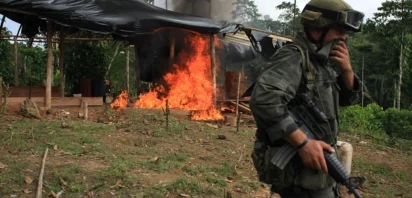
His plans in office are unclear since he ran only a handful of explicit policy platforms, most of which centered on security. Espriella told InfoBae in an interview that he has a 90-day security plan to “return to territories with a full security presence.” He promises a bombing campaign against “narco-terrorist camps,“ to fumigate “330,000 hectares of coca” fields, capture 10 guerrilla and criminal leaders, and deploy the army to the streets of major cities.
He’s also made an enemy of the Special Jurisdiction for Peace (JEP), which was established during the 2016 peace process with FARC as a truth-and-reconciliation body investigating human rights abuses committed by both FARC and paramilitary groups. Espriella called it “a political body disguised as a tribunal, to wash the blood-stained hands of FARC members and persecute the heroes of the nation.”
In the 2000s, collusion between members of Uribe’s government and paramilitary groups fighting guerrillas was well documented; the latter were responsible for a series of human rights abuses and extrajudicial killings. Additionally, the Colombian Army killed 7,837 civilians to inflate the number of guerrillas they could claim to have killed, an episode later dubbed “falsos positivos.” The JEP is responsible for investigating these incidents.
In 2004, De la Espriella founded an NGO called Fundación Iniciativas por la Paz (FIPAZ) that hosted events with demobilized paramilitary leaders during the government’s negotiations with the right-wing paramilitary group the AUC. Espriella later acknowledged that paramilitaries funded the events and claimed that the Uribe government authorized them.
The new president is also planning to construct “ten megaprisons built by private parties through concessions, in the middle of nowhere, where not even a phone signal gets in.” With this policy and much of his rhetoric, Abelardo is echoing the strategy of El Salvador’s President Nayib Bukele, who incarcerated 3% of El Salvador’s adult male population.
Bukele’s policies have successfully reduced gang violence in El Salvador. The country that formerly had the highest homicide rate in the world recorded just 82 total murders last year, albeit using a narrow definition of murder to suppress the rate. Bukele’s government achieved this partly by disregarding due process and standard judicial procedure, holding mass trials of large groups of prisoners simultaneously.
Despite those caveats, Bukele serves as a shining example for those who want to win political popularity by overpromising their ability to deliver security.
The Graveyard of Counterinsurgency
The problem for Espriella is that Colombia is not El Salvador. Bukele was able to fight street gangs like MS-13, not guerrilla armies. Groups like the ELN, FARC, and Clan del Golfo all have significant territorial control, influence over local communities, and troops accustomed to fighting the government.
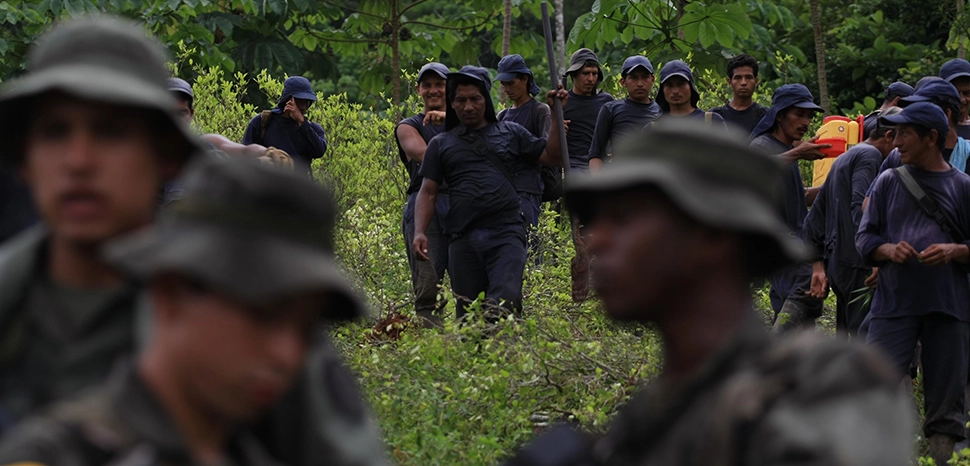
One illustrative example is Carlos Patiño, a small guerrilla front aligned with the Estado Mayor Central faction of FARC dissidents. The group controls the coca-producing region of Micay Canyon in central Cauca. In 2024, the government attempted to dislodge the group from the town of El Plateado with 1,400 troops, aircraft, and artillery capabilities in what it dubbed “Operation Perseo.”
But the operation only achieved limited results. Carlos Patiño still operates in the area immediately surrounding El Plateado. In June of 2025, 57 soldiers were detained by local people in the surrounding area for several days at the behest of the Carlos Patiño Front. This followed an earlier incident in which 28 soldiers were detained.
The key distinction between El Salvador and Colombia is that the primary challenge to enforcing the rule of law is not due process or an unwillingness to act, but the reality that when the Colombian army fights guerrillas, it often loses. The army can push back armed groups by concentrating forces on a specific area, but those guerillas will then go elsewhere in the country’s vast, mountainous territory.
The other major challenge that Abelardo de la Espriella will face is that armed groups like the ELN are being directly supported/sheltered by the Venezuelan government. The border with Venezuela is porous for both the ELN and some FARC fronts that operate in Colombia and in Venezuela.
The ELN has a meaningful presence in many of Venezuela’s border states, but especially in Apure. The ELN entered Apure in the 1980s to flee government operations in Colombia. In the 1990s, the group established a working relationship with the left-wing government of Hugo Chavez, which evolved under his successor, Nicolas Maduro, into a security partnership.
Colombian General Luis Fernando Navarro told El Tiempo in 2020 that between FARC dissidents and the ELN, there were 1,400 guerrilla fighters in Venezuela. It is unclear how the relationship between the ELN and the Venezuelan state will evolve under its new government, but for now, it appears to hold.
The ELN and FARC’s presence in Venezuela means that even if the Colombian government did meaningfully push the ELN out of the country, the group would still exist in Venezuela and could attempt to establish control within Colombia in the future.
Political Bargaining in an Era of Populism
Abelardo will have to navigate governing without the direct support of a major party. His platform, Salvación Nacional, has only four out of a hundred senators and two representatives. By contrast, Pacto Historico gained five seats in the March 2026 legislative elections and is now the largest political bloc across both houses.
He will likely be able to build a coalition in the short term. In the words of political analyst Juan Manuel Santos Arango: “Most parties are capable of giving Abelardo the benefit of the doubt, at least in the short term, because they will have an interest in being close to the government.”
But Abelardo’s style of politics is not suited to the compromise and negotiation is integral to coalition building. Santos Arango continues: “Abelardo’s pitch has been about rejecting parties. What he has said is that he will work with politicians not in their official capacity as party members, but as citizens. This again makes the possibility of formal cooperation more difficult.”
At the moment, Abelardo is popular, which will help him find the legislative support he needs. Without the backing of a party structure, congressional support could collapse because, as Santos Arango puts it, “if public support fades, there will be nobody interested in protecting him unless he gives them reasons to do so.”
A second challenge Colombia’s new president will face is navigating the shifting political landscape of Colombia’s right. The epicenter of right-wing politics for nearly a quarter of a century has been former president Álvaro Uribe and the political movement he created.
The failure of the Democratic Center’s presidential candidate, Paloma Valencia, to even reach the second round of the presidential race indicates that Uribe’s king-making power is fading. Uribe was on the Valencia ticket for a while as her proposed defense secretary and featured heavily in campaign posters.
In the words of political expert Sergio Guzman: “Uribismo is the old fading star. Abelardo and Abelardismo are the new rising star. The old star is going to become resentful, angry, and disappointed. It is going to have a difficult time accepting that its time is over. And I think the relationship between Uribismo and Abelardismo is going to be very fragmented.”