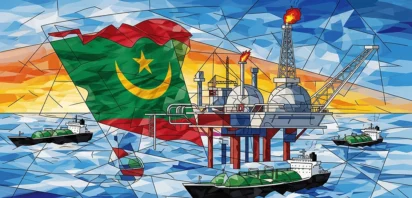
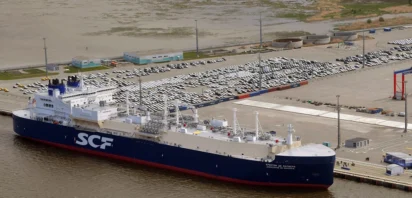
Europe hosted two conversations in Paris within the same week. On April 17, more than forty countries gathered to finalize plans for a naval mission to reopen the Strait of Hormuz. Five days later, energy ministers from West Africa and European investors convened at the IAE forum to examine the Atlantic corridor as a likely structural answer to the same crisis. Both meetings were serious. And their proximity reveals something that neither produced explicitly: Europe does not yet appear to have decided whether it wants to replace its existing supply architecture or restore it. What Paris revealed, across both meetings, is that Europe wants the benefits of diversification without accepting the conditions it requires. That gap is what the West African corridor is actually competing against.
The forum confirmed what the Hormuz disruption had already suggested. The GECF Secretary General opened proceedings by stating that the widely expected 2026 LNG oversupply has not materialized. Shifting geopolitics, capital discipline, and deferred final investment decisions are converging to tighten the market structurally rather than cyclically, with global gas investment needs estimated at eleven to twelve trillion dollars over the coming decades. The supply gap is not closing. Yet the same Secretary General also noted that there is a material gap between Africa’s gas capacity and its actual production, with no export pipeline to Europe currently running full. The corridor’s potential and its current delivery are not the same thing. At the same time, the forum itself widened the geography. Sierra Leone concluded three upstream agreements in two days, including a reconnaissance permit with Shell covering more than twenty thousand square kilometers of offshore blocks and a production license with Marginal Energy covering a further 6,800 square kilometers. The Gambia advanced its positioning within the MSGBC basin, presenting itself as one of the last first-mover opportunities along a geological trend now extending further southward than any of the original corridor’s producing countries. Gabon’s petroleum minister announced plans to sign production sharing contracts with ExxonMobil and BP within six months.
Behind all of this, however, the Nigeria-Morocco pipeline provided the forum’s most structurally significant backdrop. An intergovernmental agreement covering a twenty-five billion dollar, 6,900-kilometre pipeline traversing thirteen West African nations toward European markets was confirmed for signing in 2026, with first gas from initial phases expected in 2031. The corridor is acquiring the kind of physical infrastructure that spot-market flexibility cannot displace. These are real developments, and before the complications are introduced, they deserve to be stated clearly.
The Hormuz Mission as Revealed Preference
Yet while the IAE forum was discussing long-term African energy partnerships, the Hormuz planning meeting was revealing something else about Europe’s revealed strategic priorities. The objective of the coalition, as its organizers have stated, is to protect shipping through Hormuz through a mission described as independent and strictly defensive, with the restoration of commercial traffic and the stabilization of energy markets as the explicit intended outcome. That is a corridor defense strategy, not a diversification strategy. Europe is organizing military assets to restore the very supply architecture the Hormuz crisis exposed as fragile.
This is not irrational. The Hormuz closure is causing acute economic damage and the immediate pressure to restore flows is real. But it means the Atlantic corridor is competing not just against European short-termism and governance misalignment, but against an active institutional commitment to preserving the existing supply dependency. The two Paris meetings are not complementary. They reflect two incompatible readings of the same crisis. One treats the Hormuz closure as a temporary disruption requiring a military fix. The other treats it as structural confirmation that the existing architecture cannot be repaired. In the week that mattered most, Europe appears to have pursued both responses simultaneously without clearly choosing between them.
The coalition’s organizational logic makes this clearer still. Europe is deliberately building its Hormuz mission without US involvement, seeking operational independence from Washington. But the mission’s purpose is to restore a supply architecture whose stability depends on Hormuz remaining open, which is precisely the structural vulnerability the corridor argument identifies as the problem. Europe is asserting strategic autonomy from Washington through a military operation that restores the supply conditions the Atlantic corridor is supposed to make less necessary.
The Temporary Relief Problem
Even setting aside the Hormuz mission, the corridor faces a structural mismatch between the urgency driving European engagement and the durability that engagement would need to have. Europe’s pattern after 2022 is instructive. European buyers signed memoranda of understanding across Africa, the Mediterranean, and the Gulf. Few produced long-term offtake agreements. Crisis drives engagement; easing pressure drives reversion to spot markets. The APPO Secretary General named this at the forum. Africa cannot remain in the logic of short-term transactions, he said, arguing that what producers need is long-term partnerships that justify large-scale investments and create stability for both sides. I suspect European counterparts heard that as a negotiating posture rather than a structural condition.
The structural mismatch runs deeper still, because Europe’s own policy trajectory deepens the problem in ways that are not cyclical. The European Green Deal, binding decarbonization targets, and the political economy of the renewable energy transition all point toward declining long-term gas demand. African producers are being asked to build infrastructure at a scale requiring decades of offtake certainty for a market that is simultaneously legislating itself away from the fuel those projects produce. Between 2027 and 2030, EU long-term LNG contracts are projected to surpass demand, with surplus volumes being redirected to global markets. The demand signal driving European interest in the corridor today is crisis-driven. The structural demand signal over the medium term runs in the opposite direction. Producers who understand this dynamic are not simply asking for long-term contracts. They are asking Europe to commit to a timeline that its own climate policy is working against, and the distance between those two positions has not narrowed.
The New Dependency Problem
The Nigeria-Morocco pipeline is the corridor’s most consequential structural development, but it also introduces a dynamic the Atlantic corridor argument has not yet fully reckoned with. Morocco would become a transit node for Nigerian gas reaching European markets along a route traversing thirteen countries. Transit node leverage is the defining structural weakness of the Gulf corridor, a single point through which a political actor can extract rent or disrupt flows regardless of the number of supply contracts nominally in place. The pipeline risks replicating that logic in a West African register. Rabat would acquire a degree of leverage over both Nigerian producers and European buyers that no current LNG shipping arrangement creates. Whether Morocco would exercise that leverage is a separate question. That it would possess it is not in doubt, and in a period when Washington has demonstrated that energy relationships and political leverage are difficult to separate, it is worth asking whether Europe is comfortable creating an equivalent dependency at the corridor’s northern terminal.
And the transit country problem does not stop there. Several of the thirteen countries the pipeline traverses have experienced coups or significant political instability within the past five years. Niger’s 2023 coup, which effectively suspended progress on the trans-Saharan pipeline project and cast doubt on the entire Sahel transit corridor, demonstrated what political fragility does to infrastructure logic. A pipeline whose insulation from Hormuz risk depends on the simultaneous political stability of thirteen West African states is not structurally equivalent to open-ocean LNG shipping from Bonny Island or Punta Europa. The corridor’s geographic independence from Gulf chokepoints does not automatically extend to the political geography of the transit corridor itself. That is a distinction the enthusiasm around the pipeline announcement at Paris largely elided.
The Governance Contradiction
Africa arrived in Paris with a clear position. NJ Ayuk’s opening address was not rhetorical excess. It was a deliberate strategic signal, delivered in Trump’s register precisely because that register currently commands capital and political attention. The message was that Africa intends to drill, produce, and monetize its resources at full speed, and that European regulatory proposals reaching beyond EU borders to dictate production standards for African producers would be resisted. From a producer’s perspective, that position reflects a legitimate developmental logic. The continent contributes less than three percent of global emissions and has hundreds of millions of people without reliable electricity access. The problem is not the logic. It is that the logic is structurally incompatible with Europe’s governance requirements for long-term supply partnerships.
EU methane regulations from 2027 will require new import contracts to comply with EU-equivalent reporting rules, and maximum methane-intensity values will apply to fossil fuel imports from 2030. The Carbon Border Adjustment Mechanism adds further compliance layers for producers seeking access to European markets. These standards determine which producers can participate in the long-term contracting relationships that Phase 2 expansions and pre-FID projects require to attract financing. A producer who rejects the compliance architecture cannot access the offtake agreements that justify the capital commitments. A producer who accepts it operates within a development register that Ayuk was explicitly rejecting. The tension between Europe’s compliance-before-commitment position and Africa’s commitment-before-compliance position was audible throughout the forum.
What Genuine Diversification Requires
The Atlantic corridor is real, geologically compelling, and better positioned than any alternative currently available. Paris confirmed the corridor’s urgency and revealed its depth. But it also revealed, with more precision than before, the gap between geographic potential and strategic commitment, and the conditions under which the corridor serves as temporary relief rather than becoming a durable element of European supply architecture.
Genuine diversification would require Europe to commit to long-term offtake before the crisis eases rather than after, when the urgency currently concentrating attention will have dissipated. It would require a transit architecture for the Nigeria-Morocco pipeline that does not replicate Gulf leverage dynamics at Rabat. It would require a governance alignment between African producers and European buyers that neither side has yet moved toward. It would require Europe to reckon honestly with the tension between its short-term supply emergency and its medium-term decarbonization commitments, rather than allowing crisis conditions to generate African infrastructure investments that its own policy trajectory may eventually strand. And it would require treating the Hormuz mission and the IAE forum as competing rather than parallel responses to the same structural problem, because pursuing both simultaneously without choosing between them is not a strategy. It is the absence of one.
Even so, the corridor’s position has strengthened. The forum widened the geography, deepened the infrastructure argument, and produced concrete upstream commitments in markets that were not part of the energy investment conversation a year ago. Whether European counterparts translate that into contracting appetite at the Africa Energies Summit in London on May 12, or treat Paris as another well-attended conversation without commercial consequence, is the question that now matters. Iran has now submitted a formal proposal to reopen the strait before nuclear issues are resolved. If accepted, the urgency currently concentrating European attention on the corridor will ease, and with it, in all likelihood, the contracting appetite Paris was supposed to generate. I suspect the answer will depend less on the analytical case, which is becoming harder to dismiss, than on whether the Hormuz crisis persists long enough to force the structural commitment that strategic preference alone has not produced.