Geopolitics Weekly analyzes emerging geopolitical trends around the world, distilling the cacophony of global events into one easy reader. It lands in the inbox of Geopolitical Monitor subscribers every week. This week’s edition has been made available to all our readers.
Middle East
Iran War Ceasefire Frays as a Peace Deal Remains Elusive
What Happened
Notable developments in the Iran war over the past week:
- Ceasefire frays on both ends. The week saw a broad uptick in strikes. Both Hezbollah and the Israelis have been conducting strikes in Lebanon, including the first Israeli airstrikes targeting Beirut since the ceasefire took hold. Limited hostilities also resumed in the vicinity of the Strait of Hormuz. A rough timeline:
- ‘Project Freedom’ is launched on May 4, envisioning US Navy escorts for civilian tankers traversing the Strait;
- Project Freedom is put on hold ‘for a short period of time’ on May 6;
- Iran launches missiles at US missile destroyers traversing the Strait on May 7;
- The US military immediately responds by attacking Iranian sites near the port of Bandar Abbas, and the Gulf island of Qeshm. Multiple figures in the Trump administration stress the limited and defensive nature of the strikes;
- President Trump rejected an Iranian peace proposal on May 10, calling it ‘totally unacceptable.’
- Iranian drone and missile attacks targeted the UAE throughout the week, including in the direct aftermath of the US port strikes on May 7. A barrage on May 4 heavily damaged an oil refinery in Fujairah.
- Iranian and US forces boarded, struck, and/or seized tankers, in the Strait of Hormuz and Arabian Sea respectively. On May 8 alone, the Iranians attacked a China-flagged tanker transiting the Strait and seized at least one other Barbados-flagged tanker in the Gulf of Oman. According to CENTCOM, more than 50 Iranian vessels have been redirected and ‘multiple’ vessels disabled since the blockade was established on April 13.
- ‘Project Freedom’ is stillborn. The rise and fall of Project Freedom illustrates a ground-level reality that the war has put beyond dispute: the US military alone cannot ensure the safety of shipping through Hormuz so long as Tehran remains hostile. The IRGC has yet to demonstrate the capacity to directly imperil US Navy ships in transit; however, it can certainly create costs for Gulf allies and global shipping interests. Moreover, the Financial Times revealed that Project Freedom was temporarily shelved after the Saudis refused to allow their bases to be used in the operation. (They have since reversed the decision, after the operation was cancelled). According to one of the sources, the plan was “unnecessarily escalatory and not well thought through.”
- Iran has hit 228 structures at 15 US bases throughout the region since February 28. Satellite analysis conducted by the Washington Post found much more damage to US regional assets than has been publicly disclosed by the Pentagon. Targets have included hangars, barracks, fuel depots, aircraft, and radar installations. In some cases, staff have been evacuated from the bases over safety concerns. The tally is not exhaustive because the satellite imagery available to WP reporters only covered the first two weeks of the war.
- President Trump rejects Iranian peace proposal, calling it ‘totally unacceptable.’ Reports from the Guardian and Wall Street Journal illustrate how far apart the two sides remain. The US proposal called for the transferring of Iran’s stockpile of enriched uranium to a third-party state and the dismantling of nuclear facilities for a 20-year moratorium. The Iranian proposal conceded on a moratorium, albeit shorter, along with a partial export of its uranium stockpile and dilution of the remainder. Critically though, Tehran rejected US demands to dismantle its nuclear facilities and sought immediate sanction relief and security guarantees against a future US-Israeli attack.
The prevailing dynamic remains: President Trump is being forced to choose between the political humiliation of an expensive war that fails to achieve its (second) stated objective in nuclear disarmament, or a new military escalation that is tactically, diplomatically, and economically fraught. Playing for time is possible, but the two sides face different time horizons. Strains are beginning to show in the Iranian economy as food prices spike amid the ongoing US blockade. But pressures also exist for Washington: moribund polling ahead of the mid-terms; high domestic fuel prices; rationing among close allies; looming destabilization from global food prices, etc. It will come down to which side is better equipped to absorb the shocks and wait out the other side.
Global Food Prices Tick Upward in April
What Happened
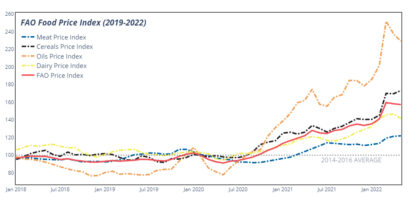
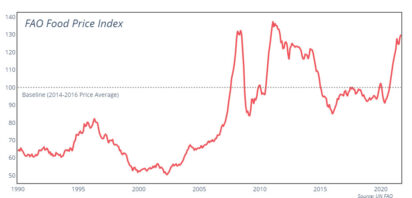
The UN’s Food and Agriculture Organization (FAO) food prices index hovered near three-year highs in April, led by a 5.9% month-on-month increase in the price of vegetable oils.
Why It Matters
The April reading of 130.7 is the highest since 2023 but is still below the recent peak of 160.2, which was recorded in the immediate aftermath of the Ukraine war breaking out in 2022. Nevertheless, new highs are already baked in due to the Iran conflict. Vegetable oils are highly correlated to global energy prices due to how they make biofuels more economically viable. They represent the first sign of rupture in global food supply chains – one that’s already enough to bring the FAO index to a three-year high. The next phase will be when fertilizer disruptions begin to resonate in harvest yields later in the year, impacting cereal crops and, by extension, meat prices. The lag between fertilizer supply disruption and harvest can be up to six months. And in the meantime, higher diesel prices will generate upward pressure on cultivation and shipping costs.
Europe
Ukraine and Russia Announce Three-day Ceasefire
What Happened
Russia and Ukraine have agreed to a three-day ceasefire for Victory Day celebrations marking the defeat of Nazi Germany in World War II, from May 9-11. President Trump has expressed hope that the agreement might be extended beyond May 11. However, both sides have already accused the other of several violations.
Why It Matters
The ceasefire is notable given that past attempts by the Ukrainian and US side have typically come to nothing. It represents a moderation of the aggressive negotiating posture Russia has maintained until now, and it comes amid several other indications that the conflict may be coming unstuck. These include:
- A New Tone in Moscow. Vladimir Putin seems to be signaling that an endgame is in sight, recently saying that he thinks the “matter [of the Ukraine war] is coming to an end,” while expressing willingness to participate in new European security structures. Rumors are swirling of a possible coup attempt against Putin, who has bolstered security around his person of late. These rumors are perennial and impossible to verify; however, an internal power struggle triggered by popular (economic) disenchantment, setbacks on the battlefield in Ukraine, and Putin’s own advancing age would align closely with the power dynamics of authoritarian regimes elsewhere. Incidentally, in the unlikely event that Putin does fall from grace, Ukraine may be the least of worries for whoever replaces him.
- New Military Realities. Russian hopes of a collapse of the Ukrainian frontline are becoming untenable, with Kyiv retaking achieving its best territorial gains in April since the Kharkiv offensive. Ukraine has also demonstrated a consistent ability to strike deep within Russia, with targets ranging from upscale Moscow apartment towers to oil refineries in the past few weeks. It was this demonstrated capacity to hit targets in Moscow that likely contributed to Putin’s decision to accept the three-day ceasefire. Much like the Iran war, the effectiveness of long-range drone strikes represents the ascendance of offensive, mass-produced weapons over technologically superior (and expensive) defensive platforms. In the end, it doesn’t matter how sophisticated US or Russian countermeasures are if there are simply too many incoming projectiles to intercept.
- New Political Realities in Europe. The fall of Viktor Orbán removed the final obstacle to a €90 billion dollar EU loan to Kyiv, covering its ‘most urgent budgetary and defense industrial capacity needs’ through 2026 and 2027, and just as the Russian war economy begins to show open signs of distress. Now the primary backer of Kyiv on the world stage, Brussels is preparing to backstop its economic support with a larger diplomatic role. There are now rumblings of a new negotiating process between the EU, Russia, and Ukraine – sans Washington – that could ultimately produce some degree of diplomatic recognition between Brussels and Moscow.