In the aftermath of Operation ‘Absolute Resolve’—the military operation during which US forces captured Venezuelan President Nicolas Maduro in early January—President Trump’s deputy chief of staff for policy and homeland security advisor, Stephen Miller, outlined his view of a world where power outweighs principle:
“We live in a world in which you can talk all you want about international niceties and everything else, but we live in a world, in the real world…that is governed by strength, that is governed by force, that is governed by power. These are the iron laws of the world since the beginning of time. We’re a superpower, and under President Trump, we are going to conduct ourselves as a superpower.”
Emboldened by the success of the Venezuela operation, the Trump administration has now set its sights on Iran, launching Operation ‘Epic Fury’ in the early hours of February 28th after negotiations in Geneva concluded without any significant breakthroughs. After more than a week of continuous aerial bombardment, the objective of Epic Fury remains unclear. From the outset, however, it has been accompanied by the same sense of triumphalism that followed the capture of Maduro.
During a press conference at the Pentagon on March 2nd, for example, US Secretary of Defense Pete Hegseth declared that the war with Iran was being fought “on our terms, with maximum authorities,” and free from the scruples of “traditional allies who wring their hands and clutch their pearls hemming and hawing about the use of force.” President Trump has also repeatedly called for Iran’s “unconditional surrender” while threatening it with “death, fire, and fury.”
Miller, Hegseth, and President Trump may not be aware of the fact, but their statements evoke one of the most important episodes of classical antiquity for international relations: the famous Melian Dialogue. Revisiting this episode offers insight into the nature of the conflict with Iran, as well as a warning about what may come next.
Echoes from History
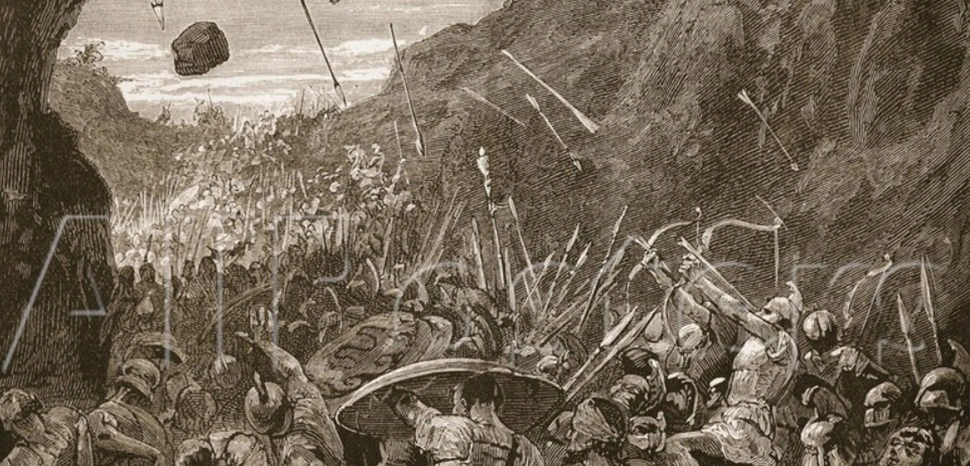
The dialogue takes place in 416 B.C. during the Peloponnesian War between Athens and Sparta. As recounted by the Greek historian Thucydides in his History of the Peloponnesian War, the Athenians sent a formidable naval fleet to the neutral island-state of Melos, demanding that the Melians pay tribute and join the Delian League (effectively rendering Melos a vassal of the Athenian empire) or be destroyed.
The Melians, a proud and free people, reject the Athenian demands, appealing to principles of justice and arguing that it would be dishonorable to submit without a fight. The Athenians then ridicule the Melians for placing their hopes in lofty ethical ideals, arguing that Athens’ superior military strength alone would decide the outcome. The Athenians add that, having already made their demands of Melos, they cannot risk accepting its independence, lest they be perceived as weak by their adversaries.
Conceding that the Athenians possess the strategic advantage, the Melians offer to sign a treaty guaranteeing their continued neutrality in the war with Sparta. Unwilling to accept anything less than complete capitulation, however, the Athenians lay siege to Melos. Although the Melians mount a stubborn resistance, the Athenians eventually conquer the island, massacring its men and enslaving its women as a warning to others who would dare to challenge Athenian might.
For students of international relations, the Melian Dialogue is often understood as a meditation on the centrality of power in international politics. In an anarchic world lacking any central authority, the lesson seems to be that might is ultimately more important than considerations of right. In the dialogue, this idea is captured by the observation that “the strong do what they can and the weak suffer what they must,” traditionally taken as the starting point of political realism.
It is questionable whether Thucydides would have agreed with this interpretation of the dialogue, however. What is often overlooked is the fate that befalls Athens later on.
According to Thucydides, after the destruction of Melos, the Athenians decide to attack the Sicilian city-state of Syracuse against the advice of the Athenian general Nicias. For Nicias, Athens would have been better served to conserve its strength and prepare for the inevitable confrontation with Sparta, but the Athenians are swayed by the statesman Alcibiades, who convinces them that the Syracusans are weak and that the other Sicilian city-states (who were not on friendly terms with Syracuse) would happily support the Athenian attack. Alcibiades also suggests that victory would allow Athens to extend its power throughout the region and greatly enrich itself with the spoils of war.
At the start of the offensive, the Athenians appear to possess the upper hand. Slowly but surely, however, the tide turns in favor of the Syracusans, who manage to rout the Athenian forces with help from Sparta, marking a decisive turning point in the whole Peloponnesian War. Although Athens manages to fight on for another decade, Thucydides traces their eventual defeat in 404 B.C. back to the disastrous effects of the Sicilian expedition.
By linking the collapse of the Athenian empire with the failure of the Sicilian expedition, Thucydides gives expression to a timeless theme: an ambitious and powerful state, which has conflated its military strength with the right to impose its will on others, loses sight of the principle of restraint and thereby brings about its own downfall. Indeed, read in its entirety, Thucydides’ account seems less an affirmation of power politics than a cautionary tale about the consequences of what ancient Greek philosophers called ‘pleonexia,’ which loosely translates to ‘greed’ or ‘the desire for more.’ In Thucydides’ telling, it is this insatiable desire for ever expanding power and dominion that drives Athens to the point of strategic overreach and, eventually, ruin. In other words, might may win out over right more often than not, but hubris always brings about its nemesis.
A Sicilian Expedition for Our Times?
As the latest Middle East war enters its second week, one wonders whether we have embarked on our own ‘Sicilian expedition’ in Iran. Although President Trump recently stated that he believes the war will be over “very soon,” he has also indicated that he is prepared to do “whatever it takes” to achieve the objectives of Epic Fury, raising the possibility of a protracted conflict. The president has also said that any decision to end the war would be made jointly with Israeli Prime Minister Benjamin Netanyahu, who recently stated that there is “more to come” in Iran while reiterating his calls to the Iranian people to topple the regime.
Even if President Trump were to unilaterally declare victory, it is questionable whether Iran would allow US forces to disengage from hostilities, as its leadership appears resolved to inflict as much pain on the US and its allies in the region as possible. During a recent NBC news interview, Iranian foreign minister Abbas Araghchi explicitly rejected rumors that Iran is seeking a ceasefire, stating that his country is prepared to continue fighting until there is a “permanent end to the war.”
Taken together, these dynamics suggest a conflict that is likely to escalate further before it resolves.
Perhaps I am wrong and an off-ramp will present itself in the coming days. Whether any of the major players would recognize such an opportunity amid the fog of war, however, is another question. As Thucydides observed: “When people are entering upon a war they do things the wrong way round. Action comes first, and it is only when they have already suffered that they begin to think.”
The views expressed in this article belong to the author(s) alone and do not necessarily reflect those of Geopoliticalmonitor.com.