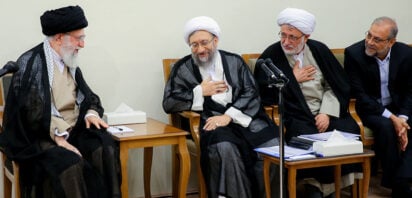
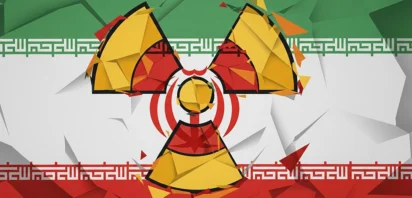
Americans concerned, if not outraged, by the Iranian nuclear agreement, see in Supreme Leader Khamenei’s unchanged attitude toward the United States evidence of its failure and of the Islamic Republic’s perpetuation of bad faith. As agreed in Vienna in July, Iran will curb its nuclear program for at least ten years in exchange for the lifting of Western economic sanctions. But critics present speeches by Ayatollah Khamenei on the Iran nuclear deal, delivered as he holds an AK-47 rifle, defying American policy in the Middle East, sprinkled with chants of “Death to America” and “Death to Israel,” as evidence that Iran is not serious about pursuing an Iranian version of glasnost – in Persian, goshayesh. The problem, of course, is much more complex than that. Just as conservatives in the United States are worried about a sanction-free Iran, conservatives in Iran, championed by Khamenei’s parliamentary factions and the Revolutionary Guards, or ‘Sepah,’ mistrust the United States. More significantly, they fear falling into political irrelevance, facing a fate little better than the Communists of the old Soviet Union. Indeed, while Tehran is now freer to pursue its regional and international goals, eroding Saudi influence and Israeli power by changing the dynamics in Syria, Lebanon, Iraq or Yemen, the preservers of the Islamic Republic’s ideology, ‘velayat-e faqih’ (the rule of the Islamic jurisconsult – i.e. rule of the ayatollahs) are far more preoccupied by Iran’s internal dynamics.
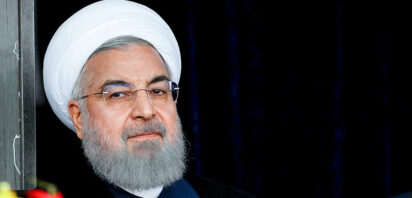
They want to ensure that the pace of goshayesh does not accelerate beyond their control. In other words, Khamenei and the Sepah militias have far more to fear from the nuclear agreement than the United States or Israel for that matter. There is a conflict between the ‘osul-garayan’ and ‘eslah-talaban, ’respectively the conservatives and reformers because the national consequences of the pact will likely be even more pronounced than the international ones. Whereas the nuclear agreement marks a significant achievement for the reformers, represented by those directly involved in the negotiations, namely President Hassan Rouhani and Foreign Affairs Minister Mohammad Javad Zarif, it has also cracked Iran’s internal equilibrium. Undoubtedly, there are convergences between the two camps otherwise the negotiations would not have been possible; it was understood that ayatollah Ali Khamenei wanted to secure the agreement, even if his statements seem to oppose its implementation. The Revolutionary Guards, or Sepah, however, may be more genuinely opposed as they have the most to lose. Their leader, General Ali Jafari expressed his skepticism, noting that any resolution would lose validity if it should contradict the policy of the Republic Islamic of Iran. The points Jafari finds most objectionable are those related to inspections of military facilities and the extension of the arms embargo for another five years. The reformers, however, are far more interested in the fact that the agreement has opened the Iranian economy to foreign investment as immediately confirmed by Mohammad Khazaee, Iran’s ambassador to the United Nations. From the economic point of view, there is a strong opening to the outside benefiting Iranian productive sectors while forcing the conservative factions to accept dialogue with the United States.