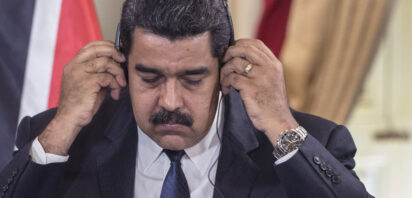
The removal of Nicolás Maduro may satisfy Washington’s appetite for decisive action, but it does not amount to regime change. For Venezuela’s citizens, the fall of one man, however dramatic, means little if the political, military and economic structures that sustained his rule remain intact.
Chavismo was never built around a single leader. It is a system more than two decades in the making, defined by military patronage, intelligence services, state-controlled economic chokepoints and a political hierarchy designed to survive leadership turnover. That reality became apparent almost immediately after Maduro’s extraction, when both Venezuela’s defense minister and interior minister were seen operating publicly and without disruption. Their continued visibility underscored a basic truth: the regime’s core institutions remain firmly in place.
From this perspective, what is being presented as a turning point looks more like a managed transition at the top than a transformation of the system itself. Removing the figurehead without dismantling the apparatus of repression and control—security services, courts, electoral authorities and economic monopolies—does not liberate a country. It preserves continuity under a different face.
This outcome is not inconsistent with how the Trump administration approaches foreign policy. Donald Trump has consistently rejected democracy promotion and regime-building as objectives in themselves. His foreign policy emphasizes transactional outcomes: security cooperation, economic access and the exclusion of strategic rivals, rather than long-term institutional reform.
In Venezuela, that logic points to a narrow, pragmatic bargain. Washington secures cooperation on narcotrafficking, access for US energy companies to Venezuela’s oil sector, and reduced strategic space for China. In return, the existing power structure is allowed to persist so long as it delivers stability and compliance. The United States avoids a prolonged military commitment, declares success and moves on.
Donald Trump’s comment about the United States “running” Venezuela for now should be read through this lens. Short of a sustained military presence or a comprehensive plan for institutional rebuilding, neither of which appears likely, the Chavista elite has little incentive to dismantle itself. Autocratic systems rarely do. More often, they adapt, sacrificing individuals to preserve the structure that keeps them in power. Trump himself has publicly questioned whether opposition leader María Corina Machado commands broad national support, language that effectively lowers expectations for democratic succession and signals acceptance of elite continuity.
For ordinary Venezuelans, the consequences are sobering. Elections conducted without institutional reform remain hollow. Anti-corruption promises without accountability are performative. The same elites retain their positions, their influence and, critically, their illegally accumulated wealth. What changes is not the nature of governance, but its external alignment.
In practice, such arrangements benefit those closest to power while excluding the societies they govern. When diplomatic engagement prioritizes stability, access and compliance over institutional reform, negotiations inevitably take place among elites, domestic and foreign, with ordinary citizens left outside the room. In Venezuela, reopening channels for selective investment, energy access and security cooperation without parallel demands for accountability risks reinforcing precisely the system that impoverished the country in the first place: a political economy built on insider privilege, opaque bargaining, and immunity from consequence.
These dynamics produce predictable winners and losers. Regime insiders survive. Foreign firms regain access to valuable assets. Politically connected intermediaries profit from newly permissive arrangements. Those excluded from the equation are Venezuelan civil society, opposition movements, and democratic institutions, which remain marginalized despite the change in leadership at the top.
Any US-Venezuela accommodation will likely pressure Caracas to scale back support for Cuba, aligning with Secretary Rubio’s priorities. But weakening an authoritarian regime’s external lifelines rarely produces democratization; such systems tend to adapt by recalibrating patrons rather than reforming internally, a pattern Cuba is unlikely to escape.
The manner of Maduro’s removal itself points to continuity rather than rupture. Autocratic systems rarely collapse solely from external pressure. They fracture when insiders conclude that sacrificing the leader is preferable to risking the system. If elements of Maduro’s inner circle facilitated his exit in exchange for regime survival and external protection, it would fit a well-established pattern: ideology yields to self-preservation.
For American audiences, the optics of decisive action are appealing. For Venezuelans, they may prove illusory. Without a credible plan for what comes next, one that addresses institutional reform, accountability, and political pluralism, the removal of Maduro risks becoming a footnote rather than a turning point.
Washington will declare success. Markets may respond. Headlines will move on. But for Venezuelans, the essential question remains unanswered: who holds power, and in whose interest? Until that changes, Maduro’s exit is political theater, not transformation.
The views expressed in this article belong to the author(s) alone and do not necessarily reflect those of Geopoliticalmonitor.com.