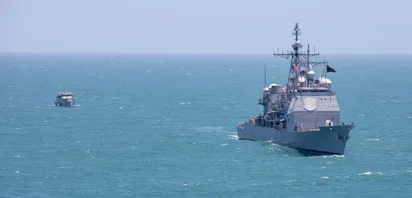
In the early hours of today, January 3, a Delta Force team carried out a surgical bombing and offensive raid in strategic operational sites in northern Venezuela. As I write this piece from the capital, Caracas, where I have lived for 30 years, I can attest to the sheer horror and shock of bombshells echoing through an empty and quiet night, as the equally dazzling sound of engines and helixes made it clear to my family that this wasn’t an ordinary exercise from the Venezuelan military, nor one of the many parties and fireworks that the government likes to throw, unannounced, in late evenings.
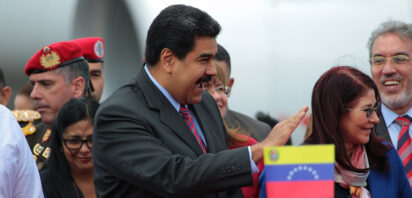
Like an earthquake, the bombshells shook the earth, rattled windows and floorboards, and sent a sleeping nation into irrational frenzy. Hours later, we learned that these were Chinnook helicopters, that they had all but destroyed the Fuerte Tiuna holdout, where the military university and headquarters are located, crossing hundreds of kilometers in a massive raid conducted across three states that seemingly delivered no civilian casualties. Rumors circled that the Minister of Defense, Vladimir Padrino López, had been assassinated along with his family, since his residence had been attacked. This was later proven to be false, since he appeared in a live streaming from a rather strange location, similar to a bunker. Then, sometime later, Donald Trump revealed through his Truth Social what seemed unbelievable: Nicolás Maduro and Cilia Flores had been captured and extracted to US soil.
The avalanche of social hysteria, in a country unused to war or traumatic events of this scale, has been uncontainable. That being said, something became very clear to me: US-Latin America relations would not remain the same. By attacking the gravitational center of Venezuela, exploiting and exposing its inner vulnerabilities, US hegemony is back into the fold as a continuation of Pax Americana-style imperialism. At the same time, it reveals the banal, abstract, and unrealistic nature of the power held by Latin American states, unaccustomed to conventional wars, but proud about a heritage and national mythos that do not transform into tangible strength.
Venezuela, under the grip of Bolivarian ideology, is usually dismissed as a minor actor in foreign relations and geopolitical analysis. This is a mistake. At the regional and sub-regional level especially, it continues to be an important actor. But there is a particular player that wages a war in the shadows to effectively operate a counter-hegemonic contention strategy against the United States: Cuba. In the Caribbean, with Venezuela, and in Central America, with Nicaragua, Cuba has consistently behaved as a sub-regional imperial power dictating a unitary foreign policy consolidated by Leninist ideology and regional exceptionalism.
Venezuela is the crown jewel of this internal geopolitical balance, with its oil reserves, Orinoco mining belt, and unexploited natural resources. If the Caribbean, according to Admiral Thayer Mahan, is to be considered the ‘Mediterranean of the Americas,’ then Venezuela is Carthage: a decaying regional power, a logistical port and beachhead, whose abundant natural resources and oil reserves should be ripe for the regional structural hegemon. In contrast, Cuba would be something like Sparta: a military thalassocracy guided by ideology, balancing its small size with soft power efficiency. While the U.S., Rome, goes and takes it all, whether counting on local allegiance or not.
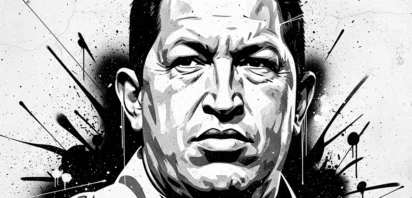
The late President Hugo Chávez, who kicked off the Bolivarian Revolution, was a mild, if not profoundly confused ideologue. He was not the revolutionary that Fidel Castro or Che Guevara were; he came from the regular military, slowly embracing Cuban soft power. His nationalism contradicted Leninist worldviews. But his fatal mistake was acting against the geopolitical imperatives of his own country. By antagonizing the regional hegemon, the U.S., and forging alliances with far-away powers with whom it shared no logistical and geopolitical connection (Russia, China, and Iran), it enabled Venezuela to become the shatterbelt of the Americas. And in so doing, this blind strategy risked destroying Latin America’s inner institutional balance as a region without a significant history of conventional wars between nation-states (basically the envy of Europe in this regard).
Those days are over. This might just become the beginning in a long chain of strategic operations aimed at dismantling Westphallian sovereignty over the Western hemisphere, in order to construct the Greater America that Trump seemingly desires. An empire that ignores the source of its historical strength, liberalism, incurs a similar flaw as Chávez himself: an irrational view of geopolitics and a cornerstone for geopolitical imbalance and instability.
The views expressed in this article belong to the author(s) alone and do not necessarily reflect those of Geopoliticalmonitor.com.