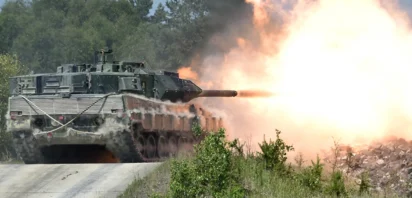
In his New Year’s address welcoming 2026 and reflecting back on 2025, Polish Prime Minister Donald Tusk made a bold pronouncement to the rest of Europe: ‘be more like Poland. Vibrant, courageous, and safe.’ Tusk cited Poland’s strong economic growth, enhanced security along its eastern border with Belarus, and revitalized military, with near 5% defense spending in 2026 and Warsaw due to have more tanks than Germany, France, the UK, and Italy combined by 2030. For Poland, being vibrant, courageous, and safe are not mutually exclusive traits but a necessary combination in order to safeguard the homeland, contribute to Europe’s wider defense, and to continue to grow and innovate as a nation. There is a bold mixture of pure national interest involved in this calculation as well as a clear message to the rest of Europe that your safety has to come first, it has to be homegrown, tinged with a degree of nationalism but supportive of the wider European project. For Tusk, as well as President Nawrocki from the opposition Law and Justice party, 2026 will see Poland as integrated as ever with Europe while continuing to fiercely adhere to its vision of a positive Euroscepticism that is essential to the growth of the wider bloc.
Meanwhile, across the Baltic, Finnish President Alexander Stubb delivered another New Year’s message that spoke not to Finland’s greatness but to the realities of the present geostrategic moment, for which Finland has particular historical insight. According to Stubb, “we are closer to peace in Ukraine that at any previous point during the war”, however, “we must be prepared to accept that there may be parts of an eventual peace agreement that do not align with our sense of justice.” Stubb recognizes the importance of small states like Finland, the Baltic nations, and Czechia in speaking to historical territorial agreements and concessions that can either pave the way for peace or for future war. However, Stubb, and the leaders of Poland and the Baltic states are also realists, knowing that much larger great powers often have more influence over the course of their history and their own security. For Stubb and others, it is sometimes necessary to settle for small victories or concessions in order to achieve a larger, longer-term sense of victory. It may be painful, but it is the reality of existing as a small state on the periphery of Europe, no matter how much of a core player in Europe all of the Baltic states, and Finland presently are.
Even with Stubb’s optimism, the odds are low of the Ukraine war coming to an end in the first half of 2026, and perhaps not even in the latter half. What is clear, however, is that Poland, Finland, Ukraine, the Baltic states, and others are calling for much greater courage. Courage for Europe to determine its own affairs and its own destiny, for it to be secure within its borders, and to prosper economically as best it can irrespective of outside economic forces. Poland’s success is Europe’s success, however the conditions in Poland responsible for its rise and prosperity are not present throughout much of Europe. That is the essence of Tusk’s message, whereas Stubb’s message is one of resilience based on geography.
Both messages speak to a confidence that is sorely lacking among the wider continent, a confidence that comes from continually learning to adapt your society and capabilities under the premise that history doesn’t return but constantly lingers. It is a confidence that comes not from living in fear of your larger, revanchist neighbor, but from maximizing your self-sufficiency, securing your path to statehood and integration within Europe, and ensuring that all citizens are prepared for the worst eventuality should it materialize.
The adaptation, resilience, and most importantly, stability and safety that Poland and Finland enjoy is something that should be shared by all EU and NATO member states. Tusk and Stubb are crying for a bolder Europe, one that doesn’t cower because it fears humiliating Russia or other powers, but one that is self-sufficient, confident, and vibrant enough to be able to export its model to the rest of the world. 2026 will be another trying year for European security, not least for Ukraine and for the thousands of Ukrainian civilians and soldiers who are dying while fighting for their country’s future. Peace may fail to come to Ukraine this year, but an increase in confidence, ultimately leading to stability, should not fail to come to Ukraine’s neighbors and allies across Europe.
The views expressed in this article belong to the author(s) alone and do not necessarily reflect those of Geopoliticalmonitor.com.