As Israel escalated its campaign against Iran’s nuclear and proxy networks, the shockwaves are felt far beyond the Middle East. Thousands of kilometers away, Iranian-supplied Shahed drones continue to strike Ukrainian cities—a grim reminder that these two seemingly distinct conflicts are tightly interwoven. The wars may differ in their origins and immediate objectives, but they are bound by a strategic partnership between two revisionist powers: Iran and Russia.
Both regimes share a vision of overturning the Western-led liberal order, albeit in different theaters. Iran seeks to dominate the Middle East by empowering a constellation of proxies—Hezbollah, Hamas, the Houthis—and displacing US and Israeli influence. Russia, for its part, aims to reconfigure the European security architecture and reestablish itself as the center of a multipolar world order carved into spheres of influence. Though their ambitions diverge in geography and scope, their alliance is one of mutual benefit — militarily, diplomatically, and symbolically.
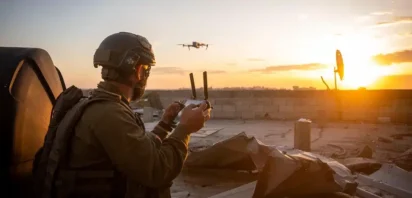
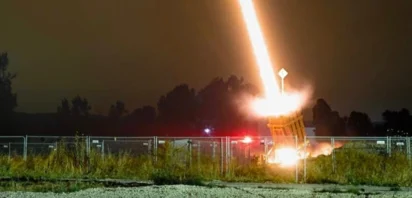
Last month’s violence offers a potent example of that convergence. Iranian Shahed drones have targeted civilians in Israel, just as identical models have rained down on Ukrainian neighborhoods. Tehran has exported thousands of these drones to Moscow, helping sustain Russia’s war effort even as its domestic military production falters. These are not coincidental parallels—they are evidence of an integrated effort to weaken Western allies across regions through asymmetrical warfare.
The parallels are not just strategic — they are visual. Around the world, newspapers and television screens are filled with images of ruined apartment blocks in both Kyiv and Tel Aviv, often side by side. Civilians in both cities have been targeted by the same model of drone wielded by two authoritarian regimes acting in concert. The symbolism is hard to ignore: the same weapon, the same tactic, and the same message of defiance against the liberal democratic order.
Their cooperation predates Russia’s full-scale invasion of Ukraine. Both countries propped up Bashar al-Assad’s regime in Syria, providing military and political support for more than a decade. The collapse of that regime last year marked a shared strategic setback for both Moscow and Tehran. Syria had served as a geopolitical bridge for their ambitions and as a joint platform for pushing back against Western influence in the region.
Now, with Iran under direct assault by Israeli airstrikes, Russia found itself unable to offer more than rhetorical support. Its military bandwidth is tied up in the Ukraine war, its international standing has been eroded by sanctions and battlefield failures, and its defense industry is overextended. For Iran, this reveals the limits of its alliance with Moscow. For Russia, it represents a growing strategic liability.
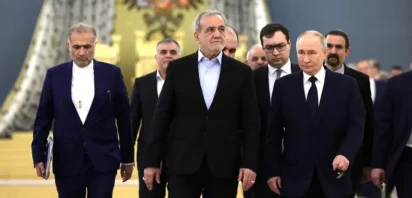
A weakened or even collapsed Iranian regime would be a serious blow to Vladimir Putin. Iran is not just a weapons supplier—it is a vital symbol that Russia is not alone. Tehran’s open defiance of the West helps Moscow portray a world where resistance to US-led norms is on the rise. Without Iran, Russia would appear increasingly isolated, its claims of a shifting global order ringing hollow.
Beyond geopolitical optics, the fall of Iran’s theocratic regime would carry a far more ominous implication for Putin: the vulnerability of entrenched authoritarian systems. The Islamic Republic has long presented itself as immovable, yet today it faces a level of internal and external pressure unseen in decades. If the ayatollahs can fall, so too can the Kremlin. The psychological effect of regime collapse in Tehran would echo through Moscow’s halls of power—and possibly hasten Putin’s efforts to consolidate territorial gains in Ukraine while a frozen conflict remains viable.
That calculation has been dramatically altered with the direct entry of the United States into the conflict. US bombers, operating in coordination with Israeli intelligence, struck hardened Iranian nuclear sites, including the Fordow enrichment facility—long considered one of Tehran’s most fortified assets. The strikes marked a stunning reassertion of US hard power, shattering any lingering assumptions that the current US administration is committed to isolationism or retrenchment.
The implications extend well beyond Iran. For Moscow, the lesson is sobering. The same United States it had written off as divided and inward-looking has now demonstrated both military resolve and operational competence. For a Russian regime counting on Western fatigue and timidity, the strikes on Fordow may serve as a wake-up call. If Washington is willing to act militarily against Iran’s nuclear infrastructure—a move fraught with global risk—it may not be unthinkable that the U.S. could increase support for Ukraine in new and more assertive ways.
In short, the US intervention may catalyze a strategic rebalancing. For Russia, the cost of continuing the war in Ukraine could grow steeper—not just in material terms but in the uncertainty of Washington’s next move. Putin, ever pragmatic beneath the bluster, may soon find it more advantageous to negotiate a face-saving pause than risk triggering a deeper Western military response.
Meanwhile, the collapse of Iran’s Russian-imported air defense systems under Israeli and now American strikes further damages Russia’s already battered image as a global arms exporter. The failures of its vaunted military machine in Ukraine have already raised doubts. The ineffectiveness of Iran’s Russian-made air defense systems dealt another blow to the Kremlin’s military-industrial prestige.
While these two wars unfold in different regions with distinct actors, they are facets of a larger struggle: a battle between revisionist regimes seeking to reshape the global order and liberal democracies struggling to contain them. The fates of Kyiv and Jerusalem, Tehran and Moscow, are more entangled than they first appear. And in this moment—marked by the return of US military resolve—the Iran–Russia axis may be closer to fracturing than at any point in the past decade.
The views expressed in this article belong to the author(s) alone and do not necessarily reflect those of Geopoliticalmonitor.com.