US military planners do not mince words on the threat posed by Russia: “[Moscow] poses acute threats, pursuing power and influence through cyber-attacks and disinformation campaigns, while its attack on Ukraine represents a moment on par with 9/11 in terms of global consequence and challenge to U.S. and international security. ”
Some experts believe Russia is already at war with the West, utilizing various forms of hybrid warfare. Hybrid warfare refers to a military strategy that blends conventional warfare, irregular warfare, and cyber warfare with other influencing methods such as propaganda and disinformation. Hybrid warfare requires delicacy in inflicting harm on the target country without escalating into a full-blown conventional war. Russia is often accused by experts and Western governments of employing such tactics to undermine the stability and influence of Western democracies. The strategy involves leaving a sufficiently faint footprint to deter military retaliation, as such a response would be seen as a violation of international norms.
Through 2018, US National Military Policy focused on deterring conventional or nuclear war with major threat countries, including Russia and China. Since that time, the National Military Strategy has acknowledged the technological advancement of the two large threat countries and how this technology will play a role in future conflicts. “Both commercial and military technologies will advance rapidly and proliferate the global technology landscape. These capabilities alone may not ensure military victory, but creative application will shape the outcome of any contest.” Consequently, the National Defense Strategy has shifted toward actively battling Russia in the cyber realm and other domains of hybrid warfare.
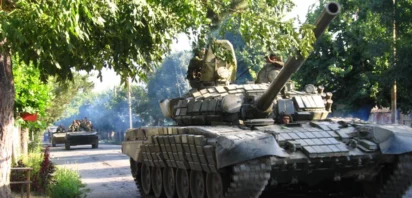
According to the Institute of War Studies, the Russian and American conceptions of hybrid warfare differ. The US definition focuses on the means and techniques used, while the Russians “define hybrid war precisely and coherently as a type of war, rather than a set of means to conduct state policy.” An example of Russian hybrid war would be the 2014 annexation of Crimea, which was conducted by “little green men” soldiers without uniforms or insignias. Another example is the proxy militias Russia supports in Ukraine and parts of Africa and the Middle East. Before the invasion, Russia used a disinformation campaign to help facilitate its invasion, and shortly after, it shut down Ukraine’s computer networks.
Apart from Ukraine, Russia is engaged in hybrid wars in Belarus, Syria, Libya, Venezuela, along with parts of the Middle East and Africa. Many of these engagements combine elements of covert operations, overt operations, proxy armies, uniformed troops, private military companies (such as Wagner), information warfare, propaganda, and disinformation.