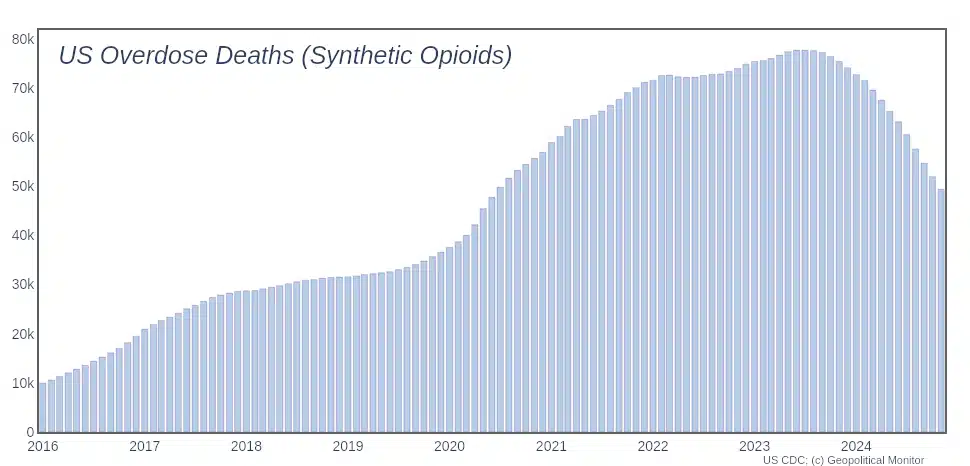
The damage wrought by the fentanyl epidemic on US society has been profound. At base level are the lives lost: over 77,000 synthetic opioid-related overdose deaths recorded by the US CDC in 2023 alone. But this bleak statistic reverberates further through US society, across broken households, distressed communities, lost economic production, and even international relations as President Trump has cited the fentanyl crisis as justification for tariffs on Mexico, Canada, and China. What makes the fentanyl crisis so destructive, and why have elected officials and law enforcement failed to stem the flow of the deadly drug? This backgrounder explores the pharmacological, criminal, and technological factors that have helped make fentanyl and synthetic opioid trafficking a crisis like no other.
A Brief History of Fentanyl
In the decades following its discovery in 1960, fentanyl remained a largely unremarkable analgesic and anesthetic drug used to treat chronic pain and cancer. Its potency – as much as 100 times stronger than morphine – and addictive nature were allayed by the fact that fentanyl was administered intravenously, and only to patients who had suffered severe trauma or were terminally ill. Starting in the 1980s, new delivery systems began to be developed, first in the form of a skin patch and later nasal and oral methods. Their commercial success led to the development of novel, rapid onset opioids, such as Subsys, a highly potent fentanyl-based oral spray that took effect in under five minutes.
Subsys was approved by the US Food & Drug Administration in 2012. In the years that followed, synthetic opioid overdoses spiked from approximately 5,700 deaths at the beginning of 2015 to 72,000 deaths in 2024. Eventually, public outrage would narrow in on Subsys-maker Insys and other companies that were either suspected or found guilty of providing kickbacks to doctors for prescribing highly addictive synthetic opioids to patients who didn’t need them.
Amid this public backlash, opioid prescription rates began to fall. Yet overdose rates continued to climb, because transnational crime networks had already moved in to fill the vacuum left by the US pharmaceutical industry.