The discovery of significant offshore oil & gas fields in the Eastern Mediterranean in the past few years has drawn increased attention to this strategical area at the crossroads between Europe and the Middle East. Hydrocarbon deposits are also believed to lay under the waters surrounding Cyprus; but while exploration activities have generally fostered cooperation elsewhere, around the island the situation is different. Turkey, which has occupied the northern part of Cyprus since the 1974 crisis triggered by a Greece-backed coup, has been leveraging the presence of a Turkish minority and the self-proclaimed Turkish Republic of Northern Cyprus (TRNC) to assert its rights over the oil & gas deposits close to the island. This has raised concern in the region and in the European Union, which imposed sanctions on Turkey over its drilling activities in and around Cyprus.
Background
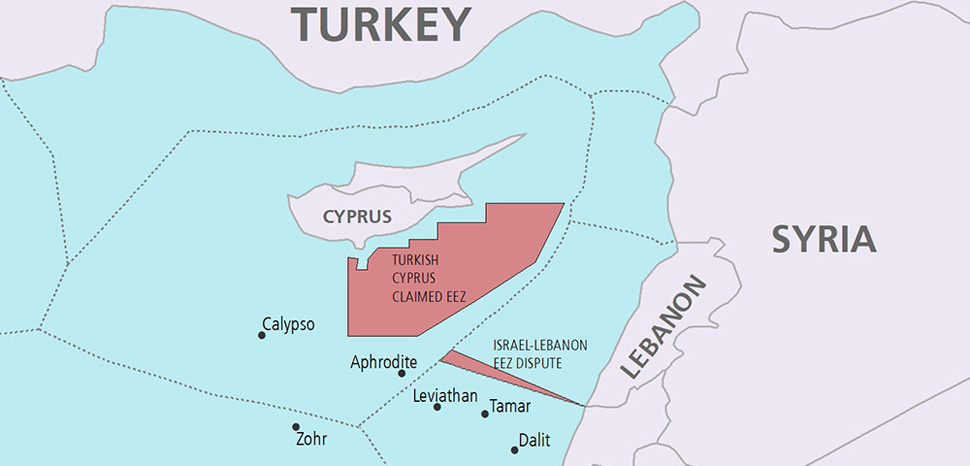
The presence of promising gas and oil reserves in the Exclusive Economic Zone (EEZ) of Cyprus is not something new. The Aphrodite gas field, discovered in 2011, was initially estimated to host 7 trillion cubic feet (tcf) of natural gas; a figure later lowered to 4-5 tcf for a total value of $50 million. Oil was also found two years later below the gas wells: reports mentioned 1.2-1.4 billion barrels, worth approximately $60 billion. These are not negligible figures for a relatively small island harshly crippled by the eurozone crisis, and whose 2017 GDP amounted to less than $32 billion in purchasing power parity terms. Another promising field, named Calypso, is also present in the Cypriot EEZ. Such resources attracted the attention of European countries, eager to find alternative energy sources and reduce their dependence on Russian gas. However, Cyprus remains a divided island. The northern part, where the Turkish minority is concentrated, has remained under Turkish military occupation since 1974. It is also the home of the self-declared Turkish Republic of Northern Cyprus (TRNC), funded in 1983. The TRNC is not recognized at the international level, except by Turkey, which in turn does not maintain any official diplomatic relation with the internationally-acknowledged and Greek-majority Republic of Cyprus, which is a full member state of the European Union and the United Nations.
This status quo contributed to the dispute over drilling rights that emerged soon after the discovery of the Aphrodite field. Turkey claims its rights – and those of the TRNC – to search for hydrocarbons in waters that are widely considered to be part of the EEZ of the Republic of Cyprus. It should be kept in mind that, since it is not internationally recognized, the TRNC is not entitled to have an EEZ; and that the Republic of Cyprus can legitimately project its EEZ to the north (of course with respect to Turkey’s own EEZ) since its de jure territory includes the area under Turkish occupation. When Nicosia’s government started exploration in late 2011, Turkey immediately condemned the act, calling it a “provocation” and stating that it would soon conduct its own surveys – with the protection of the Turkish Navy. In April 2012 the state-owned Turkish Petroleum Corporation (TPAO) began its drilling activities amid protests from the Republic of Cyprus and Greece, who is equally interested in the island’s resources and who has a long story of troubled relations with Turkey; also because of the latter’s frequent violations of Greek air and maritime space in the Aegean. The situation flared once again in February 2018, when Turkish warships intervened to prevent a drilling ship owned by the Italian energy firm ENI from performing exploration around Cyprus.