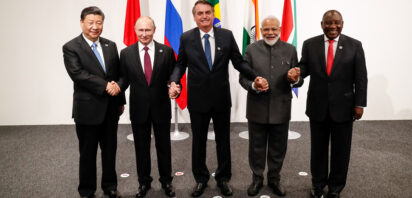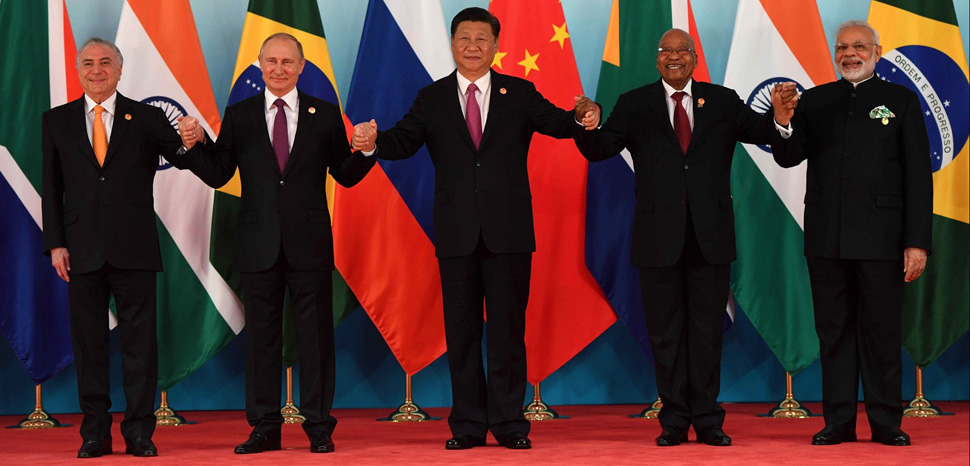
The BRICS grouping, which takes its name from the initials of its members (namely Brazil, Russia, India, China, and South Africa), includes the world’s most important emerging powers. Due to their dimension, economic growth, demographic size and (increasing) military strength, these five states are becoming more and more influential, often taking a leading regional role and even launching some global-scale initiatives. On paper, the grouping has the potential to fundamentally alter the international geopolitical landscape. In practice, however, there are serious challenges to overcome, mainly in the fundamental differences between BRICS countries in terms of configuration and polity and, most importantly, the group’s lack a unified vision. Sometimes, their respective projects can diverge. But in the case of India and China, they openly clash.
Background
Before becoming an actual grouping, “BRICS” was just an acronym. It was created in a 2001 Goldman Sachs report which foresaw their future economic importance, and it did not include the “S.” Five years later brought the first political formalization of the group, when the respective foreign ministers met on the sidelines of the 2006 UN General Assembly. Other meetings followed, which culminated in 2009 with the first official BRIC summit. It was only the following year that the group took its current form and name with the inclusion of South Africa. The BRICS countries summit has since become an annual event. On such occasions, the five powers often pledge to collaborate more in economic and political terms to achieve a more “democratic” and multipolar international system.
Each of the BRICS members has its specificities in terms of capabilities, geopolitical situation, and polity. But in common they hold quite a large share of economic (and consequently military) power, especially when compared to their immediate neighbors. As years passed, the group’s members have indeed increased their cooperation on a range of issues, albeit with mixed results. While there is more of a dialogue between them and economic ties have strengthened, cooperation remains relatively limited and there is no unified view apart from the BRICS’ vague call for a multipolar world order. Diplomatic actions remain largely bilateral and are not coordinated at the bloc level. More importantly, security issues remain a matter of single member states, and sometimes the national interests of one member differ starkly from those of another. This is particularly relevant for India and China, both of which are engaged in geopolitical competition on a variety of different fronts.
Impact
The foreign policy objectives of each of the BRICS are particular, as they correspond to the specific capabilities and needs of that power. But in general, they do not openly collide.
In spite of its domestic problems, South Africa has managed to establish itself as the leading power in its region. While surely being the least powerful and influential member of the BRICS, its interests are not in conflict with those of the other bloc members. South African investments in Africa can sometimes compete with those of other countries like China, Brazil and others, but in general there is room for cooperation and most importantly no national security interests are at stake.
Brazil is another member whose geopolitical ambitions are not in dispute with other BRICS countries. It has achieved a leading role in South America, and has its own plans for further extending its influence over the region and beyond. Again, while the presence of foreign powers like China, India, Russia and others can occasionally be in contrast to its interests, there is no major matter of divergence between them.