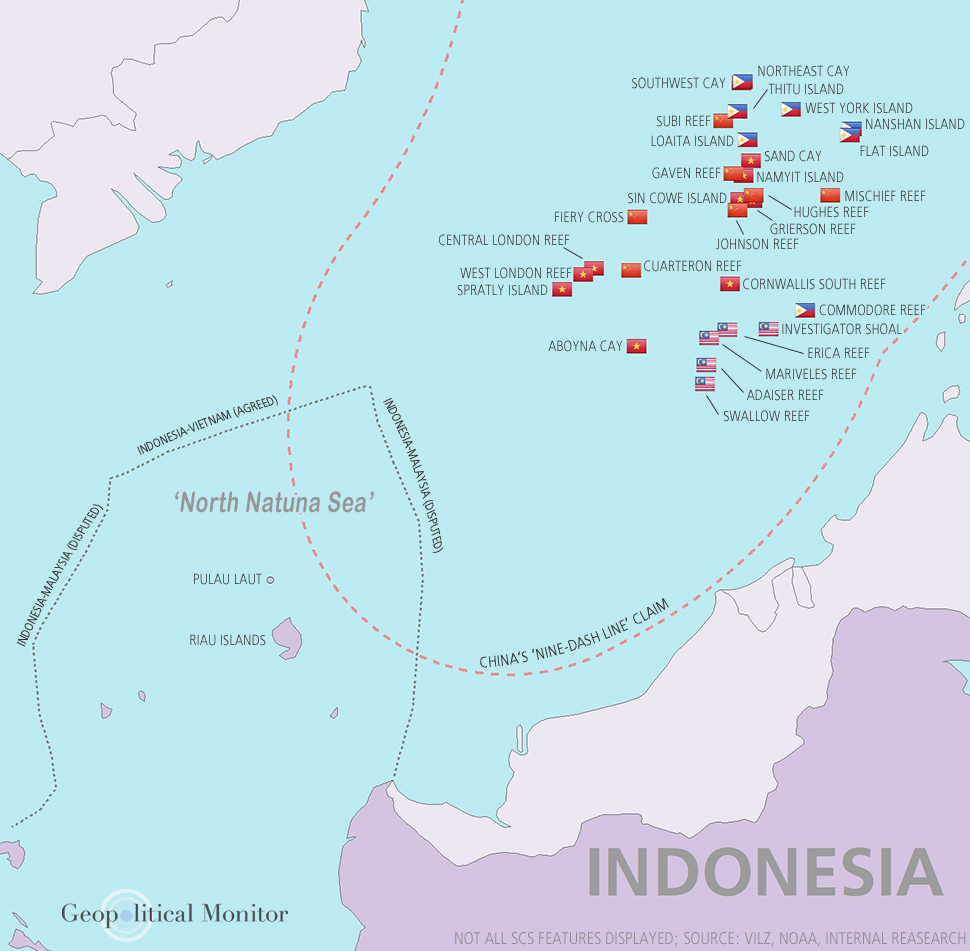
It’s widely accepted that the South China Sea is a geopolitical flashpoint that could inadvertently trigger a regional, even international conflict.
But how did it get to this point?
Broadly speaking the South China Sea dispute boils down to the question of how borders should be delineated in the absence of bilateral agreement between two countries. This discussion is given further impetus by the importance of the region. The South China Sea is as economically lucrative as it is geographically significant. There are hundreds of billions in mineral and energy wealth locked away under its waters, and the South China Sea is both a key global trade conduit and a gateway into China’s backyard. Given the economic and geopolitical stakes, it’s not surprising that the region has become a volatile frontier of global competition.
This series will examine the claimants in the South China Sea dispute: China, Taiwan, Vietnam, Malaysia, Brunei, Indonesia, and the Philippines. Now we move on to Indonesia, a country that has remained on the sidelines of the conflict until very recently.
Background
Indonesia’s South China Sea claim overlaps with the southernmost section of China’s nine-dash line via the Exclusive Economic Zone (EEZ) extending northward from the Riau Islands in Natuna Regency. The archipelago of over 270 islands is located in the northern Natuna Sea/southern South China Sea off the coast of Borneo.
Though not an official nor a self-identified claimant, this slight overlap with the nine-dash line has pulled Indonesia into the South China Sea dispute, and Jakarta has risen to the challenge. Indonesia has been increasingly forceful in policing its waters around the Natuna Regency, particularly with regards to fishing rights. Notably, President Joko Widodo (known as “Jokowi”) has pushed for joint Southeast Asian patrols of contested waters. In October 2017, he ordered the destruction of ten Chinese vessels that were caught illegally fishing in the Natuna Sea. The boats were literally blown up as a crowd of journalists and government officials looked on. The practice of blowing up illegal trawlers reflects the general trend of resurgent nationalism in Indonesia, which some have mused is the result of simmering maritime disputes with China and other neighboring states. According to Susi Pudjiastuti, Indonesia’s minister of maritime affairs and fisheries, the authorities have sunk some 317 encroaching fishing boats since 2014, many of them Chinese. There have been occasions in recent years of Chinese coast guard vessels entering Indonesia’s EEZ to interdict Indonesian vessels attempting to tow away Chinese fishing boats. In one 2016 case, Chinese coast guard vessels violated the 12-mile zone around islands in the Natuna archipelago prompting a forceful response from the Indonesian authorities, who escalated the situation by dispatching a naval vessel to escort the Chinese vessels out of Indonesian waters. Jakarta’s willingness to escalate the situation stands in stark contrast to other ASEAN claimant states, and it’s possible that the Widodo administration was emboldened by the Philippines’ unfavorable withdrawal at the Scarborough Shoal.